
 By admin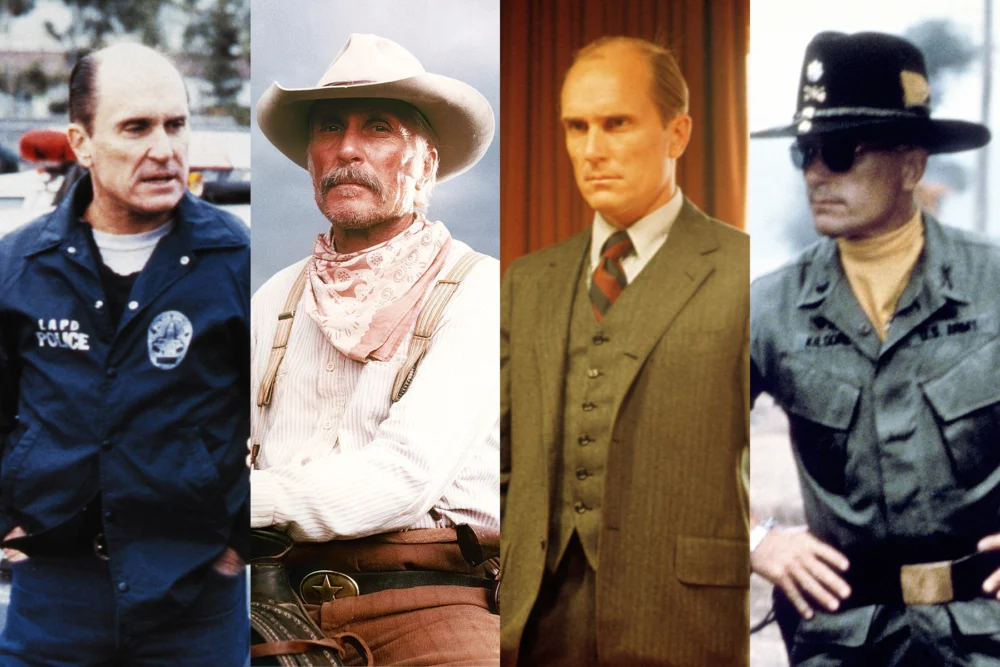
HangupsMusic.com – For over six decades, Robert Duvall carved an indelible mark on cinematic history, not merely as an actor, but as a force of nature who could imbue the most complex characters with profound authenticity and quiet power. His presence on screen was a masterclass in subtlety and command, consistently elevating every project he touched, whether in a leading role or a seemingly minor supporting part. Duvall possessed an almost uncanny ability to distill a character’s entire life story into a single gaze, a nuanced inflection, or a silent gesture, making him the quintessential embodiment of gravitas in American cinema.

From the unassuming menace of a rural recluse to the calculated cool of a mob consigliere, and from the rugged individualism of a frontier lawman to the moral ambiguity of a wartime colonel, Duvall’s versatility was boundless. He grounded roles that, in lesser hands, might have veered into caricature or melodrama, infusing them with a palpable sense of reality and human complexity. His willingness to serve the narrative, often taking a backseat to flashier performances, never diminished his impact; indeed, it frequently allowed him to steal scenes through sheer force of understated brilliance. Spanning a remarkable career from 1960 to 2022, Duvall’s filmography is a testament to sustained excellence, marked by a profound commitment to his craft and an unparalleled ability to disappear into his roles.

Duvall’s journey into acting was not one of instant stardom but a gradual, deliberate ascent built on rigorous training and a dedication to the craft. A product of New York’s Neighborhood Playhouse School of the Theatre, where he studied under the legendary Sanford Meisner, Duvall honed his skills alongside contemporaries like Dustin Hoffman and Gene Hackman. This foundational training in method acting instilled in him a deep respect for character development and emotional truth, principles that would define his entire career. His early work in television and theatre provided a crucial proving ground, allowing him to experiment and refine his unique approach to performance.

His cinematic debut in 1962, as the enigmatic Boo Radley in the iconic To Kill a Mockingbird, immediately signaled the arrival of a distinctive talent. Despite having no lines, Duvall’s portrayal of the reclusive neighbor was hauntingly memorable, conveying profound vulnerability and hidden strength through physical presence and silent reaction. It was a testament to his ability to communicate volumes without uttering a single word, laying the groundwork for a career defined by powerful, often interior, performances.

The 1970s proved to be a pivotal decade, solidifying Duvall’s reputation as an actor of immense range and depth. His portrayal of Tom Hagen, the unflappable, loyal consigliere to the Corleone family in Francis Ford Coppola’s The Godfather (1972) and The Godfather Part II (1974), remains one of his most iconic. Hagen was a character defined by his intellect, his unwavering calm, and his quiet authority, a stark contrast to the volatile personalities surrounding him. Duvall imbued Hagen with a unique blend of menace and integrity, making him an indispensable cog in the Corleone machine and a character whose moral compass, though skewed, felt undeniably human. He made "cool-headed" an art form.

Another collaboration with Coppola yielded perhaps Duvall’s most explosive and widely quoted performance: Lieutenant Colonel Bill Kilgore in Apocalypse Now (1979). Kilgore, with his infamous line, "I love the smell of napalm in the morning," was a character of terrifying charisma and detached madness. Duvall’s portrayal captured the surreal horror of the Vietnam War through a lens of almost poetic insanity, earning him an Academy Award nomination for Best Supporting Actor. He transformed a potentially one-dimensional figure into a complex study of war’s psychological toll, where bravado masked a deeper, unsettling disconnect.

Beyond these monumental supporting roles, Duvall also demonstrated his capacity to carry a film as a leading man, often in quieter, more introspective dramas. His Oscar-winning performance as Mac Sledge, a down-and-out country singer striving for redemption in Tender Mercies (1983), showcased his profound emotional vulnerability. Here, Duvall stripped away all pretense, presenting a character grappling with alcoholism, regret, and the arduous path to sobriety and spiritual renewal. His portrayal was devoid of grand gestures, relying instead on a deeply internalized pain and a flicker of hope, earning him critical acclaim and the Academy Award for Best Actor. This role cemented his status as an actor capable of delivering both grand spectacle and intimate human drama with equal conviction.

Throughout his career, Duvall consistently sought out roles that challenged him, refusing to be typecast. He brought his inimitable authenticity to every genre, from gritty urban dramas like Colors (1988), where he played a veteran LAPD officer navigating gang warfare with weary wisdom, to epic Westerns such as the seminal miniseries Lonesome Dove (1989). As Augustus "Gus" McCrae in Lonesome Dove, Duvall delivered a performance that became instantly legendary. His Gus was a garrulous, philosophical, and deeply flawed former Texas Ranger whose larger-than-life personality was tempered by moments of profound melancholy and loyalty. It was a role that allowed him to blend his comedic timing with his dramatic prowess, creating one of the most beloved characters in television history and arguably the definitive modern cowboy.

His work in films like The Great Santini (1979), where he played the tyrannical Marine aviator Bull Meechum, further illustrated his mastery of complex, often unsympathetic characters. Duvall’s Santini was a force of nature, a man whose love for his family was inextricably bound with his need for control and his inability to express affection without aggression. He explored the nuances of toxic masculinity and the generational impact of a rigid military mindset, delivering a performance that was both terrifying and tragically human. Similarly, in Network (1976), his portrayal of Frank Hackett, the ruthless corporate executive, captured the cold, calculating heart of corporate America, a man driven solely by profit and power.

Duvall’s acting philosophy seemed to stem from an intense observation of human behavior and a commitment to emotional truth rather than theatricality. He was known for his immersive approach, often spending time with the real-life counterparts of his characters to absorb their mannerisms, accents, and worldviews. This dedication allowed him to craft performances that felt lived-in, organic, and utterly believable. He never seemed to be acting; rather, he simply was the character, whether it was a small-town barber, a disgraced preacher, or a powerful political figure.

Even in his later career, Duvall continued to deliver powerful performances, defying the typical decline often seen in veteran actors. Films like A Civil Action (1998), where he played a shrewd, elderly lawyer, earned him another Academy Award nomination. His self-funded passion project, The Apostle (1997), which he also wrote and directed, saw him deliver a tour-de-force performance as Sonny Dewey, a charismatic but troubled Pentecostal preacher. This deeply personal film allowed Duvall to fully explore themes of faith, redemption, and human fallibility, showcasing his multi-faceted talents behind and in front of the camera.

In a career spanning more than sixty years, Robert Duvall remained an unwavering presence in American cinema, a testament to his enduring talent and tireless work ethic. He worked with virtually every major director of his era, consistently elevating the material and leaving an indelible mark on cinematic history. His legacy is not just one of memorable roles, but of a profound influence on the art of acting itself. He showed generations of performers that true power lies in authenticity, that gravitas is earned through quiet understanding, and that even in a supporting role, a truly gifted actor can command the screen and steal the show. Robert Duvall was, and remains, a titan of the silver screen, whose performances continue to resonate with audiences, offering deep insights into the human condition.
