
 By admin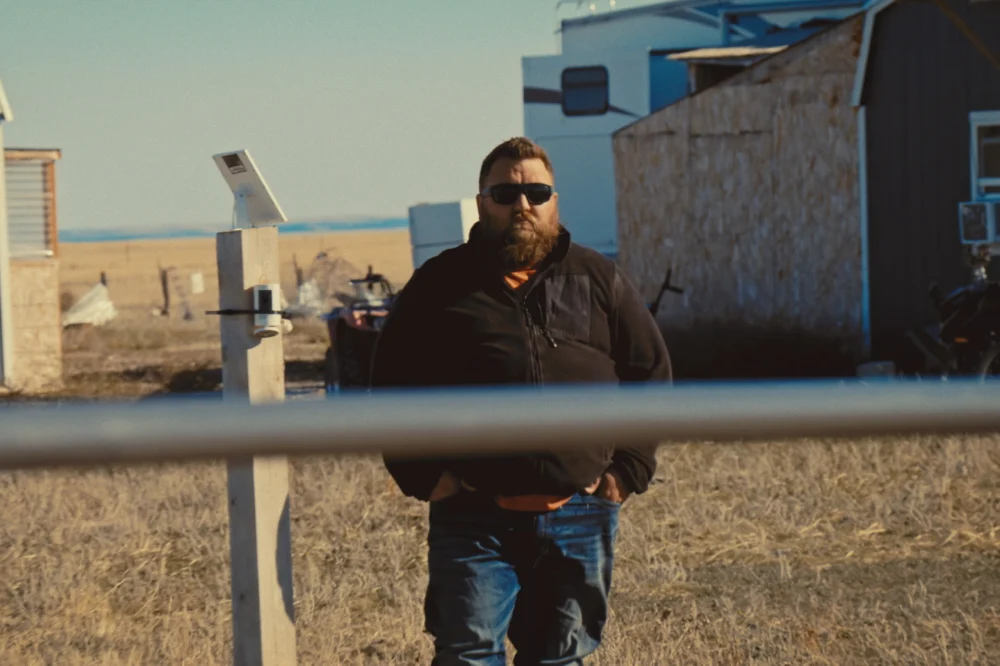
HangupsMusic.com – The landscape of contemporary American society, often characterized by its profound divisions and a seemingly intractable inability to forge common ground, finds a poignant and often absurd mirror in Neighbors, the compelling new HBO docuseries from directorial talents Harrison Fishman and Dylan Redford. Executive produced by Josh Safdie and Ronald Bronstein, known for their work on Marty Supreme, this A24 and HBO collaboration embarks on a dizzying, sometimes darkly comedic, yet surprisingly empathetic journey into the heart of everyday disputes, revealing them as powerful allegories for our broader social predicament.
One of the series’ early and most striking narratives unfolds in rural Shawmut, Montana, introducing viewers to Seth Collins, a figure whose public persona is a tapestry of modern fringe beliefs – a self-proclaimed 9/11 truther, a QAnon adherent, and a man who accessorizes his black MAGA hat with custom dental fangs. Collins relocated to Shawmut in 2016 with his wife, Starla, driven by a vision to construct an off-grid "bug-out" fortress, a sanctuary designed to weather global catastrophes, and to raise horses. Life, by Collins’ account, proceeded without incident until 2020, when Josh Alspaw, a blacksmith with a significant TikTok following, and his family became their adjacent landowners.
The arrival of the Alspaws ignited a spark that quickly escalated into a full-blown conflagration. Josh and his wife, Brittany, viewed the Collins’ horses not as livestock, but as an unwelcome intrusion, referring to them as "nuisances and pests." Their preferred method of deterrence involved chasing the animals off their property with ATVs and dirtbikes – a practice that did little to endear them to the wider community. Tensions boiled over in a heated exchange where a different neighbor, angered by the Alspaws’ tactics frightening his own horses, reportedly threatened Brittany with a firearm. In the aftermath of this confrontation, Josh Alspaw erected a gate across a road traversing his land, a route crucial for the Collins family to access their free-range pasture. This act became the focal point of a burgeoning online saga, with Alspaw extensively documenting the escalating feud on TikTok, where his "neighbor drama" videos garnered "hundreds of thousands, if not millions, of views."
What began as viral content quickly morphed into a draining legal battle, depleting the Alspaw family’s finances and placing immense strain on their marriage. Yet, Josh Alspaw, clutching a long sword as he addresses the documentary crew, remains unyielding, refusing to remove the gate. "If you’re in a situation like this, if you can move, I would," he advises, without clarifying his own inability or unwillingness to relocate. "If you can’t, be ready to defend yourself." The stark declaration encapsulates the entrenched positions that define many of the disputes explored in Neighbors. Later, Seth Collins offers a chillingly detached assessment of the situation: "If you can’t get along with your neighbors, that kind of says something about you," a remark delivered with a deadpan certainty that underscores the series’ exploration of self-perception and blame.

The genesis of Neighbors dates back to 2019, when Fishman and Redford found themselves captivated by the burgeoning genre of online neighbor dispute videos. They recognized these micro-conflicts as a potent lens through which to examine the burgeoning social frictions across the nation. To curate the approximately dozen disputes featured in the six-episode series, the directors undertook an exhaustive search, poring over Craigslist listings, Facebook groups, local newspapers, and court dockets. Their selection process was rigorous, adhering to non-negotiable criteria: each conflict had to be ongoing, both parties had to agree to participate, and the dispute needed to resonate as a distinctly "contemporary American story."
Redford explains that the conflicts, much like the early online videos that first piqued their interest, typically commence with something tangible, even mundane. "Starting with something fairly concrete — it might even have seemed kind of mundane — and then coming to understand both people’s values and why there’s this misalignment." The isolating and polarizing effects of the pandemic, he notes, only exacerbated these failures in communication. "This really traumatic event has occurred that has affected everyone, and this social contract that maybe barely existed before has kind of broken," Redford observes, acknowledging that while not an initial focus, the pandemic’s shadow became an undeniable backdrop to the series.
Each of Neighbors‘ 30-minute installments delves into a pair of these localized feuds. The origins of these disputes are as varied as the American landscape itself: rural property lines, suburban fences, the delicate stretch of sand behind a luxurious waterfront estate, or a modest patch of lawn separating two bungalows. The participants range from complete strangers to former confidantes who once shared life’s milestones, from weddings to divorces, now locked in bitter contention.
Strikingly, these conflicts rarely revolve around explicit political affiliations. While the voting preferences of the feuding parties occasionally emerge, they are seldom the root cause of the animosity. Yet, the series offers profound insights into the underlying fractures of American society. Across the disparate settings, unsettling patterns emerge. A pervasive readiness to resort to firearms is evident, a characteristic that initially surprised the filmmakers but ultimately became "just part of the tapestry" of the stories they uncovered. A surprising number of subjects also exhibit a penchant for exhibitionism, including OnlyFans creators, nude models, former strippers, and dedicated nudists. Furthermore, nearly every episode features individuals who subscribe to at least one paranoid or fringe belief system, whether it’s the New Age concept of "starseeds" – an extraterrestrial influence on Earth’s gene pool – or the reptoid hypothesis of David Icke, positing a secret global control by shapeshifting aliens.
Redford draws a compelling parallel between the trajectory of neighbor disputes and the evolution of conspiracy theories. Both, he suggests, begin with a precipitating event and a fundamental disagreement over its cause. Following this initial divergence, both sides tend to "retreat into their own worlds, they start looking online, and asking for feedback from people that they feel comfortable and aligned with. And they start building a narrative, and that narrative — maybe, potentially — starts really diverging from what may be an agreed-upon reality." He adds a crucial nuance: "Conspiracy theories don’t have to be these crazy things about lizard people. We’re all very capable of telling stories and telling narratives that start to detach us from a shared understanding of reality."

This detachment is vividly illustrated in seemingly trivial matters, such as differing aesthetic interpretations of a property wall. One individual might passionately describe their boundary as evoking an "Italian-French villa," while their neighbor vehemently insists it resembles an "Osama bin Laden compound." The irony is further amplified when the neighbor spearheading the charge to dismantle the wall is revealed to be a former Texas state legislator, instrumental in codifying the "castle doctrine" – the legal principle asserting one’s right to defend their home, their fortress, with lethal force if necessary.
What resonates most profoundly in Neighbors is not merely the points of divergence, but their seemingly insurmountable intractability. There is an overwhelming sense that these conflicts can only be addressed through the intervention of external authorities – law enforcement, city councils, or even television personalities like Judge Judy, who presides over a dispute in one episode. Even when a third party renders a judgment, there is often a steadfast refusal by one or both sides to accept the outcome. Consequently, the episodes rarely conclude with a neat, satisfying resolution. "The cleanest version of the show [would be if] at the end of the episode everything’s resolved," Fishman reflects. "The reality is, it’s just not the way these things work, because you might get an on-paper resolution, but the emotional conflict will go on, potentially, forever."
Fishman clarifies that "Solving conflicts… is really not what the purpose of our show is." Instead, the series aims to cultivate empathy within the audience. Through their deliberate and "studied refusal to take sides," Fishman and Redford empower viewers to achieve what their subjects often cannot: to step into another’s shoes and genuinely comprehend their perspective. Redford emphasizes the nuanced reality: "None of this is clean. It’s a much more complicated picture than, oftentimes, what we see online." He cites the example of the neighbor who threatened Brittany Alspaw. While footage of his angry outburst, screaming threats, is undeniably shocking, a broader context reveals him, in the same conversation, extending an invitation for the Alspaw family to join him for a barbecue. This juxtaposition highlights the complex, often contradictory, layers of human behavior that defy simplistic judgment.
In a poignant testament to the depth of the animosity they documented, the directors admit to one unsuccessful attempt at mediation. During filming, they discovered that both Seth Collins and Josh Alspaw, the feuding Montana neighbors, shared a passion for Dungeons & Dragons, both serving as Dungeon Masters. "We really wanted them to play D&D together," Fishman recounts. "We were trying to get them to play D&D, and then at one point they were like, Guys, we hate each other. Like, He has a gate in the road. I don’t want the gate. Why would I play D&D with him?" This anecdote powerfully underscores the chasm that can open between individuals, where shared interests are eclipsed by deeply rooted grievances, and the practical realities of a disputed gate trump any potential for fantastical camaraderie.
Neighbors is more than a collection of local squabbles; it is a vital sociological document, holding up a mirror to the underlying currents of paranoia, distrust, and fractured realities that define much of contemporary American life. By immersing viewers in these intensely personal, often absurd, and profoundly intractable conflicts, Fishman and Redford compel us to confront our own biases, challenge our assumptions, and perhaps, in understanding the struggles of those next door, gain a deeper insight into the larger discord that resonates across the nation.
