
 By Azzam Bilal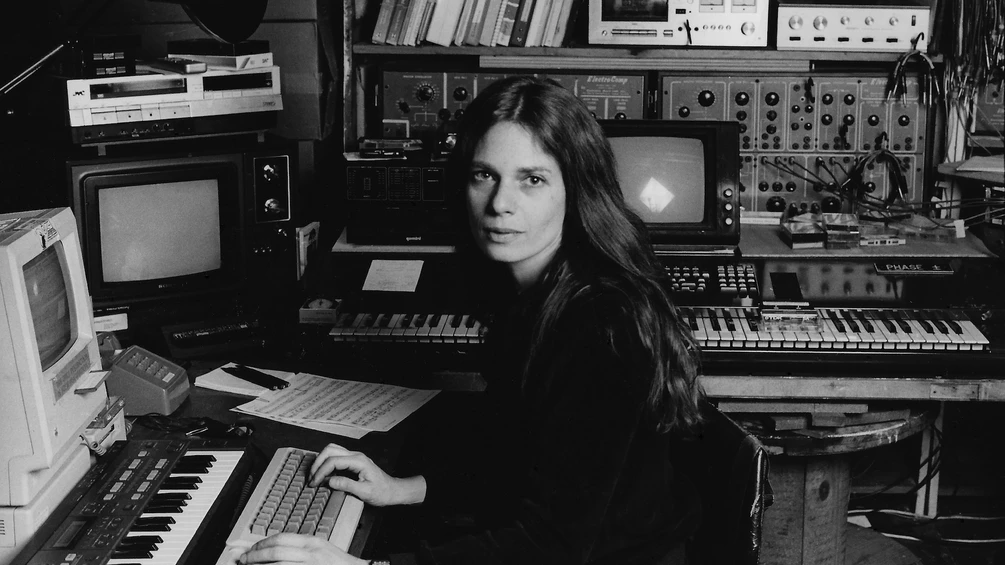
HangupsMusic.com – The landscape of electronic music composition is often defined by a tension between the rigid precision of the machine and the fluid intuition of the human performer. In the mid-1980s, few individuals bridged this gap as effectively as Laurie Spiegel, a visionary composer and technologist whose work at Bell Labs and beyond fundamentally altered our understanding of what a computer could be in a creative context. Now, in a collaboration that bridges decades of technological evolution, Spiegel has partnered with the audio pioneers at Eventide to release a modernized, enhanced version of her seminal software, Music Mouse. This revival is not merely a nostalgic exercise in "abandonware" restoration but a functional reimagining of a tool that was, and remains, light years ahead of its time.
Originally debuted in 1986, Music Mouse was marketed as an "intelligent instrument." In an era when personal computers like the Macintosh, Amiga, and Atari ST were just beginning to find their way into home studios, Spiegel envisioned a program that could transform the simple, two-dimensional movement of a computer mouse into complex, harmonically rich musical expressions. Unlike a traditional sequencer, which requires the user to input notes one by one, or a synthesizer that demands deep knowledge of oscillators and filters, Music Mouse acted as a collaborative partner. It utilized sophisticated algorithms to handle the minutiae of scale, harmony, and counterpoint, allowing the user to focus on the macro-level elements of performance: texture, phrasing, and emotional trajectory.
The re-release of Music Mouse comes at a pivotal moment in the history of music technology. As the industry grapples with the implications of generative artificial intelligence and black-box algorithms, Spiegel’s creation offers a refreshing alternative—a transparent, interactive system where the human remains the primary driver of the creative engine. The modern version, developed alongside Tony Agnello and the engineering team at Eventide, preserves the core logic of the original while introducing the connectivity and flexibility required by the 21st-century producer.
One of the most significant hurdles for the original software was its isolation. In the 1980s, getting a computer to talk to external hardware was a feat of engineering. The updated Music Mouse eliminates these barriers, offering full MIDI integration and the ability to sync with an external MIDI clock. This allows the software to lock perfectly to a Digital Audio Workstation (DAW) or hardware sequencers, turning it into a powerful performance controller. Users can now record their "mouse-gestures" directly into MIDI tracks or notation software, bridging the gap between spontaneous improvisation and formal composition.
The interface has also received a thoughtful overhaul. While maintaining the aesthetic spirit of the 1980s original, the new version features a scalable UI that looks crisp on modern high-resolution displays. The legendary "Polyphonic Cursor," which visualizes the relationship between the mouse position and the generated notes, provides clearer feedback than ever before. New UI guides, a helpful hint bar, and the inclusion of left- or right-handed layout options ensure that the software is accessible to a broader range of creators. Furthermore, the inclusion of presets based on Spiegel’s own patches for the Yamaha DX7 and TX7 synthesizers provides a direct link to the sonic palette that defined the early days of algorithmic music.
To understand the weight of this release, one must look at the career of Laurie Spiegel herself. Long before she was a software developer, she was a pioneering composer. Her 1980 album, The Expanding Universe, is frequently cited as a masterwork of early electronic music, utilizing the GROOVE (Generated Real-time Output Operations on Voltage-controlled Equipment) system developed at Bell Labs. Her work was characterized by a deep sense of space and a fascination with the mathematical underpinnings of sound. This fascination reached its zenith when her realization of Johannes Kepler’s "Harmony of the Worlds" was selected by Carl Sagan to be the opening track on the Voyager Golden Record. As the Voyager spacecraft travels through interstellar space, it carries Spiegel’s interpretation of planetary motion—a testament to her status as a global (and celestial) cultural figure.
Tony Agnello, the First Engineer at Eventide, noted that when Spiegel first introduced him to the concept of Music Mouse, he was struck by how different it was from the prevailing trends of the 1980s. While most developers were focused on creating digital versions of traditional hardware—digital reverbs, delays, or subtractive synthesizers—Spiegel was building a new kind of interface. She viewed the computer as an extension of the human mind, a tool that could be "trained" to understand the rules of music so that the musician could bypass the technical barriers of entry and go straight to the heart of the composition.
The return of Music Mouse is also a victory for the preservation of digital history. Many pioneering software tools from the 80s and 90s have been lost to "bit rot," becoming unusable as operating systems evolved. By porting Music Mouse to Mac 10.14+ (including native support for Intel and Apple Silicon) and Windows 11, Eventide and Spiegel have ensured that this unique philosophy of music-making remains available to a new generation. It can be run as a standalone application or integrated into a DAW workflow, making it as versatile as any modern VST or AU plugin.
In practice, using Music Mouse is an experience unlike any other. By moving the mouse across a grid, the user triggers notes that are automatically constrained to specific scales or harmonic structures. As the mouse moves vertically or horizontally, it can control different voices, create arpeggios, or modulate the density of the sound. It encourages a "playful" approach to music, where the user can discover melodies and harmonies through movement and exploration rather than rote memorization of theory. For the seasoned composer, it serves as a "brainstorming" tool that can break creative blocks; for the novice, it provides an immediate entry point into the world of complex harmony.
The philosophy behind Music Mouse—that technology should empower the artist rather than replace them—is perhaps more relevant now than it was forty years ago. In a market saturated with "one-click" solutions and AI-generated content, Spiegel’s software demands that the user remain engaged. It provides the "rules" of the game, but the user must still play the match. It is an "intelligent instrument" in the truest sense: a tool that augments human capability without stripping away the soul of the performance.
As Eventide begins distribution of the software, the music community is rediscovering the genius of Spiegel’s design. The addition of features like the ability to perform live and record directly into notation software makes it a viable tool for film scoring, ambient soundscapes, and experimental electronic production. The legacy of Laurie Spiegel is one of breaking boundaries—between science and art, between the terrestrial and the cosmic, and between the human and the machine. With the revival of Music Mouse, that legacy is not just preserved; it is given a new life, ready to inspire the next wave of musical explorers to find their own "expanding universe" within the movements of a simple cursor.
Music Mouse is available now through Eventide Audio’s digital platform. It stands as a bridge between the pioneering spirit of the 1980s and the infinite possibilities of the modern digital studio, reminding us that sometimes, the most revolutionary ideas are the ones that have been with us all along, waiting for the technology to finally catch up.
