
 By admin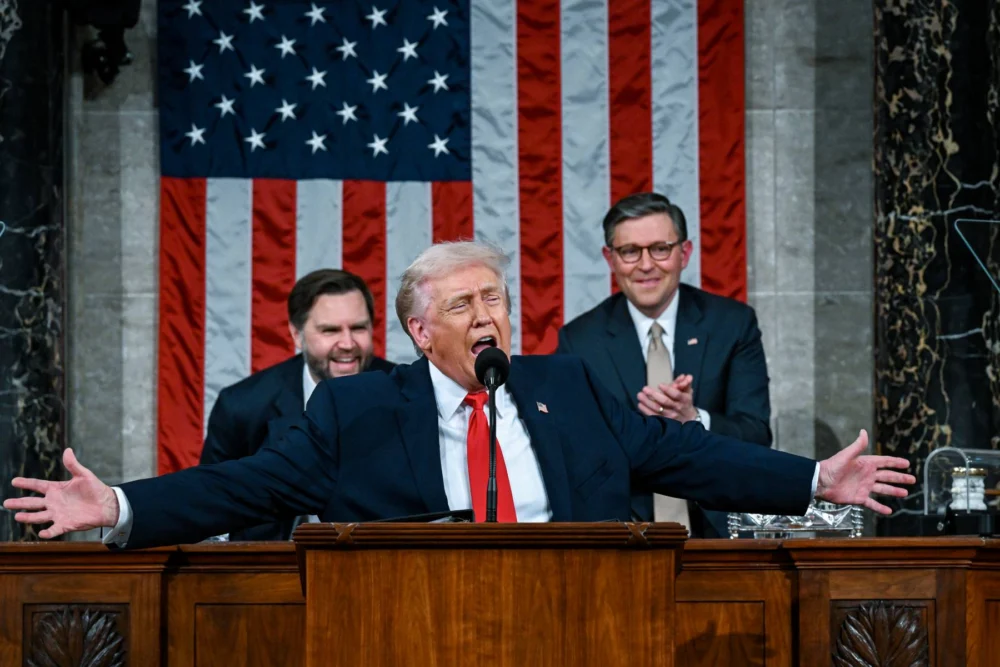
HangupsMusic.com – Washington, D.C., The nation’s capital recently witnessed a presidential address of unprecedented duration and intensity, as the incumbent leader delivered a State of the Union speech that shattered his own previous record, extending for a remarkable 108 minutes. Weeks prior, the president had hinted at the extensive nature of his upcoming remarks, a promise he unequivocally fulfilled, leaving an indelible mark on the annals of congressional history. This marathon address, a significant event in the political calendar, unfolded against a backdrop of heightened partisan tensions and recent controversies, making it a pivotal moment of national discourse.
The evening’s proceedings, akin to a grand national performance, commenced with the customary recognition of distinguished guests seated in the gallery. Among those specially invited were members of the U.S. men’s hockey team, celebrating their recent achievement of an Olympic gold medal, a triumph not seen in nearly five decades. Also present was Erika Kirk, identified as the widow of Charlie Kirk, alongside a diverse group of everyday American heroes: working mothers, military veterans, and first responders lauded for their valiant efforts in the aftermath of the devastating floods that swept through Texas the previous year. A particularly poignant moment saw the president honor a 100-year-old Navy pilot, whose valor was recognized with the Medal of Honor, personally fastened around his neck by the First Lady, Melania Trump. During this solemn presentation, the president injected a moment of characteristic levity, remarking on his own unfulfilled desire for the Congressional Medal of Honor, acknowledging the constitutional impediment to self-bestowal. The evening’s commendations extended beyond this, with the presentation of a Presidential Medal of Freedom and a Purple Heart to other deserving individuals, weaving a narrative of national pride and recognition throughout the lengthy speech.
However, the core of the nearly two-hour address was dominated by the president’s characteristic rhetorical style, featuring a torrent of claims and assertions that immediately drew scrutiny and sparked heated debate. Critics and fact-checkers quickly challenged several of the president’s pronouncements. He claimed to have dismantled "DEI" (Diversity, Equity, and Inclusion) initiatives, asserted the nation was experiencing the "hottest" economy in its history, and declared victory over the "scourge" of undocumented immigration. Furthermore, the president staunchly defended his administration’s signature economic policies, specifically the widespread implementation of tariffs. These measures, he contended, were beneficial despite widespread reports indicating they had contributed to increased costs for American consumers. In a striking display of defiance, even in the presence of several Supreme Court justices, the president openly dismissed a recent high court decision. That ruling had found his administration to have unlawfully overstepped its emergency economic powers, usurping tariff authority explicitly granted to Congress by the Constitution.
A significant portion of the president’s extended address was dedicated to the topic of immigration, a theme that has consistently defined his political narrative. Despite recent polling data, including a Reuters/Ipsos survey, suggesting a significant decline in public approval for his administration’s immigration enforcement strategies, the president doubled down on rhetoric that many characterized as fear-mongering. He vividly recounted a series of violent crimes, attributing them to undocumented individuals and directly linking these incidents—regardless of the actual immigration status of the perpetrators in specific cases—to what he described as "open borders" and the policies advocated by the Democratic party. This narrative, critics argued, aimed to paint immigrants as a direct threat to the safety and well-being of American families.
The tension within the chamber reached a crescendo when the president issued a direct challenge to the assembled lawmakers, demanding they "stand up" if they believed the primary role of the American government was to "protect American citizens, not illegal aliens." Predictably, the Democratic side of the aisle remained seated, a collective refusal that prompted an immediate and sharp rebuke from the president: "You should be ashamed of yourselves, not standing up." This unscripted exchange underscored the profound ideological chasm pervading the legislative body.
The president’s outburst was met with a vocal counter-response from within the Democratic ranks. Representatives Ilhan Omar (D-Minn.) and Rashida Tlaib (D-Mich.) passionately shouted back, accusing the president of violating the very principle he espoused. Omar notably interjected, "You have killed Americans!" drawing attention to specific incidents in her home state of Minnesota where Immigration and Customs Enforcement (ICE) agents were implicated in the deaths of two American citizens, Renee Good and Alex Pretti. "You should be ashamed," she reiterated, directly mirroring the president’s own words.
Another dramatic interlude saw Rep. Al Green (D-Texas), known for his history of vocal protests during such addresses, forcibly removed from the chamber shortly after the speech began. Green had held aloft a sign bearing the stark message, "BLACK PEOPLE AREN’T APES," a direct reference to a controversial video recently posted by the president that depicted former President Barack Obama and former First Lady Michelle Obama in a manner widely criticized as racist. The removal of a sitting member of Congress during a State of the Union address is a rare and highly symbolic act, further highlighting the fraught atmosphere of the evening.
Transitioning from immigration, the president articulated a fervent demand for federal electoral reform, framing it around his consistent assertions of widespread election fraud costing him the 2020 election. He implied that the current term should legitimately be his "third term." His proposed solution, the Safeguard American Voter Eligibility (SAVE) Act, was presented as a crucial measure to ensure election integrity. This expansive legislative proposal calls for stringent new requirements, including mandatory in-person presentation of proof of citizenship for voter registration, the implementation of national voter identification mandates, significant restrictions on mail-in voting and voter registration processes, and grants the federal government unprecedented access and influence over state voter rolls. Critics, however, argue that these provisions would effectively disenfranchise millions of eligible American voters, disproportionately impacting minority groups and young people, while ultimately serving to bolster Republican electoral prospects in future contests.
The president rhetorically challenged the opposition, stating, "Why would anybody not want voter ID? One reason: because they want to cheat. There’s only one reason. They make up all excuses, they say it’s racist, they come up with things you almost say what imagination they had." Despite passing the House of Representatives, the SAVE Act faces an uphill battle in the Senate, where it requires a 60-vote majority for passage. Given the steadfast opposition from the Democratic minority, who show no inclination to provide the president with such a legislative victory ahead of upcoming midterm elections, its prospects remain dim.
Adding another layer of complexity to an already charged evening, just hours before the president’s arrival at the Capitol, two prominent news outlets, NPR and MSNBC, released back-to-back reports detailing allegations that the Trump administration had improperly withheld critical documents. These documents were said to be related to accusations that the president had sexually abused a minor, specifically including dozens of pages from a series of FBI interviews with the accuser, which were conspicuously absent from the Epstein files released by the Justice Department over several months. This explosive revelation immediately intensified scrutiny, prompting Rep. Robert Garcia (D-Calif.) to announce that Democrats were actively investigating the allegations of wrongfully withheld documents.
The timing of these reports cast an even brighter spotlight on the Epstein-related protests already planned for the State of the Union. Dozens of Democratic lawmakers opted to boycott the event entirely, a highly unusual protest in the address’s history. Others who attended made their dissent known through symbolic gestures: some invited survivors of Epstein’s abuse as their personal guests, while others wore pins or held signs within the chamber, drawing attention to the ongoing scandal and the newly surfaced allegations. In a rare display of bipartisan cooperation on this specific issue, Representatives Ro Khanna (D-Calif.) and Thomas Massie (R-Ky.), both leading figures in the congressional push for transparency regarding the Epstein case, notably bridged the traditional partisan seating divide, choosing to sit together for the duration of the event.
Meanwhile, many of those who boycotted the official address congregated at the "People’s State of the Union," an alternative event held on the National Mall. This gathering featured a series of public speeches and speakers, offering a counter-narrative to the president’s message. Prominent lawmakers who participated included Senators Chris Murphy (D-Ct.), Adam Schiff (D-Calif.), Chris Van Hollen (D-Md.), Ed Markey (D-Mass.), Jeff Merkley (D-Ore.), and Tina Smith (D-Minn.), alongside Representatives Greg Casar (D-Texas), Pramila Jayapal (D-Wash.), Maxwell Frost (D-Fla.), and Robert Garcia (D-Calif.).
The official rebuttal to the president’s lengthy address was delivered by Virginia Governor Abigail Spanberger, a recently elected Democrat who had achieved an upset victory the previous year, reclaiming the state’s governorship from Republican control. Her remarks were framed as a direct challenge to the president’s performance and policies. "Let me ask you, the American people watching at home, three questions," Spanberger began, setting a conversational yet critical tone. "Is the president working to make life more affordable for you and your family? Is the president working to keep Americans safe, both at home and abroad? Is the president working for you?" Her conclusion was unequivocal and sharp: "We all know the answer is no." This concise and pointed response provided a stark contrast to the president’s marathon delivery, capping an evening defined by both unprecedented length and profound political division.
