
 By admin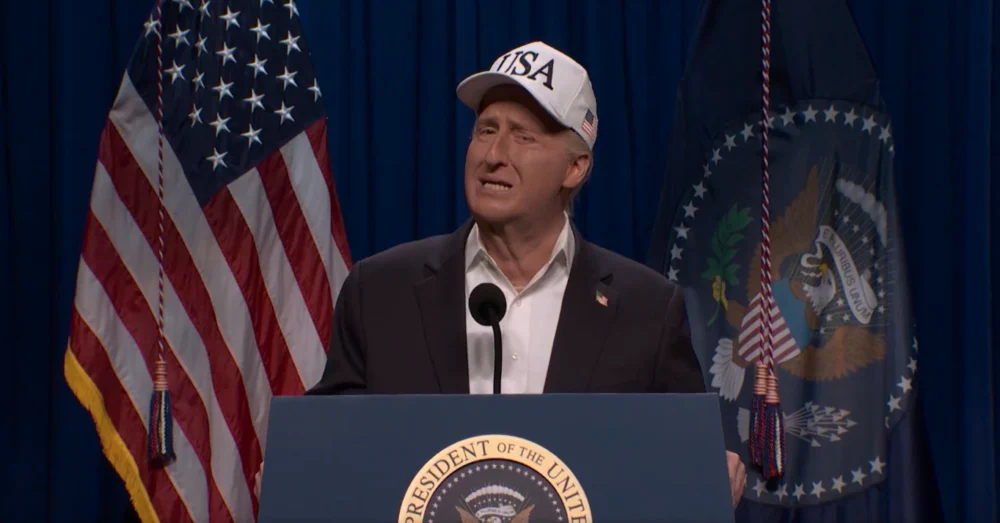
HangupsMusic.com – Saturday Night Live (SNL), a venerable institution in American television, recently offered a biting satirical commentary on the unpredictable nature of contemporary politics through its signature cold open. The sketch, featuring James Austin Johnson’s widely acclaimed portrayal of former President Donald Trump, delved into the paradoxical shift from a self-proclaimed "Board of Peace" leader to a figure orchestrating significant military actions abroad. This comedic exploration of political capriciousness, delivered from the familiar setting of Mar-a-Lago, underscored the challenges of maintaining a consistent political narrative in an era defined by rapid-fire news cycles and shifting public sentiment. The segment meticulously dissected the rationale behind recent, controversial foreign policy decisions, juxtaposing campaign promises with executive actions, and employing musical parody to amplify its critical message, thus cementing SNL’s role not just as an entertainment program, but as a potent cultural mirror reflecting and shaping public discourse.
For decades, SNL has honed its craft as a cultural barometer, offering comedic interpretations of the nation’s most prominent political figures and events. Presidential impersonations, in particular, have become a cornerstone of the show’s enduring legacy, influencing public perception and often providing a much-needed outlet for collective processing of complex political realities. James Austin Johnson has distinguished himself in this lineage, capturing not just the visual likeness but the distinctive vocal cadence, rhetorical style, and idiosyncratic mannerisms of Donald Trump with remarkable precision. His performance in this particular sketch was instrumental in conveying the layered irony inherent in the former president’s persona, especially regarding the abrupt pivot from a platform of non-interventionism to a stance of overt military engagement.
The sketch opened with Johnson’s Trump character addressing his "America First" constituency from his Mar-a-Lago residence, a setting that has become synonymous with his post-presidency public appearances. The central conceit revolved around Trump’s self-appointed title as the "Board of Peace" leader, a moniker immediately undermined by the very announcement he was making: a series of military strikes against Iran. The comedic tension was palpable as the character struggled to reconcile this aggressive foreign policy with his previous rhetoric, ultimately resorting to a characteristic blend of bluster and self-justification. The core of the satire lay in the character’s dismissive explanation for this contradiction – he had simply grown "bored of peace," a statement designed to highlight a perceived impulsiveness and lack of consistent strategic thought in political decision-making.
A significant portion of the sketch was dedicated to satirizing the rationale presented for these military actions. Johnson’s Trump invoked a long-standing, often-cited concern about Iran’s nuclear ambitions, comically distorting the timeline by claiming Iran had been "two weeks away" from developing a nuclear weapon for the past fifteen years. This exaggerated timeline served as a pointed critique of how geopolitical threats are often framed and re-framed to justify military interventions, regardless of consistent intelligence or evolving circumstances. The humor derived from the absurdity of such a protracted "imminent" threat underscored the sketch’s broader commentary on the elasticity of political arguments.
Perhaps the most culturally resonant moment for a music-focused publication came when the sketch ingeniously incorporated Edwin Starr’s iconic 1970 anti-war anthem, "War." The original song, a powerful and impassioned protest against the Vietnam War, asks rhetorically, "War, what is it good for? Absolutely nothing!" SNL brilliantly subverted this message, with Johnson’s Trump character offering an updated, cynical interpretation. Instead of "absolutely nothing," the satirical lyrics proclaimed that war was good for "distracting from the Epstein files." This moment not only demonstrated SNL’s keen ability to weave contemporary political scandals into its commentary but also highlighted the enduring power of music as a vehicle for social and political critique. By repurposing a classic protest song, the sketch underscored the perceived instrumentalization of foreign conflicts for domestic political maneuvering, turning a symbol of peace advocacy into a tool for comedic cynicism. This musical interlude resonated deeply, bridging cultural memory with present-day anxieties, and showcasing how music, even in parody, continues to articulate public sentiment.
The sketch further explored the dissonance between political pledges and presidential actions by addressing Trump’s campaign promise of "no new foreign wars." Johnson’s character, with a mischievous grin, cleverly reinterpreted this vow, arguing that "wars" (plural) meant he was still permitted "one foreign war, and possibly one civil." This linguistic contortion served as a sharp critique of how political promises can be selectively interpreted or conveniently circumvented once in power, exposing the often-flexible nature of campaign rhetoric. It poked fun at the expectation of voters for literal adherence to pledges versus the reality of political maneuvering and strategic exceptions.
A central theme of the cold open was the character’s direct engagement with his "MAGA" base, many of whom, in the satirical narrative, were depicted as expressing dismay over the interventionist turn. Johnson’s Trump, however, swiftly dismissed their objections with a rhetorical flourish: "To all my MAGA followers who are upset and saying ‘This is not what I voted for’: well, you did! Don’t you know who I am? I’m me! Even I don’t know what I’m going to do next." This segment brilliantly encapsulated the perceived cult of personality surrounding the former president, suggesting that a significant portion of his support base voted for the unpredictable individual rather than a fixed ideology or set of policies. The line, "People beg and beg for Trump, and then when you get him, you don’t like him," delivered with a mock-bewildered expression, satirized the often-unforeseen consequences of populist appeal and the complex, sometimes contradictory, demands placed upon political leaders by their most ardent followers. It highlighted the challenge for any political figure to maintain consistency when their appeal is rooted in charisma and a rejection of traditional norms.
The sketch concluded with a meta-commentary on the timing of political events and their impact on media and entertainment. Johnson’s Trump character humorously claimed that the timing of the strikes – reportedly resulting in the death of Iran’s supreme leader, Ayatollah Ali Khamenei, and occurring days before the stock market could fully react – was partly orchestrated to disrupt SNL writers’ plans. "Those guys were going crazy," he boasted, "They probably had a big State of the Union address thing they were going to do. Not anymore!" This self-referential joke not only provided a humorous peek behind the curtain of late-night comedy production but also underscored the pervasive influence of real-world events on satirical content. It acknowledged the symbiotic relationship between politics and media, where each constantly reacts to and influences the other, creating a dynamic cycle of news, commentary, and comedic response.
Ultimately, this SNL cold open was more than just a series of jokes; it was a sophisticated piece of political theater. It leveraged James Austin Johnson’s uncanny portrayal to dissect complex political shifts, the malleability of campaign promises, the strategic use of distraction, and the unique bond between a populist leader and their base. Through sharp dialogue and a memorable musical parody, SNL once again demonstrated its unparalleled ability to distill the essence of political absurdity, providing audiences with both laughter and a moment for reflection on the turbulent currents of contemporary governance. For a music news publication, the repurposing of "War" serves as a poignant reminder of how art, in all its forms, continues to be a vital tool for engaging with, and critiquing, the world around us.
