
 By Azzam Bilal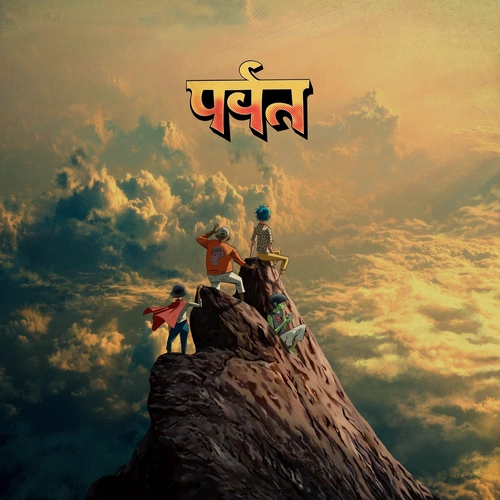
HangupsMusic.com – London, the evolution of Gorillaz has always been defined by a tension between the animated artifice of Jamie Hewlett’s visual world and the restless, genre-blurring curiosities of Damon Albarn. Now entering their third decade, the project has transitioned from a Britpop-adjacent novelty into a global institution of collaborative alchemy. Their ninth studio album, The Mountain, arrives not just as a collection of high-concept pop songs, but as a deeply personal response to profound loss. Last year, both Albarn and Hewlett lost their fathers within a ten-day window, an intersection of private grief that has seeped into the marrow of this record. While Gorillaz have often toyed with themes of environmental collapse and digital alienation, The Mountain feels like their most humanistic work to date, a sprawling, 15-track meditation on mortality, legacy, and the spiritual climb toward peace.
The album’s title serves as a recurring motif, a symbolic peak where the physical world meets the metaphysical. Despite the heavy thematic weight, the record avoids becoming a dirge. Instead, Albarn operates as a "happy dictator"—a nickname he leans into during the Sparks-assisted track of the same name—conducting a massive, disparate ensemble of artists through a landscape that shifts from woozy hip-hop to celestial choral arrangements. Albarn’s genius has always been his foresight as a curator, and The Mountain provides some of his most daring pairings yet. A standout example is the seamless blending of Mumbai fusion pioneer Asha Puthli with the sharp, cerebral bars of Black Thought. It is the kind of collaboration that looks impossible on paper but feels inevitable in the hands of Albarn, who manages to find the common frequency between Puthli’s ethereal jazz-pop and The Roots frontman’s grounded lyricism.
The record’s political edge is sharpened on "The Happy Dictator," which features the art-pop legends Sparks. Here, Albarn reprises his iconic megaphone-distorted vocal style, a sonic callback to the Plastic Beach era, as he and the Mael brothers deliver a biting satire of authoritarianism. The track serves as a high-energy foil to the more introspective moments that follow. The emotional core of the album begins to reveal itself with "The Hardest Thing," a track that feels like a spiritual successor to the late-period work of David Bowie. Beginning with looped fragments from the late Afrobeat pioneer and longtime Albarn collaborator Tony Allen, the song builds into a majestic, tear-streaked anthem. Albarn’s delivery is fragile and resonant as he navigates the universal pain of saying goodbye, backed by parping trumpets and a celestial choir that suggests a transition from the earthly to the divine.
This theme of death is handled with a surprising amount of levity on the recent single "Orange County." Built around a jaunty, infectious whistling hook that is almost impossible to shake, the song creates a fascinating cognitive dissonance. It is arguably the most radio-friendly track Gorillaz have released in years, yet its lyrics grapple directly with the finality of life. The inclusion of Illinois poet Kara Jackson adds a layer of literary depth, her verses weaving through Albarn’s "hardest thing" refrain to create a tapestry of grief that feels both communal and private. It is a testament to the album’s strength that it can handle such heavy subject matter without losing its sense of playfulness.
As the album progresses, the guest list continues to impress, pulling from various corners of the musical map. On "The God Of Lying," the Bristol-based post-punk outfit Idles makes a surprising appearance. Rather than their usual high-octane fury, frontman Joe Talbot adopts a more restrained, "street-real" delivery, navigating a woozy, hip-hop-inflected soundscape. It is a masterclass in adaptation, showing a different side of Talbot’s vocal range while maintaining the gritty honesty that has made Idles a household name. This willingness to push collaborators out of their comfort zones is what keeps the Gorillaz project feeling vital twenty-five years into its existence.
One of the record’s most ambitious moments arrives with "The Empty Dream Machine." Here, the Bowie influences move from the periphery to the center. The track draws a direct line from Albarn’s solo work on Polaris and Blur’s "The Universal" to the avant-garde textures of Bowie’s Blackstar. The instrumentation is a rich, multi-layered triumph: hypnotic chiming bells, judicious sitar work from Anoushka Shankar, and the unmistakable, lilting guitar of Johnny Marr. The second half of the track sees the return of Black Thought, whose conscious rhymes provide a grounded counterpoint to the song’s languid, swelling atmosphere. It is a sprawling piece of music that shouldn’t work—a blend of Indian classical music, Britpop sensibility, and Philadelphia hip-hop—yet under Albarn’s direction, it becomes a coherent and moving highlight.
The second half of The Mountain delves even deeper into the afterlife. The seven-minute epic "Manifesto" pairs the fiery Argentine rapper Trueno with archival vocals from the late D12 member Proof. It is a haunting, cross-generational dialogue that ruminates on what remains after we are gone. This is followed by "Plastic Guru," another collaboration with Anoushka Shankar that explores the intersection of religion and materialism. The track is built on a beats-driven tableau, featuring a diverse array of choral voices that evoke the image of a spiritual seeker lost in a digital maze.
Perhaps the most startling moment on the record is "Delirium," which features a posthumous contribution from the legendary Mark E. Smith. The late Fall frontman possessed one of the most recognizable voices in the history of modern music, and his inimitable Mancunian drawl is used to great effect here. Snarling the word "Delirium" over a jagged, mountain-evoking intro, Smith’s presence adds a layer of grit and unpredictability to the album’s cleaner, more spiritual moments. It serves as a reminder of Albarn’s deep roots in the UK alternative scene and his ability to honor his influences even after they have passed.
The final stretch of the album maintains this high level of quality. "Damascus" features a vocal duel between Syrian singer Omar Souleyman and Yasiin Bey (formerly known as Mos Def). The track is a jaunty, polyrhythmic affair that showcases Bey’s clever wordplay and Souleyman’s high-energy delivery. It is followed by "The Shadowy Light," a multi-faith spiritual lament that reinforces the album’s overarching themes of transcendence.
One of the most anticipated tracks, "Casablanca," brings together two titans of the British guitar scene: Johnny Marr of The Smiths and Paul Simonon of The Clash. Despite the pedigree of its contributors, the song is a remarkably restrained, downtempo rumination on death. It is a beautiful, somber piece of music that relies on atmosphere rather than hooks, allowing the bass and guitar work to breathe within a sparse arrangement.
The album closes with a pair of contemplative finales, "The Sweet Prince" and "The Sad God." These tracks act as a summation of everything that has come before, tying together the motifs of the mountain, the struggle of life, and the inevitability of the end. By the time the final notes fade, there is a sense of resolution—a feeling that the climb has been completed.
The Mountain is a rare achievement in a discography already filled with landmarks. It is an album that manages to be both a star-studded revue and a deeply personal diary. Albarn has mastered the art of funnelling a chaotic array of global talent into a singular, coherent vision. It is an record that demands multiple listens, revealing new layers of instrumentation and lyrical depth with each pass. Rich, inspired, and profoundly affecting, The Mountain is not just a return to form; it is arguably the most complete and emotionally resonant album Gorillaz have ever produced. It stands as a towering tribute to the fathers who inspired it and a definitive statement on the power of music to bridge the gap between the living and the dead.
