
 By admin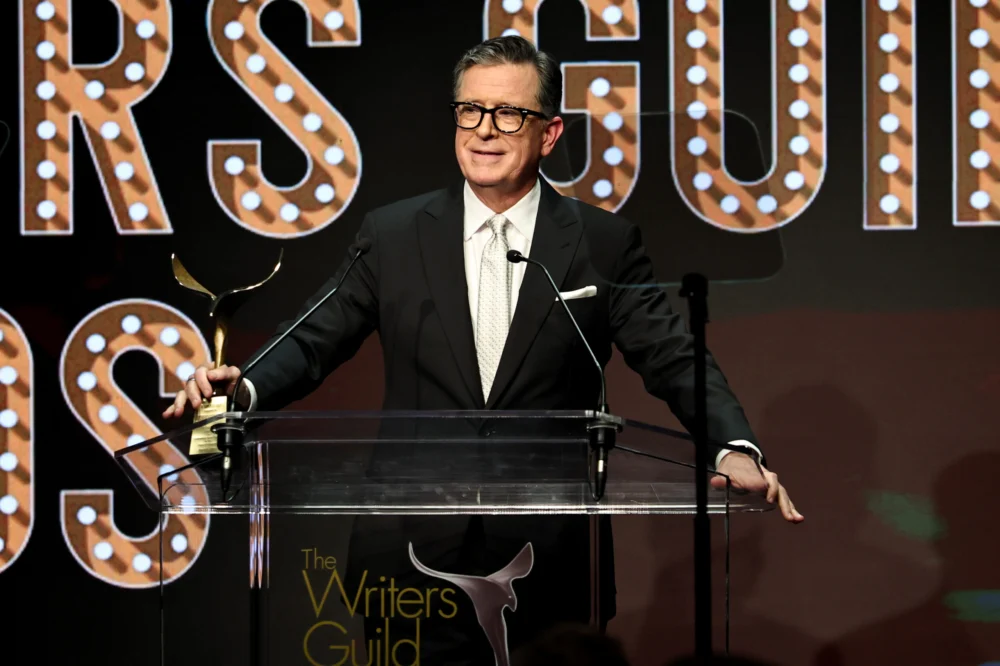
HangupsMusic.com – Los Angeles, The glittering backdrop of the 2026 Writers Guild Awards served as more than just a stage for celebration last night; it became a pulpit for Stephen Colbert, the esteemed host of The Late Show, who seized the moment of receiving the prestigious Walter Bernstein Award to deliver a pointed critique of his network parent, Paramount. His acceptance speech was a masterclass in comedic commentary, blending historical insight with contemporary corporate jabs, all while delivering a heartfelt homage to the unsung heroes of late-night television: his writing staff.
The Walter Bernstein Award itself carries immense historical weight and significance. Bestowed only twice before in its history, it recognizes individuals who have demonstrated "with creativity, grace and bravery a willingness to confront social injustice in the face of adversity." Named for Walter Bernstein, a celebrated American screenwriter whose career was severely impacted by the notorious Hollywood blacklist during the anti-communist fervor of the 1950s Red Scare, the award stands as a testament to the enduring power and peril of artistic integrity. Bernstein’s ordeal, like that of many other artists, writers, and directors, underscored a dark chapter where fear and political paranoia led to widespread professional ruin, often without formal legal process. It was a time when careers were shattered not by law, but by an industry-wide consensus driven by external political pressures and internal anxieties.
Colbert, with characteristic intellectual rigor, delved into the nuanced history of the blacklist, acknowledging his own evolving understanding of its mechanics. "I hadn’t previously realized that the blacklist was not a government policy," he confessed to the assembled luminaries. He meticulously deconstructed the reality: "The blacklist wasn’t a law or a regulation or an executive order. It was a voluntary industry-wide agreement to deny work to left-leaning artists out of fear that certain members of the government might publicly attack the parent corporation of these artists or the union that they belong to. It was that threat, only the threat, of trouble that ended so many careers." This careful distinction laid the groundwork for his subsequent, implicit parallel to the modern corporate landscape, even as he humbly disavowed any direct comparison to Bernstein’s profound struggles. "While to be associated with Mr. Bernstein in any way is a great honor, I want to be clear that I do not deserve the implied parallel here," he stated, setting the stage for his contemporary critique.
The core of Colbert’s message then shifted, subtly but firmly, from historical analysis to a sharp commentary on current industry dynamics. He drew a deliberate contrast between the political climate of the 1950s and the present day. "This is not the 1950s. This is not the Red Scare. And, as far as I can tell, no one in late night is fomenting a revolution." This ostensibly reassuring statement quickly pivoted into a biting indictment of corporate power, specifically aimed at Paramount, the conglomerate behind CBS and, by extension, The Late Show. "As we know, the revolution will not be televised," he quipped, before delivering the punchline that reverberated through the room: "It was going to be televised, but then Paramount bought it. Evidently, the revolution was losing, like, $40 million a year – it had to go. I hear the revolution is thinking about starting a Substack."
This pointed jest was more than just a comedic flourish; it was a thinly veiled, yet deeply felt, criticism of Paramount’s decision to cancel The Late Show. The beloved late-night institution, which has been a staple of American television for a decade under Colbert’s stewardship, is slated to conclude its run on May 21st. The cancellation, officially attributed to financial considerations, has been met with dismay by fans and industry observers alike. Colbert’s "losing $40 million a year" line directly mocked the reported rationale, suggesting that even a "revolution" – a metaphor for groundbreaking or challenging content – can be extinguished by corporate bottom lines. The "Substack" reference further underscored the growing trend of creators seeking independent platforms in an increasingly consolidated media landscape, a direct consequence of traditional networks shedding expensive, albeit critically acclaimed, programming.
While Colbert meticulously avoided any direct mention of Donald Trump, the context of The Late Show‘s impending end has been widely discussed in conjunction with reports of pressure from the Trump administration during its tenure. It was an open secret within media circles that The Late Show‘s sharp political commentary, often directly targeting the then-President, had reportedly drawn the ire of the White House, leading to informal pressures on Paramount. By invoking the specter of the blacklist – a period defined by corporate capitulation to external political threats – Colbert’s speech implicitly acknowledged a modern echo of such pressures, albeit one manifesting as "financial decisions" rather than overt censorship. His careful omission of Trump’s name served to broaden the critique, suggesting that the underlying mechanisms of corporate fear and self-preservation, regardless of the specific external instigator, remain a potent force in shaping creative output.
Beyond the corporate critique, Colbert’s speech was also a poignant tribute to the unsung heroes of late-night: his writing staff. As a final act of comedic defiance and appreciation, he shared several jokes that had been deemed too controversial or edgy for broadcast during his tenure, attributing their brilliance to his team. These unreleased gems offered a glimpse into the creative ferment of the writers’ room and the delicate balance between comedic ambition and network standards. One such joke, delivered with Colbert’s signature deadpan, highlighted the absurdity of political rhetoric: "The actual ‘Go’ message from President Trump to launch last week’s Iran attack was ‘Operation Epic Fury is approved. No aborts, good luck.’ Coincidentally, ‘No aborts, good luck’ was also the majority opinion in the Dobbs Decision." The sharp, immediate juxtaposition drew gasps and laughter, showcasing the kind of incisive, often provocative, humor that defined The Late Show under Colbert. Another, offered by a female writer at the height of the #MeToo movement in response to the Louis C.K. revelations, demonstrated a raw, visceral comedic take: "Oh my God, he masturbates like a toddler poops." These examples underscored the writers’ fearless approach to taboo subjects and the constant push against conventional boundaries that defines effective satire.
Colbert’s concluding remarks were imbued with a deep sense of camaraderie and melancholy, reflecting on his journey from a writer to a prominent host and the profound bond he shared with his creative team. He urged the industry to recognize and employ his "lovely folks" after May 21st, emphasizing their talent and dedication. "They are the best writing staff I have ever known at any show, and I have loved our time together, which wasn’t as much time as I would like," he confessed, hinting at the demanding nature of a host’s role that often keeps them separated from the daily grind of the writers’ room.
He painted a vivid picture of the creative ecosystem, recalling his own origins in late-night as a writer alongside luminaries like Robert Smigel, Dana Carvey, and Jon Stewart. He spoke of the unique joy and intellectual stimulation found within the writers’ room, a place of constant ideation and shared laughter. "And to some, hosting may seem like a hard job, and sometimes it is, but what’s also hard is hearing the laughter from the room down the hall and not being able to go in," he revealed, offering a rare glimpse into the bittersweet reality of his elevated position. For Colbert, the sound of that collaborative laughter was the true pulse of the show, a "beautiful sound" created daily amidst the "fresh hell" that the news cycle constantly delivered.
His final words were a heartfelt expression of gratitude, not just to his team and the guild, but to the very spirit of artistic integrity embodied by Walter Bernstein. It was a powerful, layered speech that transcended mere acceptance, transforming into a significant statement on the current state of media, corporate power, and the invaluable, often-threatened, role of comedy and satire in confronting injustice. Stephen Colbert’s farewell salvo at the Writers Guild Awards was a reminder that even as the curtain falls on The Late Show, the fight for creative freedom and the celebration of those who wield words with wit and bravery continues, perhaps now more than ever, on new stages and in new forms.
