
 By Azzam Bilal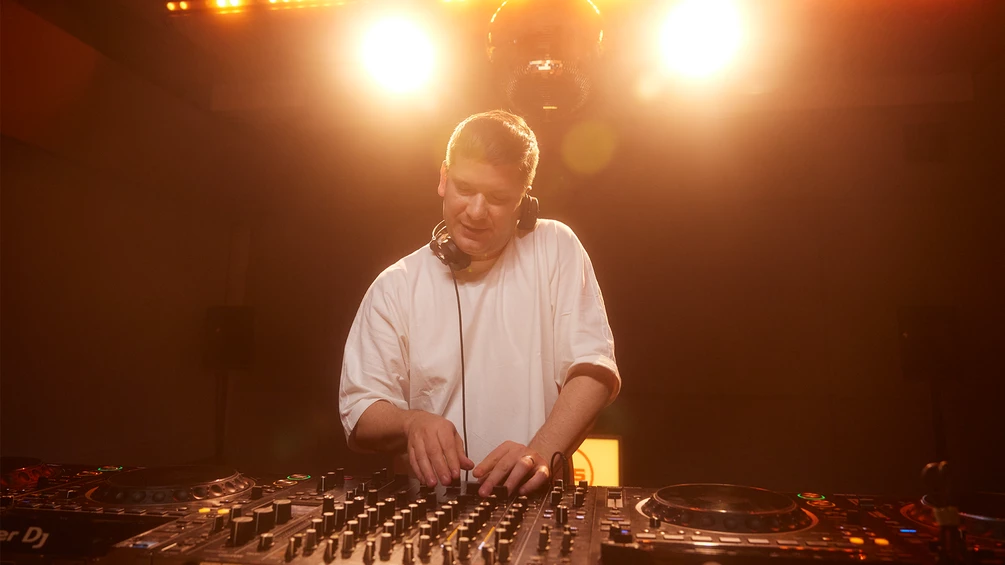
HangupsMusic.com – Amsterdam, the trajectory of a career in broadcasting is often measured by the ability to adapt without losing the core identity that first captured an audience’s imagination. For Tim Sweeney, the mastermind behind the seminal Beats In Space radio program, the last quarter-century has been a masterclass in this delicate balance. Five years ago, many wondered if the magic of his long-running show would dissipate after it moved from the grit of college radio to the polished ecosystem of a global tech giant. Today, those doubts have been thoroughly silenced. As Sweeney navigates the bustling corridors of the Amsterdam Dance Event (ADE) 2025, it is clear that his transition to Apple Music has not only preserved the legacy of Beats In Space but has provided it with the fuel to reach a new stratosphere of influence.
The shift occurred in 2021, marking the end of a twenty-year residency at WNYU. Since 1999, Sweeney had been the voice of New York’s late-night underground, broadcasting from a basement studio that became a pilgrimage site for the world’s most discerning DJs. When he signed off for the final time on March 9, 2021, he left behind a staggering archive of over 1,000 broadcasts. However, by the end of that same year, the show had been reborn on Apple Music. Now, lounging in a sleek, minimalist meeting room at Apple’s Amsterdam headquarters, Sweeney appears revitalized. Clad in a coordinated corduroy ensemble, he represents the modern face of dance music curation—one that respects the history of the craft while utilizing the tools of the future.
Sweeney’s presence at ADE 2025 underscores his elevated role in the industry. He recently stepped off a stage after interviewing the techno visionary Jeff Mills to celebrate the relaunch of the "One Mix" series in Spatial Audio. Such high-profile engagements are now part of his weekly routine, yet he remains grounded by the same "just go for it" philosophy that guided his student days. This lack of pretense is perhaps the secret to his longevity. Despite the high-tech surroundings and the global reach of his current platform, the fundamental mechanics of Beats In Space remain largely unchanged. It is still a show built on the pillars of exclusive guest mixes, deep-cut personal selections, and a genuine, infectious curiosity about where electronic music is heading next.
The curation of Beats In Space has always been its greatest strength. Sweeney possesses a rare ability to bridge the gap between disparate worlds, placing a mainstream powerhouse like KETTAMA in the same orbit as a niche crate-digger like Daniel T. This democratic approach to programming ensures that the show never feels stagnant or exclusionary. In a typical month, listeners might be treated to the avant-garde techno of Polygonia, the legendary electro-pop sensibilities of Soulwax, and the soulful New York house traditions of Jovonn. For Sweeney, this variety is the point. He views the radio show as a space where the giants of the industry can be heard alongside the artists who influenced them, as well as the rising stars who will eventually take their place.
Central to this process is Sweeney’s insistence on handling the booking himself. In an era where many prominent broadcasters delegate such tasks to teams of producers, he maintains a personal line of communication with his guests. This hands-on approach fosters a level of intimacy that translates directly to the airwaves. Whether he is reaching out to a personal hero or a newcomer he discovered on a late-night SoundCloud deep-dive, the message is the same: a sincere appreciation for their work and an invitation to contribute to a living archive of dance culture. This archive is visually punctuated by the show’s famous Polaroid tradition, where every guest is photographed and asked to sign the print with a black Sharpie—a tactile ritual in an increasingly digital world.
The transition to a professional studio environment has also allowed Sweeney to indulge his inner audiophile. He speaks with a quiet intensity about the constant pursuit of sonic perfection, citing the influence of legendary venues like Sapporo’s Precious Hall. In that Japanese club, every detail—from the hand-built speakers to the physical placement of the equipment—was designed to optimize the experience. Sweeney has brought this obsessive attention to detail to his Apple Music residency. He works closely with engineers to fine-tune the studio, adjusting speaker angles by the inch and experimenting with EQs to ensure that both the DJs and the listeners experience the music in its highest possible fidelity. This commitment to quality is what draws artists like Floating Points back to the booth, eager to hear their records played on a system that does them justice.
Beyond the technical aspects, Sweeney has significantly evolved as an interviewer. In the early days of WNYU, conversations were often spontaneous and unrefined. Today, they are the product of rigorous research. Sweeney dives deep into his guests’ histories, reading every available interview to avoid the repetitive questions that often plague music journalism. He looks for the "little bits"—how a person poses for a photo, the style of their handwriting, or their reaction to a joke—to gauge how to navigate the conversation. While he admits that not every interview is a resounding success, his goal is always to extract something new, whether it’s a revelation about a production technique or a deeper understanding of the artist’s personal philosophy.
This commitment to documentation is perhaps Sweeney’s most significant contribution to the genre. Over twenty-six years, he has built a comprehensive history of electronic music’s fluctuations. To listen back through the Beats In Space archives is to hear the evolution of house, techno, disco, and IDM in real-time. Sweeney views these recordings as "moments in time," snapshots of what a specific artist was feeling and playing at a specific juncture. This historical perspective is balanced by his own contributions as a DJ. Even as he scales back his club appearances to focus on special occasions and festival sets, his radio mixes remain a priority. He views each hour-long set as a storytelling opportunity, a chance to express a narrative through sound that can resonate with listeners for years to come.
Sweeney’s philosophy is deeply rooted in the concept of generosity—a trait he attributes to his late friend and mentor, Keith McIvor, better known as JD Twitch of Optimo. He recalls Twitch’s willingness to share rare tracks and edits through early file-sharing communities, a practice that flew in the face of the "gatekeeping" culture often found in DJ circles. Sweeney has adopted this mantle, using his platform to educate and inspire rather than to hoard knowledge. He wants his listeners to be sparked by a track they can’t find, to be driven to research a producer they’ve never heard of, and ultimately, to be inspired to create music of their own.
As he looks toward the future, Sweeney remains focused on the long game. Influenced by forward-thinking icons like Jeff Mills, who contemplates time on a millennial scale, Sweeney is content to keep refining his craft year by year. There are still "bucket list" guests to secure—Theo Parrish remains a top priority—and there are always new sounds to investigate. Yet, the core mission remains the same: to trust his instincts, to keep pushing the boundaries of the radio format, and to provide a home for the infinite variety of beats in space. In a landscape defined by fleeting trends and algorithmic recommendations, Tim Sweeney’s enduring presence is a reminder that genuine passion and a commitment to quality are the only true constants. As long as there is new music to discover and stories to tell, the frequency will remain open.
