
 By Azzam Bilal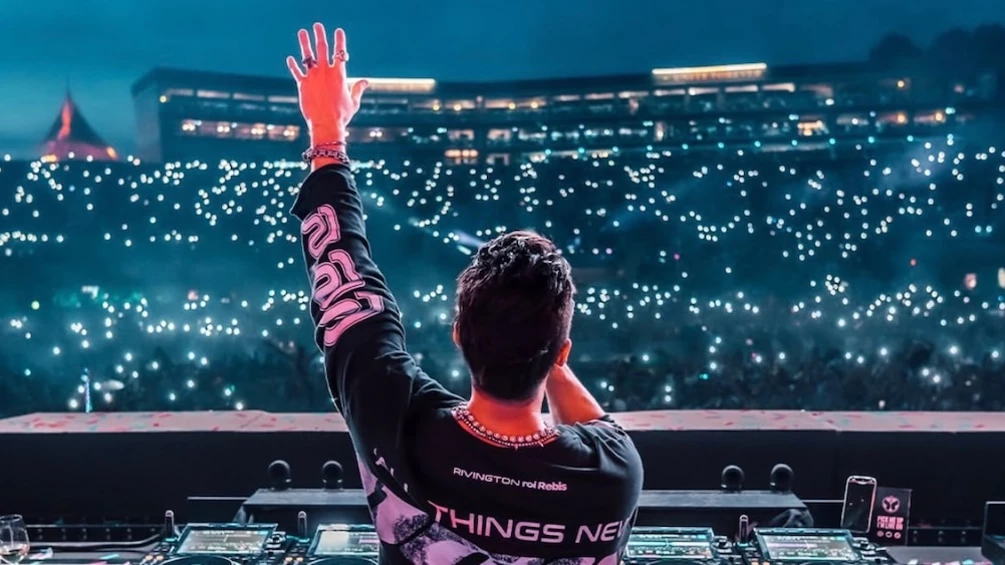
HangupsMusic.com – Boom, the legendary grounds of Tomorrowland witnessed a moment of profound emotional and historical significance during its 2026 edition, as the Brazilian powerhouse Alok transformed the Mainstage into a tribute to his own lineage. On a Friday night that will likely be remembered as a career-defining milestone, Alok did more than just deliver a high-energy set of global hits; he shared the spotlight with the very individuals who laid the foundation for his journey. In a move that bridged three decades of electronic music history, Alok welcomed his parents, the pioneering DJ Swarup and DJ Ekanta, to perform a back-to-back set that celebrated their thirty-year contribution to the global dance scene.
The atmosphere at the Mainstage was electric as Alok took a moment to address the tens of thousands in attendance, stripping away the persona of a global superstar to speak as a grateful son. He introduced his parents with visible pride, identifying his father as DJ Swarup and his mother as DJ Ekanta. He noted that their three-decade-long careers were the primary catalyst for his own professional path, stating that their influence was the sole reason he stood on that stage. This public acknowledgment served as a bridge between the underground rave culture of the 1990s and the massive, polished spectacle of modern-day EDM festivals.
To understand the weight of this moment, one must look back at the origins of electronic music in South America. Swarup and Ekanta are not merely local performers; they are widely revered as the architects of the psy-trance movement in Brazil. Their legacy is most tangibly felt through the creation of the Universo Paralello festival in Bahia, an event that grew from a niche gathering into one of the most respected alternative electronic music festivals in the world. By bringing them onto the Tomorrowland stage, Alok wasn’t just performing a family favor; he was contextualizing his own success within the broader history of a movement his parents helped build from the ground up.
The path to this moment was not always a direct one. Despite their own deep involvement in the arts, Swarup and Ekanta initially harbored reservations about their son following in their footsteps. In past reflections on his upbringing, Alok has admitted that his parents originally encouraged him to pursue a traditional academic path, perhaps fearing the instability and hardship that often accompany a life dedicated to artistic expression. They witnessed firsthand the struggles of the early rave scene, where financial security was rare and the lifestyle was grueling. However, the pull of the studio and the deck proved irresistible. Alok’s transition from an observer of his parents’ craft to a producer in his own right felt like a natural evolution, an inevitability born from being raised in an environment where rhythm and frequency were the primary languages.
This return to his roots at Tomorrowland 2026 coincided with a significant shift in Alok’s artistic direction. While he has achieved unparalleled success as a mainstream artist, often dominating radio charts and streaming platforms, the Brazilian producer has recently sought to reconnect with the more visceral, uncompromising sounds of his youth. This desire has culminated in the "Rave The World" project, a multi-faceted initiative that includes a new record label, a specialized EP, and a global tour. The project is designed to showcase a side of Alok that is less "mainstream" and more aligned with the raw energy of the club scene.
Speaking backstage after his performance, Alok elaborated on the philosophy behind "Rave The World." He explained that the project is an attempt to bridge the gap between his massive global following and the core electronic music community. For an artist of his stature, communicating with the "underground" or "Gen Z" audiences can be difficult when every move is scrutinized through the lens of commercial viability. By creating a dedicated space for this project, Alok has established a platform where fans know exactly what to expect: music designed for the dancefloor rather than the airwaves.
The "Rave The World" label serves a crucial role in Alok’s creative autonomy. He noted the liberation that comes with not needing the approval of major label A&R departments, whose strategies are often dictated by radio playability and broad demographic appeal. For Alok, this new venture is about creative freedom—the ability to release records that might not fit a corporate strategy but resonate deeply with the culture that raised him. This "club-first" mentality was on full display during his Tomorrowland set, where the inclusion of his parents served as a sonic and symbolic manifesto for this new chapter.
The logistics of Tomorrowland 2026 also added a layer of complexity to the weekend’s events. During the festival’s second weekend, there was significant concern regarding the Belgian government’s wildfire risk warnings. Initial announcements suggested that the festival would have to forego its signature large-scale fireworks and limit pyrotechnics to ensure safety during a period of extreme dry weather. This was a potential blow to the visual spectacle for which Tomorrowland is famous. However, by the time Alok took the stage for his weekend two Mainstage set, conditions had allowed for the highly anticipated return of the full fireworks display. The explosion of color and light served as a fitting backdrop for the reunion of the Petrillo family, adding a sense of triumph to an already historic performance.
Alok’s recent output further underscores this period of intense productivity and experimentation. Earlier in the year, he released "I Wonder If You Know" under his SOMETHING ELSE alias, a project that allows him to explore different sonic textures away from the primary Alok brand. This diversification of his artistic identity suggests a producer who is no longer content with staying in one lane. Whether he is performing under his own name, an alias, or alongside his parents, the common thread is a deep-seated respect for the history of the genre and a desire to push its boundaries.
The significance of Alok appearing on the cover of global industry publications in 2025 further cemented his status as a leader in the field, but the Tomorrowland 2026 performance felt more like a personal homecoming than a professional victory lap. By integrating the pioneers of Brazilian psy-trance into the most mainstream of stages, Alok successfully educated a new generation of listeners on where their music comes from. He demonstrated that even in an era of massive commercialization and high-tech production, the heart of electronic music remains rooted in community, family, and the shared experience of the dancefloor.
As Tomorrowland 2026 drew to a close, the conversation surrounding Alok’s set focused not just on the tracks played, but on the narrative he presented. In an industry often criticized for its fleeting nature and focus on the "next big thing," Alok chose to look backward to move forward. By honoring Swarup and Ekanta, he ensured that their 30-year legacy was recognized by a global audience, while simultaneously carving out a new, more authentic space for himself within the electronic music landscape. The "Rave The World" era has officially begun, and if its debut on the Tomorrowland stage is any indication, it will be defined by a powerful blend of nostalgia and innovation.
