
 By Azzam Bilal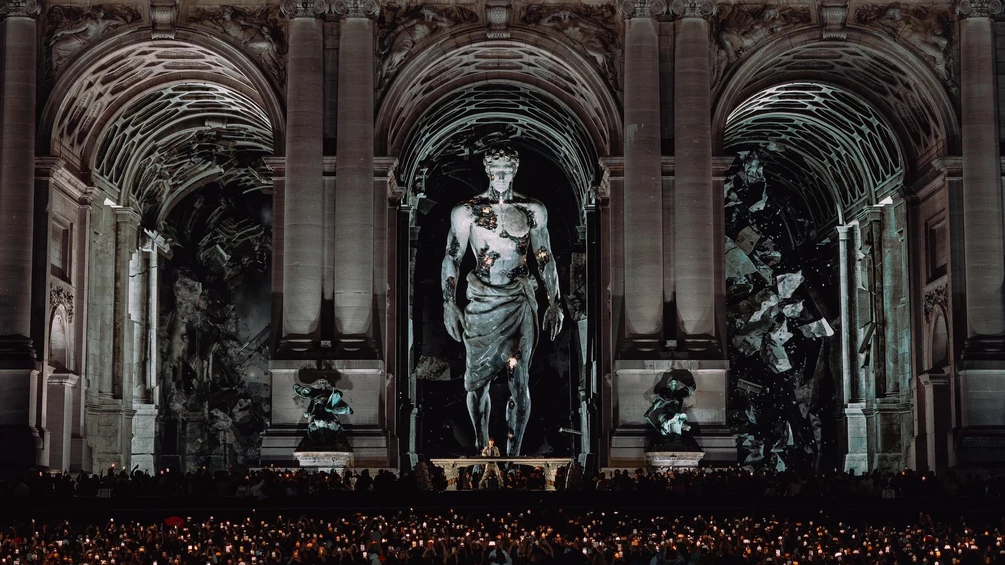
HangupsMusic.com – Istanbul, The intersection of cutting-edge digital art and traditionalist cultural sensitivities has reached a volatile boiling point in Turkey, following the abrupt cancellation of a highly anticipated performance by the Italian multidisciplinary artist Anyma. Scheduled to take place on September 12th at the Ataköy Marina Arena, the event was poised to be a landmark stop on the artist’s globally acclaimed "Genesys" tour. However, what was intended to be a celebration of futuristic audio-visual storytelling was derailed by a localized social media campaign that labeled the performance’s imagery as "satanic," leading to a swift administrative intervention by the Istanbul Governor’s Office.
The fallout from this cancellation has sent ripples through the international electronic music community, raising urgent questions about the vulnerability of artistic expression in an era of digital misinformation. Anyma, the solo project of Matteo Milleri—one-half of the influential duo Tale of Us—has become synonymous with a specific brand of high-concept, melodic techno paired with hyper-realistic 3D visuals. His "Genesys" series explores themes of consciousness, the evolution of artificial intelligence, and the convergence of the biological and the mechanical. To his global audience, the visuals represent a sci-fi odyssey; to a vocal group of local activists in Istanbul, they represented something far more malevolent.
The controversy began to brew in the days leading up to the event. Social media platforms became a staging ground for a coordinated effort to block the show, with campaigners circulating specific clips and stills from Anyma’s previous performances. These images, which often feature towering humanoid figures, biomechanical structures, and dramatic lighting, were presented as evidence of occult symbolism. As these posts gained traction, they were accompanied by calls for the Istanbul Governor’s Office to intervene on moral and religious grounds. The pressure campaign proved effective; shortly before the stage could be fully erected, the permits for the event were officially rescinded.
While the Istanbul Governor’s Office has refrained from issuing a broad public press release regarding the decision, the motivations behind the move have been clarified through investigative efforts. Teyit, a prominent independent fact-checking organization based in Turkey, pursued the matter directly with government officials. Their inquiries led to a confirmation from Emin Gökçegözoğlu, the Provincial Press and Public Relations Director. Gökçegözoğlu reportedly verified that the primary catalyst for the withdrawal of the event permit was indeed the allegation that the show contained "satanic elements." This admission highlights a growing trend of administrative censorship fueled by online moral panics.
In the wake of the silence from his scheduled stage, Anyma took to social media to provide a comprehensive rebuttal to the accusations. Through a detailed statement shared on his Instagram stories, Milleri sought to demystify the intent behind his creative output. He described the "Genesys" show not as a religious or political manifesto, but as a narrative rooted in the tradition of science fiction. According to Milleri, the A/V experience is designed to take the audience through a journey of "darkness and light, destruction and creation, fear and hope." He emphasized that the "darker chapters" of the visual narrative are essential storytelling devices used to reach a final, hopeful resolution—a classic dramatic structure that he argues was intentionally misrepresented by his critics.
Perhaps the most significant revelation in Anyma’s statement was the allegation that the evidence used against him was fraudulent. Milleri claimed that the images and videos circulated by campaigners were not authentic representations of his work. Instead, he asserted that his original visuals had been "manipulated with AI" by those seeking to shut down the show. By using generative tools to alter his art, these actors allegedly paired distorted imagery with sinister music to manufacture a narrative that Milleri describes as a "false sinister narrative."
The irony of this situation was not lost on the artist. Anyma’s work frequently explores the boundaries of technology and human creativity, yet he found himself a victim of technology being used to weaponize his art against him. "None of my visuals are AI-generated," Milleri clarified, pointing out the "greatest irony" that his critics used the very technology they often condemn to fabricate a version of his work that fit their political and social agenda. He lamented that his creative labor had been transformed into "social media and political propaganda," a process he characterized as "unacceptable."
Furthermore, the artist expressed frustration over the lack of due process. According to the statement, neither Milleri’s management team nor the local promoters were given the opportunity to defend the work or provide context before the ban was enacted. The cancellation was a unilateral decision made without dialogue or a request for adaptations. Milleri stressed that he and his team were, and remain, willing to engage in conversations about the cultural context of their performances, but the total absence of a "meaningful warning" left them with no recourse.
This incident is not an isolated case in the Turkish live music landscape. The Ataköy Marina Arena, in particular, has become a flashpoint for such controversies. Earlier this year, the Irish post-rock ensemble God Is An Astronaut faced an identical fate. Their scheduled performance at the same venue was scrapped just hours before doors were set to open, following a similar wave of "satanism" allegations on social media. The pattern suggests a tightening of the parameters for international artists in Turkey, where the intersection of conservative digital activism and administrative sensitivity can result in the immediate shuttering of events that stray from traditional aesthetic norms.
The cancellation of the Istanbul show stands in stark contrast to the trajectory of Anyma’s career elsewhere. Throughout the summer, he has maintained a high-profile residency at the new [UNVRS] venue in Ibiza, a residency that has been hailed as a pinnacle of modern club production. His "Genesys" project has consistently sold out arenas in London, Los Angeles, and Paris, where the visuals are viewed as a masterclass in digital surrealism. The release of the deluxe version of his "The End Of Genesys" LP last December further solidified his position as a leader in the "melodic techno" movement, with tracks like "Out Of My Body" (featuring EJAE) exploring the ethereal and the existential.
The broader implications of the Istanbul cancellation are concerning for the global touring industry. It highlights the power of "digital vigilantism," where a small but vocal group can use manipulated media to trigger government censorship. For artists who rely on complex, abstract, or avant-garde visuals, the risk of being "taken out of context" is now a tangible threat to their livelihoods and their ability to reach international audiences.
As it stands, Anyma and his team have "strongly rejected" the religious and political meanings being projected onto their work. The artist’s defense of his creative integrity serves as a rallying cry for the electronic music community, which has historically been a space for escapism, innovation, and the breaking of boundaries. The situation in Istanbul serves as a stark reminder that even in a hyper-connected digital world, the interpretation of art is still heavily dictated by local geography, and the line between a sci-fi masterpiece and a cultural transgression remains dangerously thin.
While the "Genesys" tour continues to move forward in other territories, the empty stage at the Ataköy Marina Arena remains a symbol of a missed connection. The "darkness and light" that Milleri speaks of in his art has found a real-world parallel in the tension between artistic vision and the forces of censorship. For now, Anyma’s Turkish fans are left only with the digital echoes of a show that was deemed too provocative for the physical world, while the artist himself continues to navigate the complexities of being a 21st-century futurist in a world still grappling with ancient anxieties.
