
 By Azzam Bilal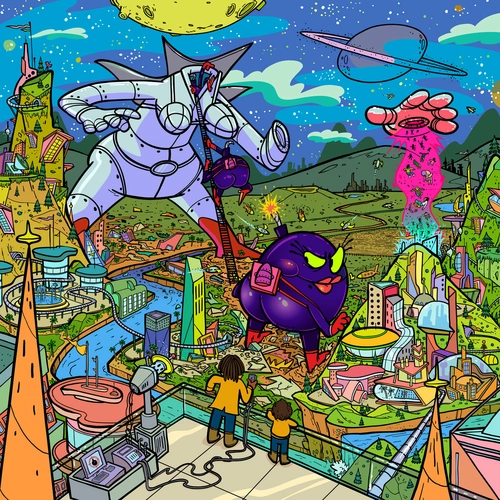
HangupsMusic.com – Los Angeles, the name Steven Ellison—better known to the world as Flying Lotus—has become synonymous with the evolution of the modern beat scene. As the founder of the Brainfeeder label, Ellison has curated a roster of talent that has redefined the boundaries of jazz, hip-hop, and electronic music. However, in a surprising turn of events for a career spanning nearly two decades, Ellison has never actually released a project of his own on the very imprint he built into a global powerhouse. That historical anomaly has finally been rectified with the arrival of BIG MAMA, a compact but explosive EP that serves as a high-octane reminder of his prowess as a producer and his roots in the dance floor’s more experimental corners.
Clocking in at just thirteen minutes, BIG MAMA is not a sprawling epic in the vein of his previous full-length efforts like Cosmogramma or the 2019 gargantuan Flamagra. Instead, it is a focused, high-intensity burst of creativity designed to be consumed as a single, uninterrupted piece of music. This continuous format allows Ellison to guide the listener through a rapidly shifting landscape of sound, where the transitions are as vital as the tracks themselves. It feels less like a collection of singles and more like a fever dream or a manic, neon-soaked animation that refuses to slow down. The EP leans heavily into his uptempo sensibilities, moving away from the cinematic grandeur of his recent film scoring work and back toward the kinetic energy of the Los Angeles Low End Theory days, albeit with a significantly higher production fidelity and a more playful, almost cartoonish aesthetic.
The journey begins with "CAPTAIN KERNEL," a track that immediately sets the tone for the EP’s hyper-saturated world. Ellison utilizes bright, neon-tinged chords that feel like they are dripping with saturation, layering them over intricate, jazzy keyboard progressions that remind the listener of his deep-rooted connection to the jazz fusion lineage. As the track progresses, the melodic elements are met with a mounting barrage of percussion. The beats here are not merely backdrops; they are aggressive, shifting entities that crescendo into a rhythmic frenzy. It captures the sensation of watching a high-definition, pixelated cartoon played at double speed—a sensory overload that manages to remain coherent through Ellison’s masterful sense of timing and space.
Transitioning seamlessly, the EP moves into "ANTELOPE ONIGIRI," a track that dives headfirst into the world of "braindance." This is Flying Lotus at his most mischievous, channeling the spirit of early Warp Records pioneers while adding his own West Coast flair. The track is characterized by jagged, unpredictable acid lines that fire across the stereo field like stray sparks. It is a frantic exercise in rhythmic complexity, where the basslines seem to warp and bend in real-time, challenging the listener to keep up with its erratic pulse. Despite the chaos, there is a distinct sense of fun throughout the track, a lightness of touch that suggests Ellison is enjoying the freedom of returning to purely electronic, dance-oriented composition.
The third movement, "BROBOBASHER," offers a brief moment of respite before escalating into one of the EP’s most driving segments. It opens with a series of contemplative, almost melancholic piano notes—a classic Flying Lotus trope that recalls his more soulful, introspective work. However, this tranquility is short-lived. The track quickly begins to build, incorporating electro-inspired textures that gradually transform into a relentless, jacked-up 4/4 kick drum pattern. The juxtaposition of the steady, driving beat with hallucinatory, ethereal pads creates a sense of tension and release. It is a track that feels perfectly suited for a dark, strobe-lit warehouse, yet it retains enough melodic complexity to reward deep listening on headphones.
The EP concludes with "HORSE NUKE," a track that represents the heaviest side of the Intelligent Dance Music (IDM) spectrum found on the record. Here, the focus shifts toward the low end, with booming, distorted basslines that threaten to overwhelm the speakers. It is a dense, textural piece of music that highlights Ellison’s ability to manipulate sound into physical shapes. The "nuke" in the title feels appropriate; the track acts as a sonic explosion, clearing the air and bringing the thirteen-minute suite to a definitive, earth-shaking close. It is perhaps the most aggressive moment on the EP, showcasing a darker, more industrial side of the Flying Lotus sound.
The significance of BIG MAMA being released on Brainfeeder cannot be overstated. Since its inception in 2008, Brainfeeder has been the home for artists who defy categorization, from the jazz-fusion virtuosity of Thundercat to the cosmic explorations of Kamasi Washington and the glitchy beauty of Teebs. For Ellison to finally place his own work on the label’s catalog feels like a homecoming—a full-circle moment for an artist who has spent the last decade-plus building a platform for others. It suggests a renewed focus on the community and the sound that he helped pioneer, stripped of the expectations that come with a major label release.
Furthermore, BIG MAMA signals a potential shift in artistic direction. For several years, Flying Lotus has been moving toward increasingly complex, multidisciplinary projects. Between his feature film Kuso, his extensive work on the Yasuke anime series, and his contributions to the Grand Theft Auto universe via FlyLo FM, his output has often been tied to visual media. This EP, however, feels like a return to the "pure" music-making process. There is a raw, uninhibited quality to these tracks, as if they were birthed from late-night studio sessions where the only goal was to see how far a single idea could be pushed. The "uptempo dance side" exhibited here is a refreshing change of pace, proving that even as he approaches veteran status in the industry, Ellison has lost none of his ability to surprise and energize his audience.
The production on the EP is, as expected, immaculate. Ellison has always had a knack for making digital sounds feel organic and "living" sounds feel synthetic, and that duality is on full display here. The "pixelated" quality mentioned by early listeners refers to a specific type of digital grit—a texture that feels both futuristic and nostalgic, like a high-tech artifact from a lost civilization. The way the jazzy keys interact with the harsh acid synths on "ANTELOPE ONIGIRI" or how the piano dissolves into the four-on-the-floor thump of "BROBOBASHER" demonstrates a level of technical proficiency that few of his peers can match.
In the broader context of 2024’s electronic music landscape, BIG MAMA stands out by refusing to overstay its welcome. In an era where streaming algorithms often encourage artists to release bloated albums to maximize play counts, a thirteen-minute continuous EP is a bold statement of intent. It demands the listener’s full attention for its duration, offering a concentrated dose of brilliance rather than a diluted experience. It is a "blink and you’ll miss it" journey that practically begs to be put on a loop.
As fans and critics digest this new material, the consensus seems to be one of overwhelming approval. If this EP is indeed indicative of a new chapter for Flying Lotus—one characterized by high-energy experimentation and a return to the dance floor—then the music world is more than ready to follow him down that path. BIG MAMA is a vibrant, chaotic, and ultimately rewarding addition to a discography that remains one of the most influential in modern music. It serves as a potent reminder that Steven Ellison is not just a label head or a filmmaker, but a master architect of sound who is still very much at the top of his game. Whether this leads to a full-length exploration of these themes or remains a standalone burst of energy, it has successfully reignited the excitement surrounding the Brainfeeder founder’s solo output. For those who have followed the FlyLo journey since the beginning, BIG MAMA is the high-velocity adrenaline shot we didn’t know we needed.