
 By Azzam Bilal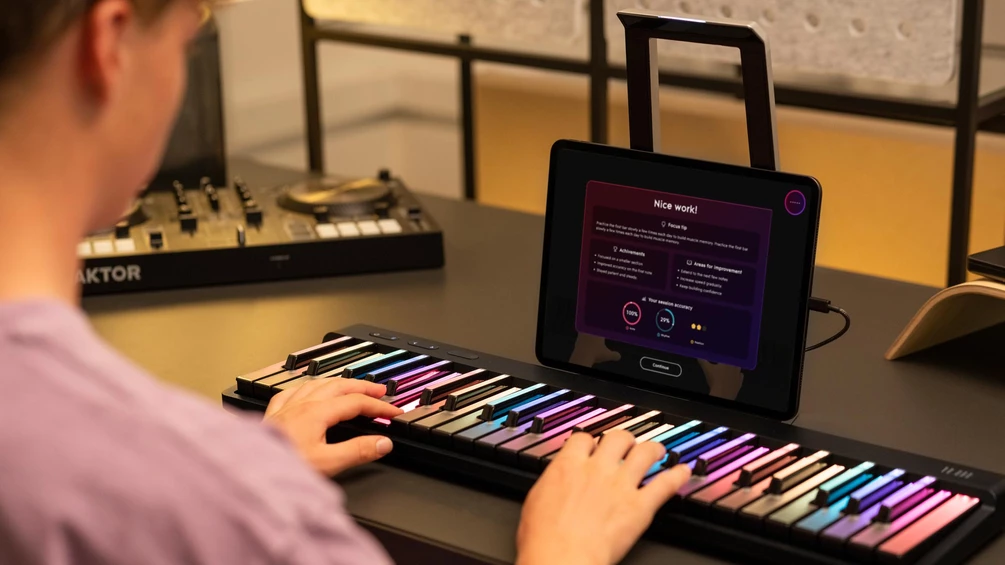
HangupsMusic.com – London, the landscape of digital music education is undergoing a profound transformation as ROLI, the pioneer in expressive MIDI technology, announces the launch of its AI Music Coach. This sophisticated digital assistant is the latest expansion of the London-based company’s "Learn" ecosystem, representing a strategic fusion of hardware innovation and artificial intelligence. By integrating advanced computer vision with real-time pedagogical feedback, ROLI aims to bridge the gap between traditional piano instruction and modern, self-guided digital learning.
The AI Music Coach is not a standalone software package but rather the intelligence layer of a larger technological triad. It operates within the ROLI Learn app, functioning in concert with the newly introduced Airwave hardware. This hardware component is a specialized infrared hand-tracking device that sits atop a keyboard, monitoring the player’s movements with surgical precision. Unlike traditional piano learning apps that rely solely on MIDI data to determine if a correct note was struck, the Airwave-powered system observes how the note was struck. This distinction is critical in music education, where physical technique, hand positioning, and posture are as vital as melodic accuracy.
Technically, the Airwave controller utilizes a sophisticated sensor array reminiscent of high-end motion capture systems or the spatial sensing found in advanced theremins. ROLI states that the device is capable of tracking 27 distinct joints in each of the user’s hands at a rate of 90 frames per second. This high-frequency data stream allows the AI Music Coach to analyze the biomechanics of a performance in real-time. It can identify if a student’s fingers are collapsing, if their wrist is too low, or if their fingering choices are inefficient for a specific passage. By providing immediate corrections on these physical nuances, the system mimics the presence of a live instructor who can see, not just hear, the student’s progress.
The AI Music Coach also introduces a high degree of accessibility through its natural voice interaction capabilities. Recognizing that many learners find it cumbersome to navigate menus while their hands are on the keys, ROLI has implemented a voice-controlled interface that supports 40 different languages. This global approach ensures that the "Coach" can explain complex musical concepts, provide encouragement, or adjust lesson parameters through spoken dialogue. This conversational layer is designed to make the learning process feel less like a clinical exercise and more like a collaborative mentorship.
While the AI Music Coach and Airwave are designed to complement the ROLI Piano—a 2024 release featuring light-up keys that guide the user’s fingers—the system is notably flexible. ROLI has confirmed that the Airwave hardware can be used with any standard keyboard or digital piano. This "open" approach allows the company to reach a broader demographic of musicians who may already own a high-quality instrument but seek the technological advantages of ROLI’s tracking software. For those who do opt for the full ecosystem, the ROLI Piano serves as a visual anchor, using its integrated LEDs to show which keys to play, while the Airwave monitors the execution of those notes.
The financial structure of this new offering reflects the industry’s shift toward hardware-as-a-service models. The Airwave hardware is priced at £299, positioning it as a premium accessory for the serious student. To unlock the full capabilities of the AI Music Coach, users must subscribe to the Learn app, which is priced at £13 per month or a discounted annual rate of £70. For those starting from scratch, the ROLI Piano itself retails for £499, though various bundles are available to lower the barrier to entry for the complete suite.
This move into AI-driven education marks another significant chapter in ROLI’s storied and sometimes turbulent history. Known primarily for the Seaboard—a soft, pressure-sensitive "keywave" controller that redefined MIDI Polyphonic Expression (MPE)—the company has spent the last several years pivoting toward the educational market. The 2022 release of the Seaboard RISE 2 proved that ROLI still holds a firm grip on the professional synthesis market, but products like the LUMI Keys (now integrated into the ROLI Piano branding) and the Learn app signal a desire to capture the much larger "prosumer" and hobbyist demographics.
The "Learn" platform’s evolution into an AI-supported environment is a response to the growing demand for gamified and interactive home learning. Competitors like Simply Piano and Yousician have dominated the app-based market for years, but ROLI’s inclusion of dedicated hand-tracking hardware gives it a unique technological edge. Most existing apps are limited by the microphone or MIDI connection of the device they run on, meaning they cannot provide feedback on hand shape or movement. By solving the "spatial" problem of piano playing, ROLI is addressing one of the most common criticisms of digital music tutors: that they teach students how to press buttons rather than how to play an instrument with proper technique.
The pedagogical content within the app has been "expertly designed," according to the company, to ensure that the AI’s feedback aligns with established musical standards. The lessons are structured to guide users from their first notes to complex arrangements, with the AI Music Coach acting as a constant companion that tracks progress and identifies areas for improvement. This data-driven approach allows the software to customize the learning path for each individual, lingering on difficult sections and moving quickly through material the student has mastered.
From a broader industry perspective, the ROLI AI Music Coach arrives at a time when the role of artificial intelligence in the arts is being hotly debated. However, in the realm of "EdTech" (educational technology), AI is often viewed through a more utilitarian lens. Rather than replacing the creativity of the artist, the AI in this context is serving as a specialized tool for skill acquisition. It addresses the "feedback loop" problem—the time gap between a student making a mistake and a teacher correcting it—which is often cited as the primary reason why many beginners abandon their studies within the first year.
The hardware itself, the Airwave, is a sleek, minimalist bar that suggests a future where our instruments are constantly "aware" of our physical presence. The use of infrared technology ensures that the tracking is consistent across various lighting conditions, a common failure point for standard camera-based tracking. By capturing the movement of 27 joints, the system can distinguish between subtle gestures, such as the rotation of the forearm during a tremolo or the "bridge" shape of the palm. This level of detail is usually reserved for professional motion-capture studios used in filmmaking or sports science.
As ROLI continues to roll out these features, the music world will be watching to see if high-tech hardware can truly replace the nuanced eye of a human piano teacher. While the AI Music Coach offers unprecedented real-time data, the emotional and interpretive aspects of music remain a human domain. Nevertheless, for the millions of people who lack access to affordable private lessons or who prefer the convenience of home practice, ROLI’s new suite offers a compelling glimpse into a future where the instrument itself helps you learn how to master it.
With the Airwave, the ROLI Piano, and the AI Music Coach, ROLI has created a closed-loop system of instruction, execution, and correction. It is a bold bet on the idea that the next generation of musicians will be just as comfortable taking cues from an infrared sensor as they are from a sheet of music. As the company expands its library of content and refines its AI algorithms, the "Learn" app may become a blueprint for how other instruments—from guitars to drums—are taught in the digital age. For now, ROLI remains at the forefront of this movement, turning the air above the keyboard into a space for interactive education.