
 By admin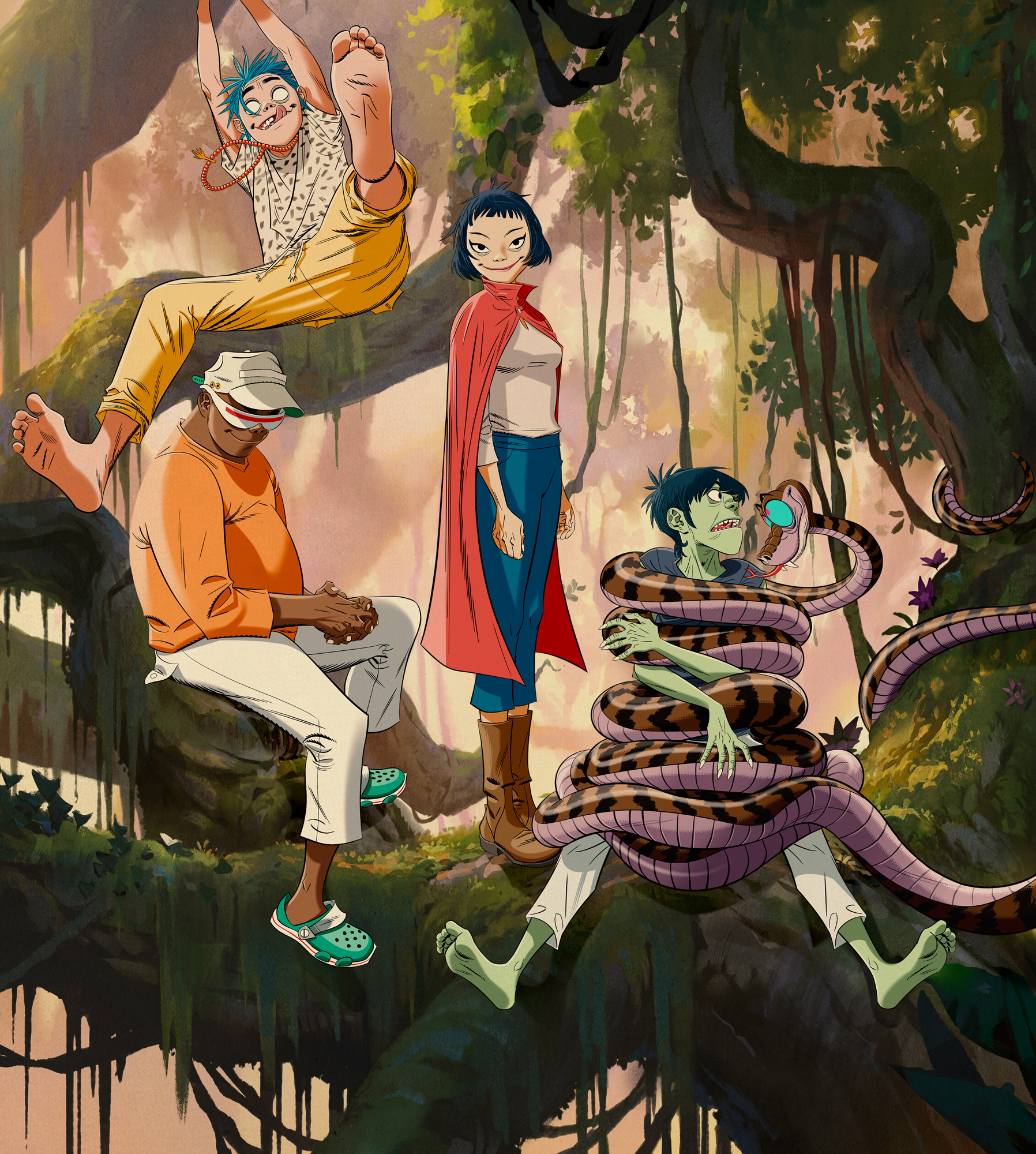
HangupsMusic.com – Los Angeles, The latest sonic venture from the world-renowned virtual band Gorillaz, their ninth studio album The Mountain, commences with an ethereal whisper from the late actor Dennis Hopper. This poignant opening, a rediscovered outtake from their seminal 2005 album Demon Days, immediately signals the record’s profound thematic undercurrents. As co-creator Damon Albarn elaborated from his home in southwest England during a recent Zoom conversation with visual collaborator Jamie Hewlett, the decision to feature departed voices stemmed from a desire to explore mortality through the lens of those who have transcended it. "If we’re going to delve into the subject of death," Albarn mused, "it felt essential to enlist the wisdom of those who are no longer with us, as they undeniably possess a unique insight."
This ambitious project, which Albarn now regards as the spiritual successor to their acclaimed 2010 release Plastic Beach, was forged in the crucible of significant personal loss for both creators. Albarn and Hewlett experienced the passing of their fathers within a mere ten days of each other, an event that profoundly shaped the album’s narrative and emotional landscape. Simultaneously, a transformative journey to India infused their creative wellspring with fresh perspectives and new archetypes for Gorillaz’s animated quartet: drummer Russel Hobbs, bassist Murdoc Niccals, guitarist Noodle, and vocalist 2-D. This convergence of personal grief and global exploration propelled them to excavate their archives, resulting in an extraordinary roster of collaborators.
The Mountain is a testament to Gorillaz’s unparalleled ability to transcend temporal and cultural boundaries. The album weaves together the posthumous contributions of legends like Afrobeat pioneer Tony Allen, soul icon Bobby Womack, De La Soul’s innovative rapper Dave Jolicoeur (Trugoy the Dove), and post-punk provocateur Mark E. Smith of The Fall. These spectral voices are harmoniously blended with the vibrant talents of living artists, including the revered 92-year-old Indian playback singer Asha Bhosle, dynamic 23-year-old Argentinean rapper Trueno, and The Roots’ lyrical maestro Black Thought. This mosaic of voices, spanning generations, genres, and geographies, solidifies The Mountain as Gorillaz’s most rewarding and substantive work in over a decade. Albarn describes it not just as an album, but as "an entire world unto itself," a sprawling concept reminiscent of Plastic Beach‘s ecological narrative, yet steeped in an even deeper existential reflection.
The creative synergy between Albarn and Hewlett, the architects behind the Gorillaz universe, has long been a cornerstone of the band’s success. Their relationship, which experienced a "cataclysm" when Hewlett relocated to France after Plastic Beach, has since undergone a profound reconciliation. The shared experience of grief and the subsequent journey to India served as a pivotal "renewal of vows," strengthening their bond and artistic alignment. Hewlett recounted their discovery of shared purpose: "Damon’s father passed away, and my father passed away 10 days later. We were like, ‘OK, the themes of this record are starting to present themselves to us quite clearly.’"
For Albarn, his first visit to India was a revelation. Despite growing up in East London alongside Indian families and listening to Ravi Shankar more than The Beatles as a child, the direct immersion was unparalleled. The ancient city of Varanasi, with its millennia-old spiritual practices and the solemn sight of funeral pyres lining the Ganges, left an indelible mark. Hewlett recalled Albarn even swimming in the sacred river. Albarn described the experience as an immediate immersion in "thousands of years of spiritual activity and ritual," a profound encounter that both infused and haunted them, allowing the themes of life, death, and renewal to wash over them. This immersive spiritual landscape directly informed the album’s core ideas, especially the concept of channeling departed spirits.
This notion, in fact, has roots in the earliest days of Gorillaz. The original 1999 "Gorillaz Manifesto," penned by Albarn and Hewlett while sharing a flat, explicitly stated that the character of Russel possessed the ability to conjure the voices of deceased musicians. Hewlett quipped about the 25-year wait to actualize this "great idea," highlighting the long gestation of some of their most imaginative concepts. This patience underscores Gorillaz’s unique artistic approach, where ideas can simmer for decades before finding their perfect expression.
Looking ahead, Gorillaz is poised for a busy year of bringing The Mountain‘s universe to life. Following a successful run in London, their immersive "House of Kong" exhibition is set to arrive in Los Angeles on February 26th. Prior to that, on February 22nd and 23rd, the band will perform The Mountain in its entirety during two special shows at the Hollywood Palladium, offering fans an unparalleled live experience of the new material. Hints of additional U.S. Gorillaz performances in the fall further fuel anticipation. Beyond the band, Albarn is also contributing to director Luca Guadagnino’s upcoming comedy-drama film Artificial, composing both score and songs that explore the rise of AI technology. Albarn humorously noted the opportunity to "put music under Elon Musk," playfully humming the Imperial March theme from Star Wars, a lighthearted jab at the tech mogul’s formidable influence.
As Gorillaz celebrates its 25th anniversary, Albarn and Hewlett convey an palpable sense of renewed energy. They remain firmly focused on the future, expressing a shared disinterest in dwelling on past achievements. "I don’t get any pleasure out of looking back on anything," Albarn stated, with Hewlett adding, "What’s next is exciting." They believe that constantly evolving and pushing creative boundaries is paramount, cautioning against the stagnation of living off past glories. Even reflecting on their early Gorillaz projects, Albarn observed how their initially "weird" and seemingly nonsensical lyrics now resonate with unsettling clarity in today’s world, suggesting that the "madness" of contemporary society has finally caught up to their quarter-century-old avant-garde vision.
The foresight of Gorillaz’s concept, a virtual band existing in an animated realm, seems almost prophetic in an era witnessing the global phenomenon of groups like KPop Demon Hunters and the technological marvel of the ABBA hologram show. Albarn dryly remarked on the monetization of their pioneering ideas, yet Hewlett acknowledged that the animated nature of Gorillaz continues to attract new, younger audiences who are drawn to the visuals before discovering the music. This enduring appeal ensures the characters – Russel, Murdoc, Noodle, and 2-D – maintain a sense of eternal relevance, even if their forms might one day shift, as Albarn jokingly suggested, to cubist interpretations, with Murdoc transforming into a "green rectangle."
The discussion inevitably turned to artificial intelligence in art, a theme pertinent to Albarn’s film score. Hewlett views AI as a tool, akin to Photoshop, emphasizing that its true value lies in how it’s wielded. He expressed skepticism about algorithms generating art that can evoke the same emotional depth as human-created works, arguing that the profound connection to an artist’s vision, their unique story, is absent when a computer merely harvests global information. Albarn, ever the philosopher, responded with a nod to Mao’s famous quote on the French Revolution: "It’s too soon to tell." This nuanced perspective underscores Gorillaz’s own complex relationship with technology – a band that thrives on digital innovation yet maintains a human heart. Albarn himself eschews modern tech, owning no phone and having "never streamed anything" in his life, a fascinating contrast to the technologically advanced world his band inhabits.
Throughout their extensive career, Albarn and Hewlett have been vocal proponents of cross-cultural understanding. They attribute their own personal growth to extensive travel and the acceptance of diverse beliefs, and this ethos is deeply embedded in Gorillaz’s DNA. Despite concerns about the current global trajectory, they strive for positivity, highlighting how The Mountain‘s beauty is intrinsically linked to its multi-cultural collaborations. This "community" of diverse voices, Albarn explained, has been the very "essence" of Gorillaz since his dramatic shift from Blur, providing the crucial human interaction that transcends the animated facade.
While Blur continues to command massive audiences in Europe, Gorillaz has cultivated a stronger presence in the U.S. Reflecting on Blur’s appearance at Coachella in 2024, Albarn felt it was a "slight mismatch," describing the festival as an "embodiment of social media" where phones are aimed at the audience rather than the stage. Despite this, the possibility of Blur returning to the U.S. for a momentous show, perhaps reminiscent of their incredible Madison Square Garden performance in 2015, remains open. Albarn, however, humorously lamented the enduring presence of Billy Joel banners at the iconic venue, which he feels deflates any sense of individual achievement.
Ultimately, Gorillaz remains a singular entity in the music landscape – a project that consistently pushes the boundaries of art, technology, and storytelling. With The Mountain, Albarn and Hewlett have once again proven their unparalleled ability to synthesize profound personal experiences with global sounds, creating an album that is both deeply introspective and universally resonant, all while challenging listeners to look beyond the surface, into the heart of their virtual, yet vividly real, world.