
 By admin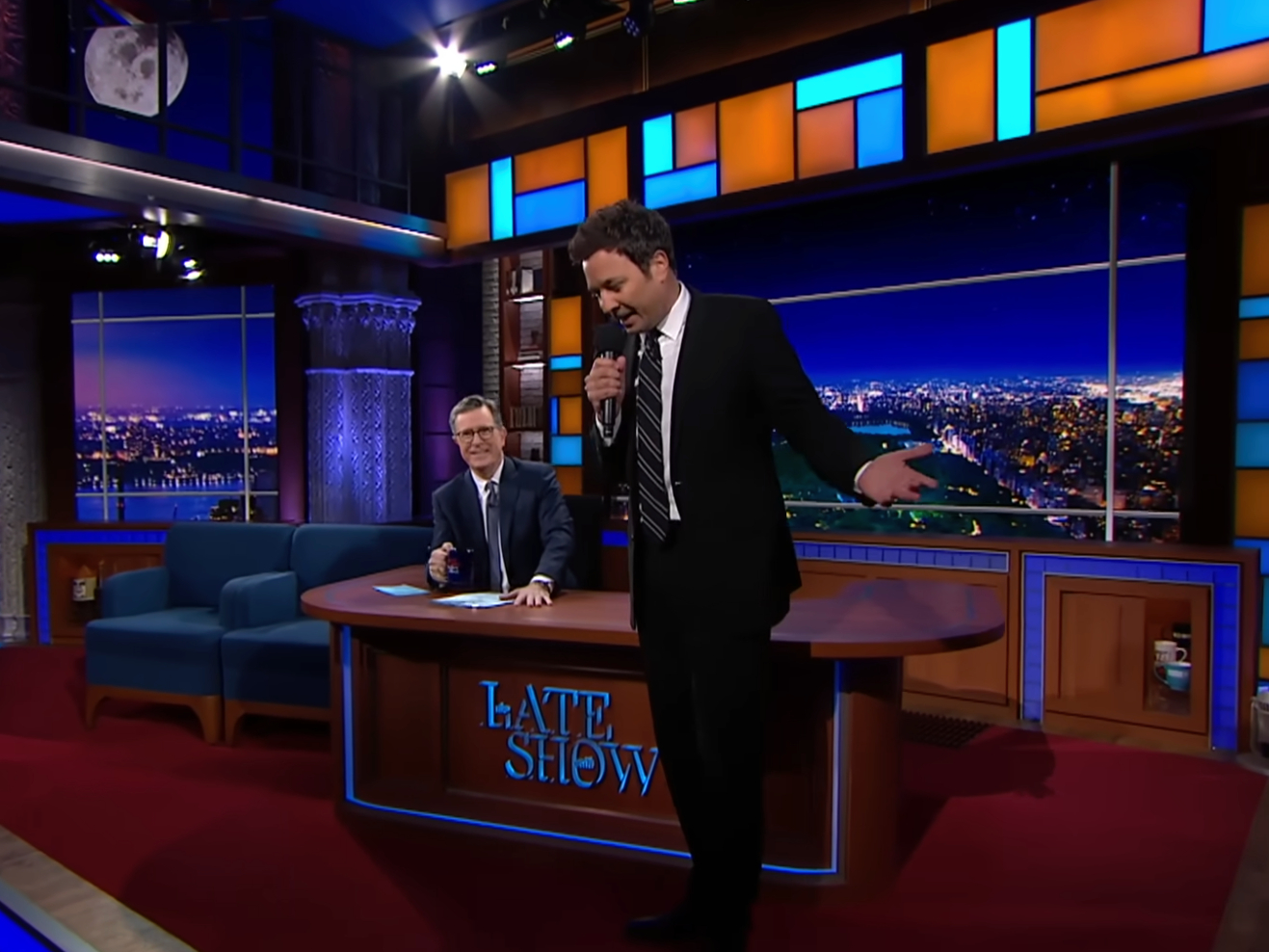
HangupsMusic.com – New York, NY – In a moment that transcended typical network rivalries and underscored the deep camaraderie within the often-competitive world of late-night television, Jimmy Fallon, host of NBC’s The Tonight Show, made a memorable debut appearance on CBS’s The Late Show with Stephen Colbert last night. What began as a friendly chat between two titans of comedy evolved into a poignant musical tribute, as Fallon serenaded Colbert in honor of his impending departure from the late-night landscape. The performance, set to the iconic tune of Frank Sinatra’s "My Way," offered a blend of humor, genuine affection, and a touch of late-night political commentary, capturing the bittersweet essence of an era drawing to a close.
The evening’s emotional crescendo arrived after a segment filled with shared anecdotes and reflections on their long-standing friendship. Fallon, known for his musical versatility and charismatic stage presence, took to the stage to deliver a personalized rendition of the classic anthem. The lights in the legendary Ed Sullivan Theater dimmed, casting a reflective glow as Fallon, with microphone in hand, began his serenade. His voice, often heard in playful parodies, took on a more tender, yet still comedic, quality as he belted out lyrics specifically tailored to Colbert’s distinguished tenure and the surprising circumstances of The Late Show‘s conclusion.
The lyrics immediately addressed the elephant in the room – the news that The Late Show, after over a decade under Colbert’s stewardship, is set to conclude on May 21st. Fallon crooned, "And now the end is near, and so you face the final curtain," a direct nod to Sinatra’s original, but quickly injected late-night’s signature political edge: "But Trump, he made it clear, he wants you gone, of that we’re certain." This line, delivered with a knowing wink, cleverly referenced the often-contentious relationship between Colbert’s politically charged humor and the former president, eliciting a roar of laughter and applause from the audience. It was a testament to Colbert’s unflinching satirical style, which became a hallmark of his Late Show era, particularly during the Trump administration.
Fallon continued, acknowledging Colbert’s journey from his earlier, influential Comedy Central days: "You’ve been a gracious host, we’ve loved you since the old Report days." This heartfelt recognition reached back to The Colbert Report, the news satire program where Stephen Colbert first cultivated his distinct persona and sharp political wit, earning him critical acclaim and a dedicated fanbase before he transitioned to the broader audience of network late-night. The lyrics underscored the evolution of Colbert’s career, from a satirical pundit to a mainstream late-night host who nonetheless retained his incisive commentary. The stanza culminated in the affirming declaration, "And more, much more than this, you did it your way," a fitting tribute to Colbert’s uncompromising artistic vision and unique brand of intelligent humor.
The performance reached its comedic peak as Fallon playfully touched upon the future of late-night and, with a characteristic touch of self-deprecating humor, even hinted at his own aspirations. "CBS, they said you’re through, and now it’s down to just two Jimmys," Fallon sang, playfully alluding to himself and Jimmy Kimmel, the current hosts of the remaining major network late-night shows. This line not only highlighted the shrinking landscape of traditional late-night programming but also playfully positioned Fallon as a surviving pillar. He then added a hilarious, opportunistic plea: "But wait, before you go, can I please have one of your Emmys?" – a lighthearted jab at Colbert’s impressive collection of accolades and a moment that perfectly encapsulated the affectionate rivalry and mutual respect between the two hosts.
As the final notes faded, the scene transformed into a truly memorable television moment. Both Fallon and Colbert, overcome with emotion and camaraderie, climbed atop Colbert’s iconic desk, embracing in a powerful display of friendship. "I’ll see you in the locker room," Colbert quipped, a seemingly casual remark laden with layers of meaning, hinting at their shared journey through the demanding world of entertainment and the private moments of friendship that often go unseen. It was a spontaneous, unscripted gesture that spoke volumes about the bonds forged in the high-pressure environment of late-night television.
The announcement of The Late Show‘s cancellation last year by CBS sent ripples through the entertainment industry. The network, in a surprising move, confirmed that the franchise, which Colbert had helmed since 2015, would conclude due to "purely a financial decision against a challenging backdrop in late night." This statement, issued by CBS, explicitly detached the decision from the show’s performance or content, praising Colbert unequivocally: "We consider Stephen Colbert irreplaceable and will retire The Late Show franchise at that time. We are proud that Stephen called CBS home. He and the broadcast will be remembered in the pantheon of greats that graced late-night television."
This candid acknowledgment of financial pressures, rather than creative or viewership decline, painted a stark picture of the evolving media landscape. The traditional late-night model, heavily reliant on linear television viewership and advertising revenue, has faced significant headwinds from the proliferation of streaming services, on-demand content, and changing consumption habits, particularly among younger demographics. Even shows like Colbert’s, which consistently drew strong ratings and critical acclaim, have not been immune to the broader economic shifts impacting legacy broadcasters and their parent companies, such as Paramount Global.
Colbert himself addressed the news with his characteristic blend of humor and sincerity, assuring his audience, "I’m not being replaced. This is all just going away. I do want to say that the folks of CBS have been great partners." His statement reinforced the network’s narrative of a strategic financial realignment rather than a performance-based termination, allowing him to exit with dignity and grace, much as David Letterman did before him.
Stephen Colbert took over The Late Show in 2015, inheriting the mantle from the legendary David Letterman, who had hosted the program for over two decades. The transition was highly anticipated, with Colbert bringing his unique blend of intellectual wit, political satire, and genuine warmth to the mainstream. His journey from The Colbert Report, where he played a conservative pundit caricature, to the host of The Late Show at the historic Ed Sullivan Theater, represented a significant evolution. He skillfully adapted his sharp observational humor and incisive political commentary to a broader platform, often delving into deeper conversations and more elaborate comedic bits, particularly during politically charged times. His tenure saw him navigate complex social and political landscapes, consistently providing a voice of reason, humor, and often, catharsis for his audience.
The final days of The Late Show with Stephen Colbert represent more than just the end of a television program; they signify a turning point in the storied history of late-night entertainment. The departure of a host as significant and influential as Colbert leaves a void, but also prompts reflection on the genre’s future. The industry is grappling with how to adapt to a fragmented media environment, where viral clips on social media often outpace traditional linear viewership, and where the very definition of "late-night" is constantly being redefined.
Fallon’s heartfelt serenade was not just a tribute to a friend and fellow performer; it was a collective acknowledgment of Colbert’s indelible mark on television, a fond farewell to a segment of the late-night era, and a poignant reminder of the enduring power of human connection, even amidst the cutthroat competition of network television. As the curtain prepares to fall on The Late Show, the shared embrace between Fallon and Colbert on that iconic desk will undoubtedly be remembered as a symbolic moment – a testament to a legacy built "his way," and a hopeful glance towards whatever new forms entertainment and camaraderie will take in the years to come. The "two Jimmys" may remain, but the unique voice and presence of Stephen Colbert will be deeply missed, leaving behind a rich archive of intelligent humor, incisive commentary, and unforgettable moments from the Ed Sullivan Theater.