
 By Azzam Bilal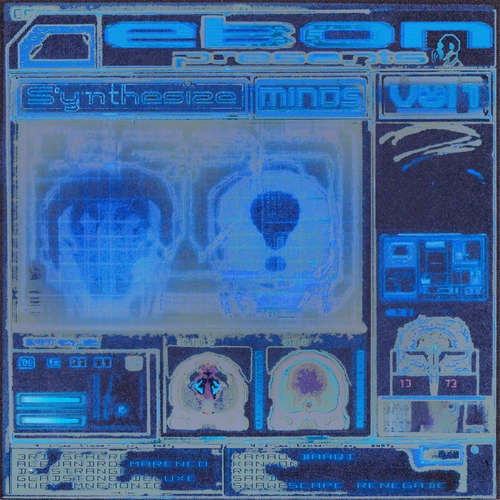
HangupsMusic.com – Detroit, the storied birthplace of techno, has long wrestled with the weight of its own monumental history. For decades, the shadow of the "Belleville Three" and the revolutionary fervor of Underground Resistance have provided both a foundation and a boundary for electronic music coming out of the Motor City. While the world remains enamored with the analog warmth and industrial soul of the 1980s and 90s, a new generation of artists is working tirelessly to ensure that the city’s sonic output is not relegated to a museum piece. Central to this contemporary movement is Huey Mnemonic, a producer and DJ whose vision extends far beyond mere nostalgia. Through his Ebon imprint—also known as Subsonic Ebonics—Mnemonic has become a pivotal architect of a modern sound that respects its lineage while aggressively pursuing the unknown. This mission finds its most comprehensive expression to date in the compilation "Synthesize Minds Vol. 1," a ten-track odyssey that maps the current topography of the American underground.
"Synthesize Minds Vol. 1" is more than just a label showcase; it is a curated manifesto that connects the dots between three of the United States’ most influential electronic music hubs: Detroit, Chicago, and New York City. By assembling a diverse roster of artists who share a common interest in "mutant" electronics, Mnemonic has created a sonic bridge that traverses the Rust Belt and the East Coast. The compilation focuses on a specific aesthetic—one defined by metallic textures, syncopated rhythms, and a refusal to adhere to the rigid constraints of traditional four-on-the-floor techno. It is a collection that thrives in the gray areas between genres, blending the mechanical precision of electro with the heavy-bottomed weight of bass music and the experimental curiosity of avant-garde synthesis.
The compilation opens a window into the "here and now," challenging the listener to move past the familiar tropes of soul-infused Detroit strings and instead embrace a more jagged, tactile reality. This shift in perspective is evident from the outset. Rather than relying on the sweeping atmospheres of the past, the artists featured here utilize sound as a physical material—something to be bent, scraped, and hammered into new shapes. The result is a series of tracks that feel intensely functional for the club environment yet possess enough structural complexity to reward deep, attentive listening.
One of the standout contributions comes from Alejandro Marenco, a Nicaragua-born artist currently based in Chicago. His track, "Gusano," serves as a masterclass in percussive restraint and tactile sound design. Marenco’s work often draws comparisons to the forward-thinking output of labels like TraTraTrax, which have pioneered a slower, more rhythmic approach to dance music that prioritizes groove over pure velocity. In "Gusano," the percussion feels organic, almost biological, as if the sounds are wriggling through a digital landscape. It is a track that emphasizes the "space between the notes," using silence and subtle shifts in frequency to create a sense of mounting tension. By including Marenco, Mnemonic highlights the cross-pollination occurring between the Midwestern techno tradition and the global rhythms that are currently reshaping the international underground.
Moving from the rhythmic experiments of Chicago to the experimental fervor of New York City, the compilation introduces the work of Gladstone Deluxe. His contribution, "Portal C5AD," represents the more cerebral side of the collection. The track is built upon a foundation of loose-limbed, syncopated percussion that seems to defy gravity. Over this shifting rhythmic base, Deluxe layers a series of idiosyncratic synth textures and "quirky twangs" that provide a sense of playful unpredictability. It is the kind of track that feels like a conversation between a human and a malfunctioning machine—a hallmark of the "mutant" techno sound that the compilation seeks to champion. The inclusion of Gladstone Deluxe underscores the compilation’s commitment to artists who are pushing the boundaries of what electronic music can sound like when it is stripped of its most predictable elements.
As the compilation progresses, the energy levels begin to climb, venturing into grittier and more high-velocity territory. This is perhaps most evident in the work of 3rd Sphere, a collaborative project featuring Huey Mnemonic himself alongside the talented 2Lanes. Their contribution acts as a bridge between the experimental leanings of the earlier tracks and the raw, unadulterated power of the Detroit dance floor. 3rd Sphere leans into the higher-BPM ranges, delivering a sound that is both punishing and sophisticated. It is techno that has been stripped of its fat, leaving behind a lean, metallic skeleton that pulses with a relentless, mechanical energy. The collaboration between Mnemonic and 2Lanes is a testament to the strength of the current Detroit scene, where veteran sensibilities and new-school aggression frequently collide to produce something entirely fresh.
The intensity is maintained through contributions from artists like Kanyon and Sard, both of whom provide tracks that lean into the darker, more industrial facets of the electronic spectrum. These offerings are characterized by their "gritty" textures—sounds that feel as though they have been recorded in the bowels of an abandoned factory and then processed through a modern digital lens. In these moments, "Synthesize Minds Vol. 1" pays its clearest homage to the industrial roots of Detroit and Chicago, yet the production techniques are undeniably contemporary. There is a crispness to the distortion and a clarity to the low-end that separates these tracks from the lo-fi aesthetic that dominated the underground a decade ago. This is high-definition grit, engineered for the massive sound systems of the modern festival and the intimate, sweat-soaked basements of the DIY circuit.
The overarching success of "Synthesize Minds Vol. 1" lies in its ability to maintain a high standard of quality while exploring such a broad range of sonic territory. Huey Mnemonic has demonstrated an astute ear for curation, selecting tracks that feel like they belong to the same universe despite their geographic and stylistic differences. The common thread is a shared affinity for "techno-adjacent" sounds—music that uses the language of techno but refuses to be bound by its grammar. This approach allows for a level of creative freedom that is often missing from more traditional genre-focused labels. On the Ebon imprint, a track can be as much about the texture of a snare hit as it is about the drive of the kick drum.
Furthermore, the compilation serves as a vital document of the cultural exchange between Detroit, Chicago, and New York. While these cities have always been linked, the specific dialogue captured on this release feels particularly relevant to the current moment. In an era where the "global" sound of electronic music can sometimes feel homogenized by algorithms and social media trends, "Synthesize Minds Vol. 1" feels rooted in specific places and specific communities. It captures the sound of artists who are talking to each other, influencing each other, and building a collective vision for the future of American electronic music.
As the final tracks of the compilation fade out, the listener is left with the impression that this is only the beginning. The "Vol. 1" in the title suggests a long-term commitment to this exploration, and if this first installment is any indication, the Ebon label is set to become one of the most important outlets for forward-thinking electronics in the United States. Huey Mnemonic has not only provided a platform for his peers but has also issued a challenge to the wider community: to stop looking solely at the past and to start synthesizing the minds and sounds of the present.
In conclusion, "Synthesize Minds Vol. 1" is a landmark release for the contemporary electronic scene. It successfully navigates the difficult balance between danceable functionality and experimental flair, offering a vision of techno that is as intellectually stimulating as it is physically demanding. By bringing together the disparate threads of the Detroit, Chicago, and NYC undergrounds, Huey Mnemonic has created a tapestry that is rich, complex, and undeniably modern. This is the sound of the American underground finding its voice once again, not by echoing the triumphs of the past, but by forging a new, metallic-hued path into the future. For those who fear that electronic music has become stagnant, this compilation is a resounding rebuttal—a vibrant, pulsing reminder that the most exciting sounds are often found in the margins, where the mutants and the experimentalists are busy building the future.