
 By Azzam Bilal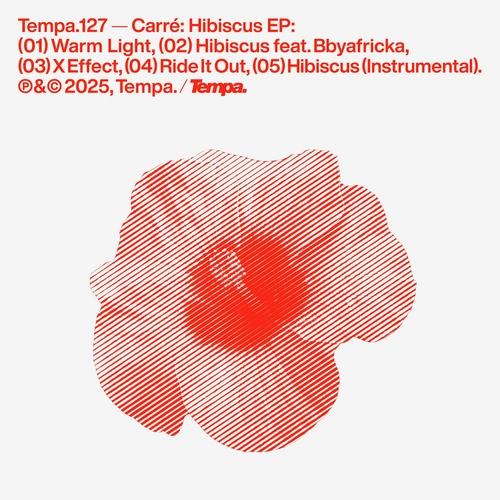
HangupsMusic.com – London, the electronic music landscape of 2025 has been defined by a profound sense of historical continuity meeting radical innovation. Nowhere is this more evident than in the resurgence of dubstep, a genre that has spent the last decade oscillating between underground purism and mainstream saturation. This year, however, the narrative has shifted. The return of the foundational club night FWD>> and the reawakening of the legendary Tempa label have signaled a formal "Dubstep 2.0" era—a movement that distances itself from the stereotypical "backpack" culture of the mid-2000s in favor of a more inclusive, sophisticated, and rhythmically diverse aesthetic. At the forefront of this transformation is Carré, a producer whose London-via-Los Angeles trajectory informs a sound that is as atmospheric as it is technically precise. Her latest offering, the Hibiscus EP, serves as a definitive statement for the modern Tempa catalog, blending the label’s historical weight with a forward-thinking sensibility.
The return of Tempa cannot be overstated in its importance to the global bass music community. As the label that arguably birthed the commercial and critical framework for dubstep through releases by Skream, Benga, and Horsepower Productions, its period of dormancy left a void in the scene. In 2025, its revival is not merely a nostalgia play but a curated effort to redefine what "deep" music sounds like in a post-genre world. The current iteration of the scene is less of a "boy’s club" and more of a globalized, gender-diverse collective of artists who prioritize groove and sensuality over raw aggression. Names like Beatrice M. and Introspekt have already begun carving out this new space, but Carré’s arrival on the label feels like a foundational moment for this second wave.
Carré’s path to the center of the UK bass scene is a testament to the cross-pollination of electronic subcultures. Moving from the expansive, experimental beat scene of Los Angeles to the dense, sound-system-driven environment of London, she has managed to synthesize the best of both worlds. Her earlier work, specifically the breakthrough track "Fawn," established her as a master of minimalism. "Fawn" was a masterclass in restraint, using negative space as a rhythmic element and focusing on the physical impact of sub-bass rather than melodic clutter. It was this specific DNA—deep, minimal, and inherently groovy—that made her an ideal candidate for the new era of Tempa.
The Hibiscus EP is a natural evolution of that minimal philosophy, yet it introduces a level of warmth and organic texture that feels fresh. The record is built on a foundation of meditative sub-bass, the kind that requires a high-fidelity sound system to truly appreciate. Unlike the jagged, midrange-heavy sounds that dominated the genre’s middle years, Carré’s low-end is smooth and enveloping. It provides a steady pulse that anchors the more complex elements of her production. Her drum programming on the EP is particularly noteworthy; it is characterized by "precision" in the most literal sense. Every snare hit and hi-hat flicker feels intentionally placed, creating a skeletal but highly effective rhythmic framework that allows the listener’s mind to fill in the gaps.
While the instrumental cuts on the EP showcase Carré’s technical prowess, it is the title track, "Hibiscus," that has captured the zeitgeist. A collaboration with the rapper Bbyafricka, the track represents a bridge between the dark rooms of dubstep and the charismatic energy of contemporary rap. Bbyafricka delivers what can only be described as "sugary, stoned bars," a vocal performance that feels effortlessly cool and slightly detached. Her flow "bumps and grinds" against Carré’s production, creating a friction that is both hypnotic and danceable. The track utilizes dubby chords that echo into the distance, providing a lush backdrop for Bbyafricka’s pulses of lyricism. It is a track that feels tailor-made for the "post-Valentine’s Day" mood—romantic but slightly melancholic, intimate but built for a dark dancefloor.
This shift toward a "sleeker and sexier" sound is a deliberate departure from the genre’s origins. In its infancy, dubstep was often associated with dark, dingy basements and a predominantly male audience focused on the technicalities of "the drop." The 2025 variant, as exemplified by Carré, embraces a different kind of intensity. It is an intensity of mood and atmosphere. By incorporating elements of R&B, dub, and even ambient music, these artists are expanding the emotional palette of bass music. The Hibiscus EP doesn’t just demand that you listen; it invites you to feel.
The collaboration with Bbyafricka also highlights a growing trend of vocal integration within the 140 BPM framework. While dubstep has always had a relationship with MC culture, the contemporary approach is less about hype and more about songcraft. Bbyafricka’s presence on "Hibiscus" isn’t an afterthought; it is the focal point around which Carré builds her sonic world. The result is a piece of music that functions as well on a radio playlist as it does in a heavyweight club set. This versatility is key to the longevity of the current scene. By breaking down the barriers between "club tracks" and "songs," artists like Carré are ensuring that the genre remains relevant to a wider audience.
Furthermore, the technical execution of the Hibiscus EP reflects a high level of modern sound design. The "meditative subs" mentioned by critics are not just loud; they are tuned and textured. In tracks across the EP, one can hear the influence of dub’s foundational techniques—the use of delay, reverb, and spatial positioning—but updated with 21st-century digital clarity. The percussion is crisp, often utilizing foley-like sounds and unconventional hits that give the music an organic, almost tactile quality. It is this attention to detail that separates the "Dubstep 2.0" movement from its predecessors. It is music that rewards close listening, revealing new layers of sound with each subsequent playback.
As the year progresses, the impact of the Hibiscus EP is likely to be felt across the festival circuit and in the underground alike. It serves as a blueprint for how a legacy label like Tempa can remain vital in a rapidly changing industry. By championing artists who are willing to experiment with the genre’s core tenets, the label is reclaiming its position as a tastemaker. Carré, in turn, has solidified her reputation as one of the most exciting producers of her generation. Her ability to balance the heritage of London’s sound-system culture with the innovative spirit of the LA underground has resulted in a body of work that is uniquely hers.
In the broader context of electronic music in 2025, the Hibiscus EP is a symptom of a healthy, diversifying scene. The "boy’s club" mentality of the past is being dismantled by a wave of talent that prioritizes different perspectives and sounds. The result is a richer, more vibrant community where the music is allowed to evolve in unexpected directions. Whether it is the precision of Carré’s drum patterns or the laid-back charisma of Bbyafricka’s vocals, "Hibiscus" is a reminder that the most interesting music often happens at the intersection of different worlds.
As we look toward the future of the genre, it is clear that the "stoned dudes wearing backpacks" era is a distant memory. The new face of dubstep is sophisticated, inclusive, and deeply rooted in a sophisticated understanding of groove. With the Hibiscus EP, Carré hasn’t just released a collection of tracks; she has helped define the sound of a new era. For Tempa, this is more than a comeback; it is a second act that promises to be just as influential as the first. The rewinds will undoubtedly continue for "Hibiscus," but the ripples of this release will be felt long after the final bass pulse fades.