
 By Azzam Bilal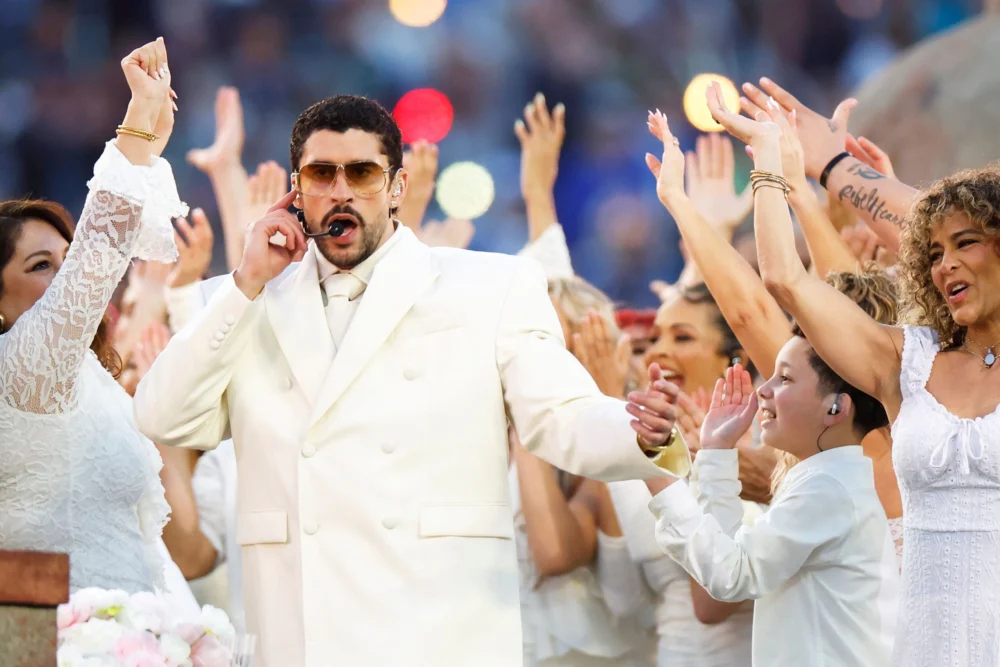
HangupsMusic.com – New Orleans, The spectacle of the Super Bowl has long been regarded as the pinnacle of American commercial and athletic achievement, yet on the evening of February 8, the event underwent a profound cultural transformation. In the center of the gridiron at Super Bowl LX, Benito Antonio Martínez Ocasio, known globally as Bad Bunny, delivered a halftime performance that was less a traditional pop medley and more a sprawling, ambitious manifesto of Puerto Rican identity. The performance, which has since ignited a firestorm of praise across the political and musical spectrum, served as a definitive statement on the current state of global music: the center of gravity has shifted, and it is firmly rooted in the Spanish language.
The performance arrived at a moment of peak momentum for the artist. Just one week prior, on February 1, Bad Bunny secured a historic win at the Grammy Awards, taking home the Album of the Year trophy for his critically acclaimed project, Debí Tirar Más Fotos. That victory set the stage for what many expected to be a victory lap, but few were prepared for the sheer scale of the production he brought to the Super Bowl. From the intricate set designs that evoked the streets of San Juan to the meticulously choreographed sequences that spanned decades of Caribbean history, the show was a masterclass in cultural storytelling.
As the final notes of the performance faded, the digital landscape erupted. The reaction was not merely a reflection of the show’s entertainment value, but a recognition of its historical weight. On X (formerly Twitter), New York City Mayor Zohran Mamdani was among the first to acknowledge the geographic and cultural resonance of the moment, posting "NUEVAYoL" alongside the Puerto Rican flag. The sentiment underscored the deep connection between the island and the diaspora, particularly in cities like New York where the "Nuyorican" identity has shaped the city’s DNA for generations.
The artist Mavi offered a more visceral reaction to the linguistic pride on display, remarking on the power of the performance to make English feel secondary. "This shit hard im finna stop speaking English actually fuck English," he wrote, capturing a sentiment shared by many who saw the performance as a refusal to assimilate. Instead of translating his art for a mainstream American audience, Bad Bunny forced the audience to meet him on his own terms, celebrating the nuances of his native tongue without compromise. This was echoed by the indie-pop group The Marías, who simply shared the exclamation "boricuaaaa," a term of endearment and pride for those of Puerto Rican descent.
Musically, the show was a kaleidoscopic journey through the sounds of the Caribbean. Rauw Alejandro, a peer and fellow titan of the genre, took to social media to break down the technical and historical layers of the set. He praised the inclusion of traditional genres that are often overshadowed by the commercial juggernaut of reggaeton. "Long live the BOMBA, the PLENA, the SALSA, the HIPHOP and above all LONG LIVE REGGAETON," Alejandro wrote in Spanish. By integrating Bomba and Plena—genres with deep Afro-Puerto Rican roots—Bad Bunny did more than just provide a beat; he provided a history lesson, honoring the ancestors of the modern Latin sound.
The guest list for the evening was equally strategic and star-studded. The appearance of Lady Gaga was a highlight that bridged the gap between American pop royalty and the new Latin vanguard. The two shared a moment of high-energy salsa dancing that quickly went viral, symbolizing a fusion of worlds. The stage also welcomed the "King of Latin Pop," Ricky Martin, whose presence served as a passing of the torch. Adding to the modern fire were Karol G and Young Miko, representing the explosive growth of women in the urban space, while Cardi B brought her signature Bronx-bred energy to the stage, further cementing the link between the island and the mainland.
While the show was a celebration, it also became a point of contrast in a polarized cultural climate. Kacey Musgraves, the Grammy-winning country star, used her platform to draw a sharp distinction between Bad Bunny’s performance and a competing event. Turning Point USA, a conservative non-profit, had organized an "All-American Halftime Show" featuring Kid Rock, which was streamed on YouTube simultaneously. Musgraves was blunt in her assessment, stating, "Well. That made me feel more proudly American than anything Kid Rock has ever done." Her comment pointed to a broader debate about what constitutes "American" culture in the 21st century, suggesting that the inclusivity and vibrancy of Bad Bunny’s set represented a more accurate and inspiring vision of the nation than the alternative.
The praise continued to pour in from diverse corners of the entertainment industry. Doechii, who appeared in a Levi’s advertisement during the game, was breathless in her admiration, calling the performance "History." Kerry Washington, writing on Threads, expressed a similar sense of awe, telling her followers she might never "recover" from the intensity of the show. Electronic producer SG Lewis and beatmaker Monte Booker both hailed it as one of the greatest halftime shows in the history of the NFL, a sentiment backed by the legendary Nancy Sinatra and Nick León.
Perhaps some of the most moving support came from veteran voices in American music. John Mellencamp, a songwriter long associated with the heartland and the struggles of the working class, offered a poignant reflection on the performance. "I don’t know what Bad Bunny is saying," Mellencamp admitted, "however, I do know he is standing up for Puerto Rico and I am standing up for him. His half time show was great." This endorsement from a traditional American icon highlighted the universal language of resistance and pride that Bad Bunny projects, even to those who do not speak Spanish.
The Super Bowl LX Halftime Show was not just a musical performance; it was a reclamation of space. For fifteen minutes, the most-watched television event in the United States was transformed into a celebration of a territory that is often treated as an afterthought in American politics. Bad Bunny used his platform to center the experiences, the rhythms, and the joy of the Puerto Rican people. By bringing out legends like Ricky Martin alongside new-age stars like Young Miko, he showcased the past, present, and future of a movement that shows no signs of slowing down.
As the dust settles on Super Bowl LX, the industry is left to grapple with the implications of this moment. Bad Bunny’s ability to command the stage, secure the highest honors in music with Debí Tirar Más Fotos, and garner the respect of everyone from Ben Stiller to Lynda Carter, proves that he is no longer just a "Latin star." He is, by every metric, the biggest pop star in the world. The flowers he is receiving today are not just for a well-executed concert; they are for his role as a cultural architect who has successfully rebuilt the American pop landscape in his own image.
The legacy of this halftime show will likely be felt for years to come. It has set a new standard for what the Super Bowl can be—not just a showcase for established hits, but a vibrant, living document of cultural pride and political defiance. For the millions of fans who watched from Puerto Rico, the United States, and beyond, February 8 was a night where the music did more than just entertain; it validated an entire culture on the world’s biggest stage. Bad Bunny’s "history" is still being written, but after this performance, its place in the archives of great American moments is forever secured.
