
 By Azzam Bilal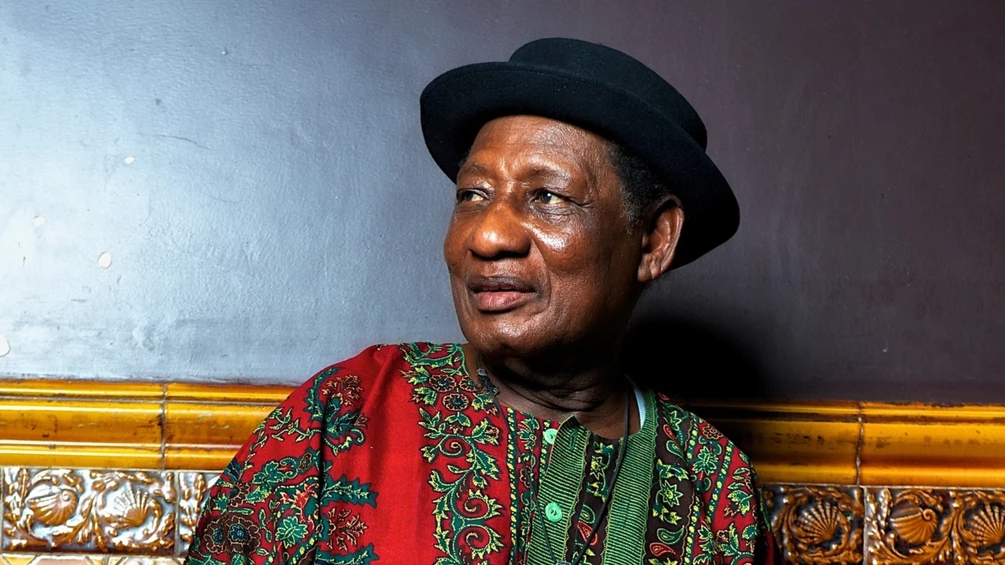
HangupsMusic.com – Accra, The global music community is mourning the loss of a foundational pillar of West African sound. Ebo Taylor, the legendary Ghanaian guitarist, composer, and arranger whose career spanned over seven decades, has passed away at the age of 90. The news was confirmed via a poignant announcement on his official social media channels on February 8, marking the end of an era for highlife and Afrobeat music. In a twist of fate that underscores his monumental status, Taylor’s passing occurred exactly one month after his 90th birthday and a mere twenty-four hours after the official launch of the Ebo Taylor Music Festival, an event designed to celebrate his lifelong contributions to the arts.
Born in the coastal city of Cape Coast in 1936, Ebo Taylor grew up in a Ghana that was on the precipice of seismic political and cultural shifts. Cape Coast, a hub of intellectual and musical exchange, provided the perfect backdrop for a young Taylor to absorb the sounds of traditional Fante music, colonial-era brass bands, and the emerging "palm-wine" guitar styles. By the late 1950s, Taylor had already established himself as a formidable talent on the Ghanaian highlife scene, a genre that fused indigenous rhythmic patterns with Western instrumentation like the guitar and trumpet.
Taylor’s trajectory took a decisive turn in the 1960s when he relocated to London to study music at the Eric Gilder School of Music. It was during this period that he formed a profound friendship and creative bond with Fela Kuti, who would later become the pioneer of Afrobeat. While in the UK, Taylor led the Starlight Highlife Band, a group that became a crucible for the "Black Star" sound. The interaction between Taylor and Kuti in the jazz clubs of London was transformative for both men. While Kuti would go on to develop the politically charged, polyrhythmic force of Afrobeat in Nigeria, Taylor returned to Ghana with a mission to modernize highlife by infusing it with the sophisticated harmonic structures of jazz and the rhythmic urgency of American funk and soul.
Upon his return to a post-independence Ghana, Taylor became a central figure in the recording industry. Throughout the 1970s, he served as an in-house arranger and producer for the influential Essiebons label, founded by Dick Essilfie-Bondzie. It was here that Taylor’s genius truly flourished. He wasn’t just a performer; he was an architect of sound, shaping the records of legendary artists like Pat Thomas and C.K. Mann. His own solo output during this decade, including his self-titled 1975 debut, showcased a unique "highlife-funk" hybrid. His guitar playing—characterized by clean, percussive lines and intricate interlocking patterns—became the gold standard for the genre.
The 1970s and 80s were a period of immense productivity for Taylor. Masterpieces such as "Twer Nyame" and the haunting "Love and Death" demonstrated his ability to blend existential themes with infectious grooves. "Love and Death," in particular, is often cited as one of the greatest compositions in African music history, featuring a slow-burning arrangement that allows Taylor’s vocals and guitar to weave a narrative of profound loss and spiritual resilience. His music was deeply rooted in the Fante culture of his upbringing, often incorporating traditional chants and proverbs, yet it possessed a universal appeal that transcended borders.
However, as the 1980s progressed and the political climate in Ghana shifted under successive military coups, the vibrant nightlife and recording industry that sustained highlife began to dwindle. For a period, Taylor’s international profile faded, though he remained a revered figure within Ghana. It wasn’t until the early 21st century that a new generation of music historians, DJs, and record collectors began to rediscover his extensive catalog. Labels such as Strut Records, BBE, Mr Bongo, and Comet Records played a pivotal role in this renaissance, reissuing his classic albums and introducing his work to a global audience that was hungry for authentic African sounds.
This resurgence led to a remarkable late-career bloom for Taylor. In his 70s and 80s, he returned to the international stage with renewed vigor. He began touring extensively across Europe, the Americas, and Asia, performing at major festivals and collaborating with contemporary musicians. His 2010 album Love and Death (a re-recording of his classic material) and 2012’s Appia Kwa Bridge were met with critical acclaim, proving that his creative fires had not dimmed with age. These later works were not merely exercises in nostalgia; they were vibrant, contemporary expressions of a man who remained a student of his craft until the very end.
Taylor’s influence extended deep into the world of electronic music and hip-hop as well. His grooves were frequently sampled by producers looking for the "perfect beat," and his tracks received high-profile remixes from electronic heavyweights like Ron Trent and Henrik Schwarz. These collaborations bridged the gap between the golden age of highlife and the modern dancefloor, ensuring that Taylor’s rhythms continued to move bodies in clubs from Berlin to Brooklyn.
Beyond the technical brilliance of his arrangements, Ebo Taylor was a cultural custodian. He was a living link to the era of decolonization, a time when music was a primary vehicle for African identity and pride. He often spoke about the importance of preserving the "highlife" name and the specific Ghanaian identity within the broader umbrella of African music. His commitment to his roots was evident in the way he mentored younger musicians in Cape Coast and Accra, always encouraging them to look to their own heritage for inspiration rather than simply imitating Western trends.
The timing of his passing, just as the Ebo Taylor Music Festival was being inaugurated, serves as a bittersweet reminder of his enduring impact. The festival was intended to be a living monument to his work, a space where the next generation of Ghanaian artists could showcase their talents under the banner of his legacy. While he did not live to see the festival reach its conclusion, his spirit undoubtedly permeated the event, serving as a guiding light for all in attendance.
Ebo Taylor’s death is not just the loss of a musician; it is the loss of a visionary who saw the potential for music to act as a bridge between cultures and eras. He took the traditional sounds of his ancestors and propelled them into the future, creating a body of work that is as relevant today as it was forty years ago. His guitar lines, characterized by their rhythmic precision and melodic grace, will continue to echo through the halls of music history.
As the news of his passing continues to ripple through the world, tributes have poured in from fellow musicians, historians, and fans. Many have noted his humility and his tireless dedication to his art. Even in his final years, Taylor could often be found with a guitar in his hands, still searching for that perfect chord progression or that elusive rhythmic pocket. He was a man who lived and breathed music, and in doing so, he enriched the lives of millions.
The legacy of Ebo Taylor will be preserved not only in the grooves of his records but in the continued vitality of the Ghanaian music scene he helped build. From the bustling streets of Accra to the prestigious stages of the world’s concert halls, the "Highlife Giant" has left an indelible mark. As we look back on his ninety years of life, we see a journey defined by curiosity, innovation, and an unwavering love for his culture. Ebo Taylor may have left the stage, but the music he composed will play on, a timeless testament to the power of the human spirit expressed through sound.
