
 By admin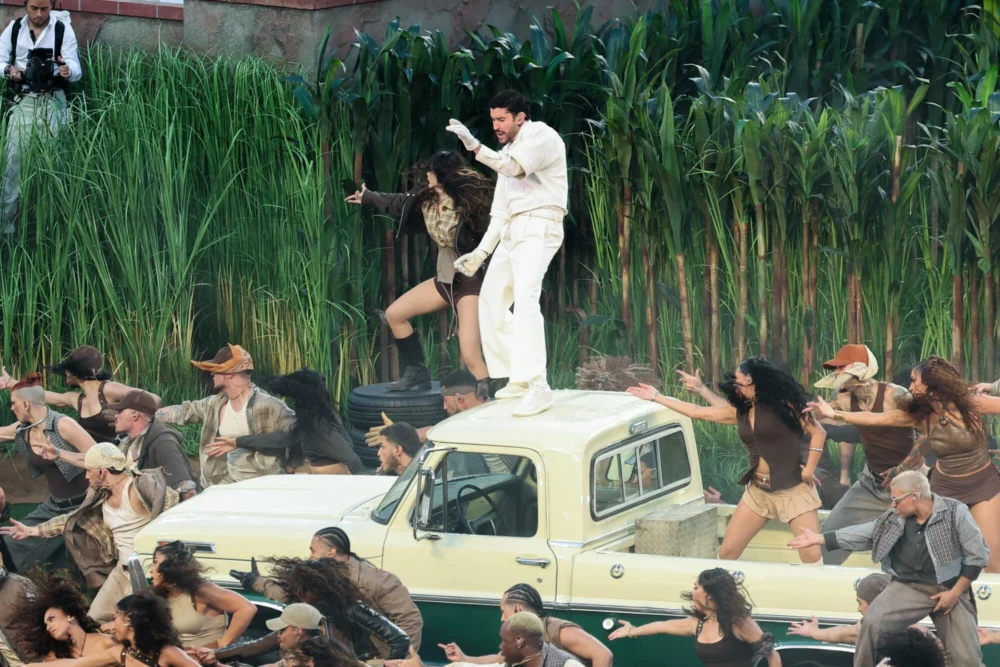
HangupsMusic.com – Santa Clara, California, In a monumental display of global stardom and cultural resonance, Benito Antonio Martínez Ocasio, universally known as Bad Bunny, delivered a Super Bowl LX halftime show that transcended mere entertainment, cementing his status as the "Greatest Pop Star of 2025" and igniting conversations across the music industry and beyond. Following a year of unprecedented triumphs, capped by a dominant showing at the Grammy Awards, the Puerto Rican trailblazer took to the grand stage at Levi’s Stadium, transforming the traditional American sporting event into a vibrant, unapologetically Latin-infused spectacle. His 13-minute performance, a whirlwind of sound, color, and profound cultural statements, left an indelible mark, garnering both widespread critical acclaim and significant, predictable controversy, proving that Bad Bunny remains at the epicenter of pop culture’s most compelling dialogues.
The journey to Super Bowl LX was, for Bad Bunny, a culmination of an extraordinary 2025, a year that saw him shatter streaming records, headline sold-out stadium tours across continents, and release critically acclaimed music that pushed the boundaries of reggaeton and Latin trap. His latest album, hypothetically titled El Universo en Mí, had dominated charts globally, earning him multiple Grammy Awards just days before his Super Bowl appearance. This remarkable run mirrored the trajectory of the previous year’s "Greatest Pop Star," Kendrick Lamar, who similarly transitioned from Grammy glory to Super Bowl halftime headliner. For Bad Bunny, however, the stakes felt even higher. He wasn’t just representing himself; he was a standard-bearer for an entire generation of Latin artists, bringing a cultural phenomenon to one of the world’s most watched stages.

As the lights dimmed and the roar of the crowd intensified, Bad Bunny emerged, not with a bang, but with a deliberate, almost spiritual opening that paid homage to his Caribbean roots. The stage, a colossal, multi-tiered structure bathed in neon hues and tropical foliage, became a canvas for his vision. He launched into a medley of his biggest hits, seamlessly blending the raw energy of early tracks like "Soy Peor" with the smooth, global appeal of "Tití Me Preguntó" and "Ojitos Lindos." His performance was a masterclass in dynamic stage presence, moving with a swagger that was both confident and inviting, backed by a troupe of dancers whose choreography wove traditional Latin styles with contemporary street dance.
The "historically rich and unmistakably timely" nature of his show was evident in every detail. Visually, the performance was a vibrant tapestry, incorporating elements from Puerto Rican folklore, street art, and the island’s natural beauty. Aurally, it was a testament to the genre’s evolution, showcasing how Latin rhythms have permeated global pop. Midway through, the stage transformed into a pulsating dance hall, and the first surprise guest, Lady Gaga, appeared, joining Bad Bunny for an electrifying rendition of "Dákiti" infused with her signature theatricality. Her unexpected fluency in Spanish for a segment sent ripples of excitement through the audience. Later, the legendary Ricky Martin brought a wave of nostalgia and pure pop exhilaration, delivering a high-octane performance of "Livin’ la Vida Loca" that intertwined with Bad Bunny’s newer sounds, bridging generations of Latin music dominance. In a truly unique moment, amidst a more reflective segment featuring a romantic ballad, a real-life couple was spotlighted on one of the stage’s lower tiers, exchanging vows in a brief, intimate ceremony, symbolizing love and unity amidst the spectacle – a spontaneous, heartwarming touch that instantly went viral.
Post-performance, the reviews poured in, largely praising the spectacle’s audacity and cultural significance. Critics lauded Bad Bunny for delivering a show that was both deeply personal and universally appealing, an "unapologetic celebration of Latin culture" that defied expectations. His charisma, the seamless transitions, and the electrifying guest appearances were highlighted as major successes. Many saw it as a powerful statement on representation, a moment where Latin music truly took its rightful place at the pinnacle of global entertainment. The meticulous integration of visual storytelling and musical evolution underscored his artistic prowess.
However, as with any artist who dares to challenge the status quo on such a massive platform, a significant backlash quickly materialized. Even before the performance, conservative voices and some segments of the mainstream media expressed skepticism, questioning whether a non-English-speaking artist should headline the quintessentially American event. Following the show, criticisms ranged from complaints about the Spanish-language lyrics being inaccessible to some viewers, to accusations of the performance being "too political" – a common, often thinly veiled critique leveled against artists of color who dare to express their identity or cultural perspective. This led to the widely reported "alternative halftime show" aired by Turning Point, a conservative organization, which offered a performance featuring country and rock artists, explicitly positioned as a "traditional American" counter-narrative to Bad Bunny’s innovative display. This stark dichotomy underscored the growing cultural polarization in the United States, positioning Bad Bunny’s performance as a flashpoint in a broader cultural war.
Despite, or perhaps because of, the controversy, Benito Antonio Martínez Ocasio found himself at the epicenter of every major discussion surrounding Super Bowl LX. His performance, by all accounts, overshadowed the actual football game, which many commentators deemed underwhelming. This unparalleled visibility is poised to translate into significant commercial gains. Industry analysts predict an imminent surge in Bad Bunny’s catalog streams and sales, likely propelling his albums and singles back to the top of the Billboard charts. The race for the Billboard Hot 100 next week is already being hotly debated, with many anticipating a direct showdown between Bad Bunny and perennial chart-topper Taylor Swift, whose own new release was making waves.
The morning after, on a bonus episode of Billboard’s "Greatest Pop Stars" podcast, host Andrew Unterberger and Billboard’s Emily Fuentes delved deep into the performance’s nuances. They discussed what worked – the undeniable energy, the cultural pride, the smart use of guest stars – and what might have been missed opportunities, such as the absence of a single, easily digestible "viral moment" akin to Kendrick Lamar’s iconic "Say Drake" from the previous year. While Bad Bunny’s show delivered spectacle, it focused more on a continuous flow of cultural immersion rather than a singular, meme-worthy utterance. The hosts debated whether the balance between his older, more raw material and his newer, more polished tracks was perfectly struck, and how the unconventional inclusion of the "IRL wedding couple" added to or detracted from the overall artistic statement. They also explored the validity of the criticisms and the reasoning behind the alternative halftime show, acknowledging the deep cultural divides it represented. Ultimately, the consensus was clear: Bad Bunny’s Super Bowl LX halftime show was more than just entertainment; it was a cultural event that solidified his unparalleled global influence and ensured his reign as a true pop icon would continue to shape the industry for years to come.
