
 By admin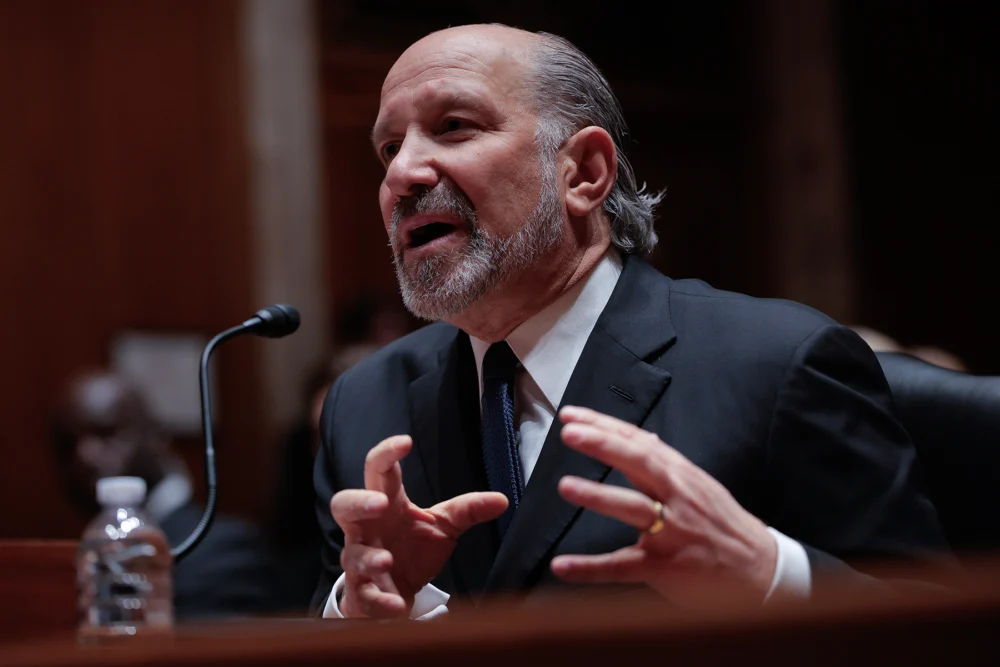
HangupsMusic.com – Washington, D.C. – A meticulously crafted narrative of disassociation by Howard Lutnick, a prominent figure in finance and a potential cabinet member for a future Trump administration, has been profoundly challenged by a recent tranche of Justice Department emails. These documents cast a starkly different light on Lutnick’s interactions with the notorious convicted sex offender Jeffrey Epstein, directly contradicting his emphatic public statements regarding his minimal contact with the disgraced financier. The revelations have ignited a fierce debate over Lutnick’s credibility, his fitness for high office, and the broader implications for public trust.
Lutnick, known for his robust leadership as CEO of Cantor Fitzgerald, had previously offered a vivid and seemingly definitive account of his relationship with Epstein. In an October interview with the New York Post, he recounted a chilling first encounter in 2005. Having recently moved into a property adjacent to Epstein’s infamous Upper East Side townhouse, Lutnick and his wife accepted an invitation for coffee next door. His description painted a picture of immediate repulsion: upon entering, they were met with a scene featuring a massage table prominently displayed in the living room, surrounded by candles. Lutnick recalled asking Epstein about the massage table, to which Epstein allegedly responded, "every day," followed by a disquietingly intimate whisper about "the right kind of massage." This interaction, Lutnick asserted, was so profoundly disturbing that he and his wife made an immediate, resolute decision.
"In the six or eight steps it takes to get from his house to my house, my wife and I decided that I will never be in the room with that disgusting person ever again," Lutnick declared unequivocally in the interview. He further insisted, "So I was never in the room with him, socially for business or even philanthropy. If that guy was there, I wasn’t going because he’s gross." This statement created a clear boundary, portraying Lutnick as a man who recognized and recoiled from Epstein’s predatory aura from the very outset, maintaining an unbreachable distance thereafter. His narrative positioned him as someone acutely sensitive to moral red flags, a quality often valued in public servants.
However, the carefully constructed image began to unravel with the Justice Department’s release of emails earlier this month. Among the multitude of documents, one particular email stood out, suggesting an interaction that directly contravened Lutnick’s public oath. This email indicated that Lutnick, along with his wife, their four children, nannies, and another family, had dined with Epstein at his private residence on Little St. James island in 2012. Crucially, this visit occurred several years after Epstein had already been convicted in 2008 of procuring a child for prostitution and soliciting a prostitute, a detail that significantly escalates the gravity of the association.
Confronted with this evidence during a Senate Appropriations Committee hearing, Lutnick confirmed the incident. "I did have lunch with him as I was on a boat going across on a family vacation," he testified. He reiterated the presence of his wife, children, and nannies, adding, "I had another couple with their children. And we had lunch on the island. That is true. For an hour. And we left with all of my children." While confirming the event, Lutnick simultaneously sought to minimize its significance, insisting he "did not have any relationship" with Epstein and "barely had anything to do with that person." This explanation, however, struggled to reconcile with the explicit "never again" vow he had so dramatically presented just months prior. The narrative shifted from an absolute avoidance to a seemingly casual, hour-long family lunch on the private island of a convicted sex offender.
The revelations did not stop at the 2012 island lunch. The extensive trove of emails contained dozens of references to Lutnick, painting a picture of far more frequent and varied interactions than he had publicly acknowledged. These documents detailed consistent coordination between Lutnick, Epstein, and their respective assistants over several years, explicitly arranging phone calls in 2009 and 2011—again, both dates falling after Epstein’s initial conviction. Further evidence indicated plans for Lutnick and Epstein to meet for drinks at Epstein’s home in May 2011, suggesting a social engagement beyond mere incidental contact.
Perhaps most damagingly, the emails revealed that Epstein contributed financially to a 2017 event honoring Lutnick, implying a level of mutual recognition and support that belied Lutnick’s claims of disengagement. In a further display of what appeared to be a reciprocal relationship, Lutnick himself invited Epstein in 2015 to what was described as an "intimate" fundraising event for then-presidential candidate Hillary Clinton. These interactions spanned over a decade, crossing social, professional, and even political boundaries, all occurring well after Lutnick’s professed moment of profound revulsion and his public commitment to total avoidance. The sheer volume and nature of the correspondence suggest an ongoing, if perhaps not deeply personal, connection that far exceeded the "two or three times over a decade" that Lutnick now claims for in-person meetings.
The political fallout has been swift and sharp. Senator Chris Van Hollen (D-Md.) articulated the core of the criticism during the Senate hearing, stating, "The issue is not that you engaged in any wrongdoing in connection with Jeffrey Epstein, but that you totally misrepresented the extent of your relationship with him to the Congress, to the American people and to the survivors of his despicable criminal and predatory acts." Van Hollen emphasized the profound breach of trust, reminding Lutnick of his earlier unequivocal pledge: "You told us when you first encountered Epstein in 2005, you vowed never to step foot in the same room with him again. You had interactions with Epstein over the next 13 years, long after he was convicted in 2008. That calls into question your fitness for the job you hold."
The outcry has transcended partisan lines, with calls for Lutnick’s resignation emerging from both sides of the political spectrum. Representative Thomas Massie (R-Ky.), in a weekend interview with CNN, suggested that Lutnick should "make life easier on the president, frankly, and just resign." Massie drew parallels to political accountability in other nations, noting, "I mean, there are three people in Great Britain that have resigned in politics," highlighting a perceived lack of similar accountability in the United States. Such bipartisan criticism underscores the gravity of the perceived misrepresentation, particularly when it involves association with a figure as universally condemned as Jeffrey Epstein.
However, Lutnick’s allies have rallied to his defense. House Speaker Mike Johnson (R-La.) dismissed the calls for resignation as "absurd." Johnson lauded Lutnick’s professional contributions, stating, "He’s done an extraordinary job for the country," and advised Massie and others to "stop playing political games." This defense suggests a strategic attempt to insulate Lutnick from the controversy, emphasizing his professional merits over the discrepancies in his personal narrative. Yet, for many, the issue is not Lutnick’s professional competence but his candor and integrity in the face of public scrutiny regarding a deeply unsettling association.
The ongoing saga surrounding Howard Lutnick and Jeffrey Epstein serves as a potent reminder of the enduring public fascination and revulsion surrounding the disgraced financier. Any association with Epstein, however tangential, is now subject to intense scrutiny, and any perceived dishonesty about such ties carries significant political and reputational risk. For public figures, transparency regarding past relationships, particularly those involving individuals of Epstein’s notoriety, is paramount. The unfolding events raise fundamental questions about the standards of truthfulness expected from those in or aspiring to high office, and how such discrepancies impact public confidence in the integrity of government. As the full extent of the email revelations continues to be absorbed, the pressure on Howard Lutnick and the Trump camp to provide a more coherent and truthful account of his past interactions with Jeffrey Epstein is unlikely to abate. The narrative has indeed unraveled, and the consequences remain to be fully seen.
