
 By Azzam Bilal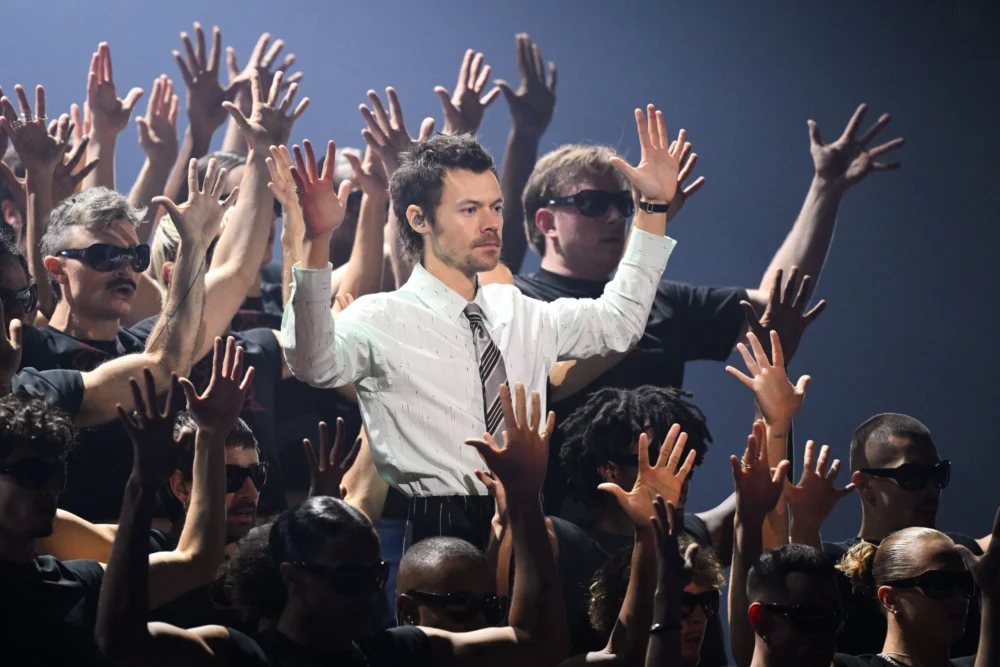
HangupsMusic.com – Manchester, The landscape of British music found its center of gravity on February 28, as the 2026 BRIT Awards took over the state-of-the-art Co-op Live Arena in Manchester. Moving away from its traditional London roots, the ceremony embraced a Northern energy, marking a significant shift for the UK’s most prestigious musical honors. For the sixth consecutive year, the proceedings were guided by the sharp-witted comedian Jack Whitehall, whose familiar blend of irreverence and enthusiasm provided the connective tissue for a night defined by historic wins, avant-garde performances, and a celebration of both legacy and the new guard.
The evening’s undeniable protagonist was Olivia Dean. The BRIT School alumna, who recently garnered international acclaim at the Grammys, solidified her status as the current queen of British pop with a commanding four-trophy sweep. Dean’s triumphs included the night’s most coveted honors: Artist of the Year and Album of the Year for her celebrated project, The Art of Loving. She also secured the award for Best Pop Act and shared the Song of the Year title with Sam Fender for their collaborative effort, "Rein Me In."
Dean’s performance was a masterclass in stage presence and soulful delivery. Set against a vibrant, pink sequined backdrop emblazoned with the word "Loving," she delivered a soaring rendition of "Man I Need." Accompanied by a full band that featured a powerhouse three-piece brass section, Dean’s performance felt less like an awards show segment and more like a triumphant homecoming celebration. The sheer joy radiating from the stage served as a testament to her rapid ascent from a rising talent to an industry titan.
The ceremony opened with a high-concept performance by global icon Harry Styles. Marking the first live appearance of his new era, Styles performed "Aperture," the lead single from his highly anticipated album, Kiss All The Time. Disco, Occasionally. Eschewing his more flamboyant past costumes for a sophisticated ensemble of high-waisted pinstripe trousers, a crisp dress shirt, and a tie, Styles leaned into a mature, electropop aesthetic. The performance was a slow-burn spectacle, beginning with Styles center-stage before expanding to include a troupe of dancers in casual streetwear and sunglasses. As the song reached its synth-heavy crescendo, a choir and live band joined in, elevating the track to anthemic proportions. The set concluded with a stylized "cool-down" choreography, featuring jazz hands and rhythmic shoulder shakes that left the audience in raptures.
Styles’ presence loomed large throughout the night, even beyond his opening number. Host Jack Whitehall leaned into the "Stylers" fandom with several pre-recorded skits, including one where he portrayed a distraught fan weeping with relief outside the singer’s dressing room. Another recurring bit saw Whitehall dodging a pursuer meant to mirror a character from the "Aperture" music video, keeping the pop star’s influence woven into the fabric of the broadcast despite Styles not being up for individual awards this cycle.
In a moment of significant historical weight, the BRITs honored PinkPantheress as the 2026 Producer of the Year. This win was a milestone for the organization, as she became both the youngest individual and the first woman to ever receive the accolade. The award recognizes her unique sonic fingerprint—a blend of jungle, drum and bass, and hyper-pop—that has reshaped the sound of the British charts over the last two years. Her win signaled a long-overdue recognition of female technical expertise in the recording studio.
The "Outstanding Contribution to Music" award was presented to Mark Ronson, a figure whose career has bridged the gap between underground cool and global chart dominance. The tribute began with a star-studded video montage featuring testimonials from the likes of Christina Aguilera and Q-Tip. Ronson then took the stage for a sprawling retrospective of his career. He started behind the turntables, spinning "Ooh Wee" alongside Ghostface Killah, before moving to the grand piano for a poignant tribute to the late Amy Winehouse.
As Ronson played the opening chords of "Back to Black" to an isolated vocal track of Winehouse, the arena fell into a respectful hush. In his acceptance speech, Ronson was visibly moved, noting that his work with Winehouse was the foundation of his entire career. "I always treasure her voice, her talent, and our bond," he remarked. The set then shifted gears into a high-energy celebration, featuring the Dap-Kings for "Valerie" and "Uptown Funk." The segment was punctuated by a surprise appearance from Dua Lipa, who descended from the rafters on a massive disco ball. Clad in a luxurious fur coat, she performed a medley of her Ronson-produced hits, including "Dance the Night Away" and "Electricity," eventually lounging atop Ronson’s piano with a martini to close out the set.
The international segment of the night highlighted the global reach of modern pop. Alex Warren, whose ballad "Ordinary" has become a juggernaut on the Billboard charts and streaming platforms, delivered a grand-scale performance of the hit. Accompanied by a full symphony orchestra and James Blunt on the grand piano, Warren’s vocal performance aimed for maximum emotional impact. Despite the song’s ubiquity, the live arrangement breathed new life into the ballad, ending with a personal shout-out to his wife that charmed the Manchester crowd.
Similarly, the trio of Ejae, Audrey Nuna, and Rei Ami brought the energy of their KPop Demon Hunters project to the stage. Their performance of "Golden" was met with deafening cheers from the younger demographic in attendance. While they narrowly lost the International Song of the Year award to Bruno Mars and Rosé’s "APT," the trio’s performance served as a victory lap for a song that has become a cultural phenomenon and is currently a frontrunner for an Academy Award.
One of the night’s most talked-about moments came from Rosalía, who made her BRITs debut with a performance of "Berghain," the lead single from her album LUX. The stage was transformed into a reimagining of the famous Berlin techno club, complete with an operatic choir and a full orchestra. In a rare and stunning appearance, Icelandic legend Björk joined Rosalía on stage to perform her guest verse. The performance eventually dissolved into a dark, pulsing rave, with heavy hard-techno bass vibrating through the arena. Jack Whitehall perfectly captured the sentiment of the room afterward, describing the set as "epic" and a fusion of "every genre of music in one song."
The alternative scene was well-represented by Wolf Alice, who took home the Group of the Year award. Lead singer Ellie Rowsell used her acceptance speech to advocate for grassroots music venues, the very spaces where the band honed their craft. Their performance of "The Sofa" was a visual treat, set in a meticulously designed 1970s-style living room. The choreography involved dancers emerging from the furniture, eventually carrying Rowsell across the stage in a dreamlike sequence that matched the song’s atmospheric rock sound.
Raye also delivered a standout vocal performance, further cementing her reputation as one of the UK’s premier live vocalists. Backed by a string section and two vocalists, she performed a slowed-down, soulful version of "Where Is My Husband!" before transitioning into the debut of her new single, "Nightingale Lane." Both tracks are set to appear on her upcoming album, This Music May Contain Hope, scheduled for release on March 27. Raye, a former Song of the Year winner, showed a level of vocal control and emotional depth that suggested she remains at the peak of her powers.
The evening concluded with a high-energy set from Sombr. Dressed in a metallic pink suit, he performed a two-song medley from his debut album I Barely Know Her. The set featured a choreographed "interruption" where a man in a "Sombr Is A Homewrecker" t-shirt appeared to force the singer off-stage, a theatrical bit later confirmed to be a staged part of the performance. As a wall of streamers fell, Sombr transitioned into "Back to Friends," ending the night on a high-octane note.
As the lights dimmed on the Co-op Live Arena, the 2026 BRIT Awards left an impression of an industry in transition—one that is increasingly diverse, technically innovative, and unafraid to move its center of gravity to celebrate the talent emerging from every corner of the United Kingdom. With Olivia Dean leading the charge and veterans like Mark Ronson providing the blueprint, the future of British music appears both respectful of its past and boldly committed to its future.
