
 By Azzam Bilal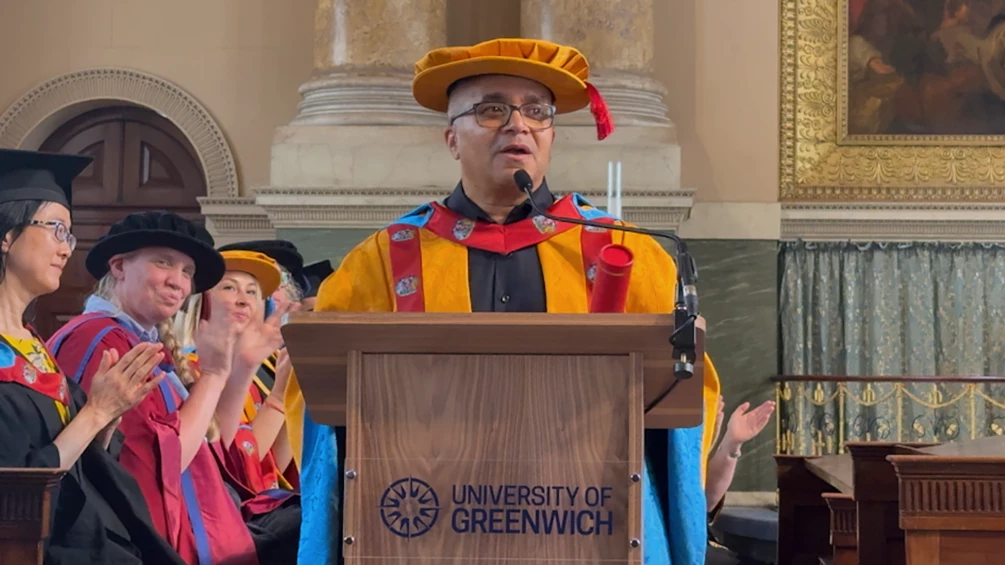
HangupsMusic.com – London, In a landmark moment for the preservation of British underground culture, Brian Johnson—the producer and DJ globally recognized as Bizzy B—has been awarded an honorary doctorate by the University of Greenwich. The ceremony, held in the historic surroundings of the university’s campus, serves as a formal academic validation of a career that has spanned nearly forty years, during which Johnson acted as a primary architect for the UK’s hardcore and jungle movements. The distinction recognizes not only his prolific output as a musician but also his tireless efforts in education, cultural documentation, and the technical advancement of electronic music production.
Johnson’s journey from the burgeoning rave scenes of the late 1980s to the hallowed halls of academia represents a significant shift in how the United Kingdom views its homegrown electronic heritage. For decades, the breakbeat-led genres of hardcore and jungle were often sidelined by mainstream institutions, viewed as ephemeral subcultures born of urban grit and illegal parties. However, the University of Greenwich’s decision to honor Johnson highlights a growing realization that these genres are essential pillars of modern British art. The award specifically cites his "contribution to the UK’s underground electronic music scene" and his ongoing commitment to supporting the "history and heritage" of the culture through various educational and cultural initiatives.
Taking to social media to reflect on the achievement, Johnson described the conferment as "one of the proudest days of my life." In a poignant address to his followers on Instagram, he emphasized the collective nature of the honor. "I was deeply honored to receive an Honorary Doctorate from the University of Greenwich in recognition of my contribution to music and culture," he wrote. "This honor belongs not just to me, but to everyone I’ve worked with over the past 35 years. Thank you to the University, my family, friends, and the incredible community that made this journey possible." He further noted that the day was one he "never imagined" would come, promising to share his full acceptance speech with the public in the coming days.
The roots of Johnson’s influence can be traced back to the early 1990s when he founded Brain Records. As a label, Brain Records became a crucible for the "darkcore" sound, a precursor to jungle that merged heavy breakbeats with ominous basslines and intricate sampling. Bizzy B’s production style was characterized by a level of technical complexity that earned him the nickname "The Scientist" among his peers. While many producers were content with simple loops, Johnson pushed the boundaries of what was possible with limited hardware, utilizing Commodore Amiga computers and early sampling technology to create rhythms that were both chaotic and mathematically precise.
This technical mastery is a cornerstone of his legacy. In an era before modern Digital Audio Workstations (DAWs) made music production accessible to the masses, Johnson was a pioneer of "tracker" software. This method of composition required a deep understanding of hexadecimal code and a meticulous approach to sample manipulation. By honoring him, the University of Greenwich is acknowledging the intellectual rigor required to innovate within these constraints—a form of "street-level engineering" that fundamentally altered the DNA of global electronic music.
The relationship between Johnson and the University of Greenwich is not a new development. Earlier in 2024, the institution hosted a comprehensive exhibition titled "Trackers & Breakbeats: Celebrating Brain Records’ Underground Revolution." The showcase served as a deep dive into the label’s history, documenting its rise from a local London operation to an international influence. The exhibition featured rare archival material, equipment from the era, and detailed breakdowns of the production techniques Johnson pioneered. It provided a scholarly framework for understanding how Brain Records utilized early computer technology to create a new sonic language, effectively bridging the gap between the DIY ethos of the rave scene and the formal study of music technology.
Beyond his historical contributions, Johnson has spent the last several years transforming himself into one of the scene’s most vital educators. Through his YouTube channel, "TheBizzyBScience," he has uploaded over 1,000 videos that serve as a living archive of electronic music production. These videos range from tutorials on how to recreate classic "Amen break" chops to deep dives into the history of specific hardware units like the Akai S950 sampler. By sharing his "secret sauce" with the next generation of producers, Johnson has ensured that the techniques of the 1990s are not lost to time but are instead integrated into modern production workflows. This commitment to open-source knowledge is a rare trait in an industry often guarded by gatekeepers, making his academic recognition even more fitting.
The honorary doctorate also reflects a broader trend within the UK’s higher education system to honor contemporary musical icons who have shaped the national identity. Just last year, the University of Kent awarded a similar honor to PinkPantheress, recognizing her role in bringing drum and bass and jungle influences to a new, younger demographic through social media and chart-topping hits. However, where PinkPantheress represents the contemporary fruit of these genres, Bizzy B represents the roots. By honoring the pioneers alongside the new stars, universities are helping to construct a complete narrative of British musical evolution.
The impact of Bizzy B’s work extends far beyond the dancefloor. Jungle and hardcore were more than just genres; they were social movements that brought together diverse communities during a period of significant social and political change in the UK. The "Brain Records" sound was a product of multicultural London, blending reggae’s bass culture with the frantic energy of breakbeat and the futuristic aspirations of techno. Johnson’s role in this synthesis cannot be overstated. He helped define a sound that was uniquely British, yet globally resonant, influencing everything from US hip-hop production to modern pop music.
As the news of his doctorate spread, tributes poured in from across the electronic music spectrum. Peers, former collaborators, and fans pointed to his humility and his relentless work ethic as qualities that made him a deserving recipient. For many in the jungle community, this award feels like a victory for the entire scene—a sign that the music they fought to keep alive in the face of police crackdowns and media stigmatization has finally earned its place in the annals of high culture.
Looking forward, the University of Greenwich and Johnson appear set to continue their collaboration. The success of the "Trackers & Breakbeats" exhibition and the formalization of his doctoral status suggest that more academic projects may be on the horizon. There is a growing appetite for the formal documentation of rave history, with archives, oral histories, and technical analyses becoming increasingly common in university curricula. Johnson, with his dual experience as a frontline creator and a digital educator, is uniquely positioned to lead this charge.
In his acceptance, Johnson’s message was one of gratitude and persistence. His journey from a teenager experimenting with samplers in a bedroom studio to a Doctor of the University of Greenwich serves as an inspiration to independent artists everywhere. It is a testament to the power of staying true to one’s craft, even when that craft is misunderstood by the mainstream. As he continues to upload "TheBizzyBScience" videos and curate the legacy of Brain Records, Dr. Brian Johnson remains a pivotal figure in the ongoing story of British sound—a scientist of the breakbeat whose work has finally received the institutional acclaim it deserves.
