
 By admin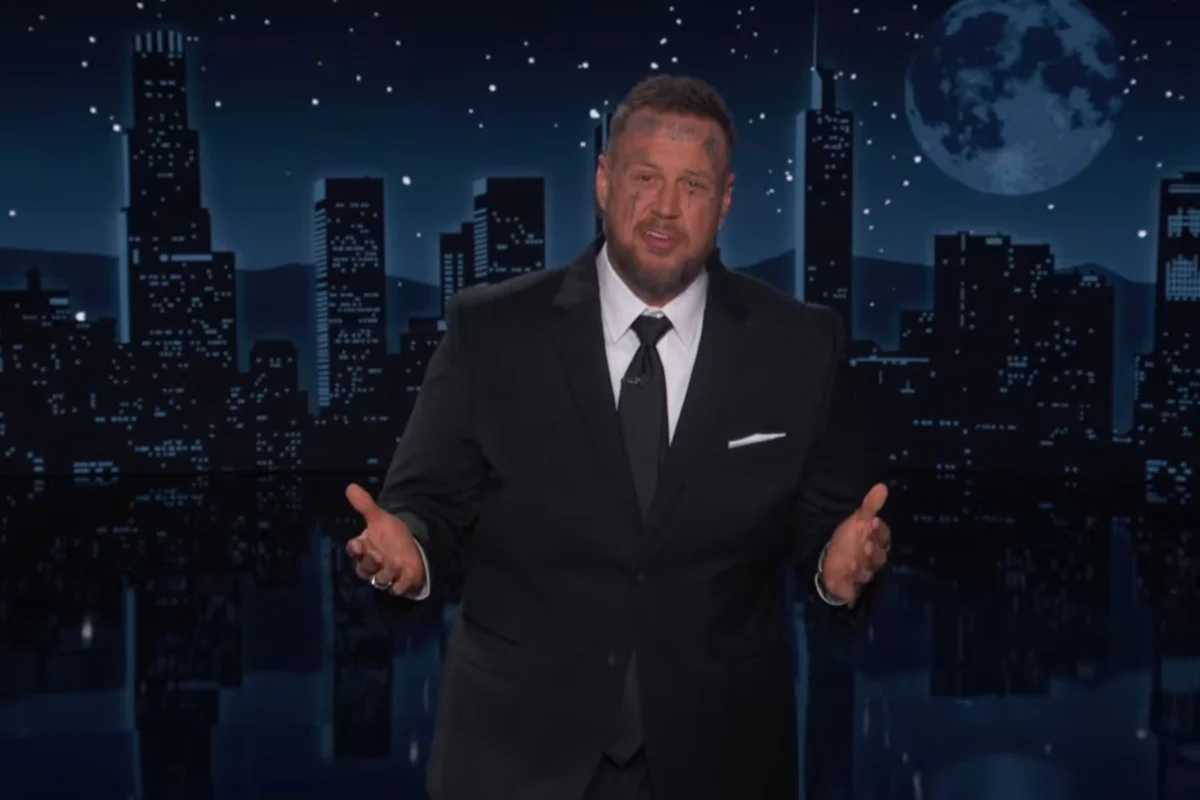
HangupsMusic.com – As his week-long tenure as guest host of Jimmy Kimmel Live drew to a close, country music sensation Jelly Roll delivered a profoundly personal and impassioned monologue, finally addressing the swirling speculation surrounding his political leanings. The performance, raw with emotion and candid introspection, served as a powerful platform for the artist to reclaim his narrative and advocate for unity in an increasingly polarized world.
The anticipation had been building for months. Back in February, during the high-profile Grammy Awards, Jelly Roll found himself in a spotlight that transcended his musical achievements. Having just received multiple accolades, a reporter posed a question about his political stance. At the time, he demurred, stating a need for more time to articulate his thoughts, promising a comprehensive statement within the following week. That immediate declaration, however, went unfulfilled, leaving fans and commentators to wonder when and how the outspoken musician would eventually weigh in on such a sensitive topic.
Throughout his recent week-long guest-hosting stint on the popular late-night show, the artist engaged in lighthearted banter and observational humor, often taking playful jabs at former President Donald Trump and his administration. These comedic segments, while characteristic of late-night television, quickly ignited a firestorm of speculation across social media and various news outlets. Many attempted to categorize him, oscillating between labeling him a staunch supporter or an unexpected critic, thereby intensifying the pressure for a definitive statement.
Addressing these conjectures head-on during his final monologue, Jelly Roll humorously dispelled notions that his jokes were dictated by a team of unseen writers. With his characteristic blend of self-deprecating wit and earnestness, he asserted his autonomy, proclaiming that he was merely "telling it like it is." He quipped that his recent physical transformation, marked by significant weight loss, perhaps allowed people to finally perceive his courage and conviction. He then highlighted the irony of the public’s perception, noting how swiftly he transitioned from being perceived as a "MAGA" adherent to a "liberal snowflake" based on a few jokes.
The musician then took a moment to clarify his multifaceted identity, portraying himself as someone who defies simple categorization. While acknowledging that he "leans left on some things," he emphasized his fundamental position as "pretty down the middle." He described himself as a Christian, a country music singer, a farmer, and a bow hunter—a man deeply connected to traditional values and a self-sufficient lifestyle, preferring to procure his sustenance through "a stick and a string." This nuanced self-portrait aimed to dismantle preconceived notions often associated with artists in the country music genre.
He explained that while the experience of guest-hosting Jimmy Kimmel Live had been thoroughly enjoyable, his primary motivation for taking the stage was to use the platform to "get some very personal stuff off my chest." For the past half-year, he lamented, he had observed others constructing his identity, beliefs, and allegiances. This sense of being misjudged was only amplified during his hosting week, merely by telling a few jokes. He traced this frustration back to the Grammy night, recalling the profound joy of winning his first, then three, awards—a childhood dream realized—only to be immediately confronted with a demand for a political stance.
Jelly Roll admitted to fumbling his words under pressure that night, a moment he now viewed with a mix of understanding and regret. While he didn’t necessarily regret asking for time to reflect, advocating for more deliberate speech from everyone, he wished he had found the courage to articulate his true feelings sooner. He expressed his apprehension that any statement he made would inevitably be politicized. The ultimate irony, he observed, was that "by trying so hard not to make a political statement, I became one." He revealed that he had spent his entire career deliberately avoiding affiliation with any political party, partly because, until March of this year, he had been disenfranchised. Now, with the right to vote restored, he pledged to exercise it in the upcoming November elections.
Though he refrained from endorsing any specific party, Jelly Roll articulated a broader mission: to amplify the voices of "those without representation." He deeply regretted not seizing the Grammy moment to speak for "people who were scared, hurting, and felt like nobody was speaking for them." His voice thick with emotion, he shared a poignant lesson from his father: "it is never too late to do the right thing." With tears welling, he declared a universal truth: "human dignity isn’t Republican nor Democrat. Compassion isn’t left wing and mercy isn’t right wing. Pain and healing knows no partisanship. Hurting hearts are more important than poll numbers and there are no boundaries or borders for broken families."
He proudly identified himself as "a man of second chances," attributing his transformative journey to the opportunities afforded by America. This deeply personal reflection led to a powerful call for inclusivity: "The American Dream can’t just be for people like me." He passionately argued that essential values such as "second chances, grace, dignity, opportunity, redemption, empathy, decency, and hope" should not be exclusive but universally accessible, asserting that "The American Dream should be for everybody."
In a testament to his nuanced perspective, Jelly Roll also addressed his willingness to shake the hand of any U.S. president, regardless of political affiliation. Rooted in his profound respect for his veteran father and all who serve in the military, he explained that his father would have expected nothing less. He expressed pride in having shaken the president’s hand, juxtaposing it with his pride in living in a country where he could also freely joke about its leader. He made it unequivocally clear: "a handshake is not an endorsement," "a conversation is not an allegiance," and crucially, "a joke is not a political point of view."
Concluding his heartfelt address, Jelly Roll shared a touching anecdote about his late father, a "blue back Democrat," and his uncle, a "red hat Republican," who despite their political differences, remained the absolute best of friends. His father taught him that they agreed on hundreds of things, differing only on a few. This personal story underscored his ultimate message: "Politicians and algorithms make an absolute fortune convincing us that the person across the street from us is the reason our life is hard." He urged his audience to look beyond partisan divisions and remember a fundamental truth: "the person across the street is a human being before they’re a voter." Jelly Roll’s monologue was not just a clarification of his own views, but a heartfelt plea for a return to empathy, understanding, and shared humanity in a fragmented society.
