
 By Azzam Bilal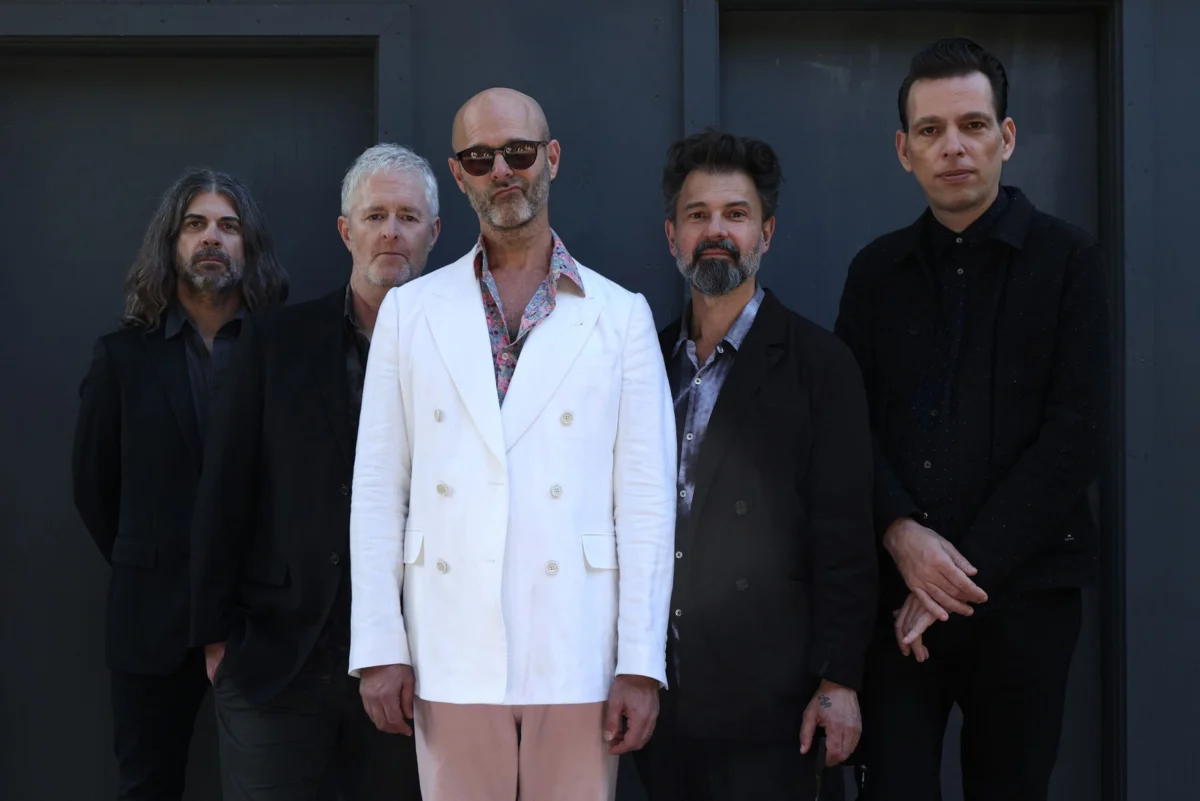
HangupsMusic.com – In a move that bridges a multi-decade gap in their discography, the seminal post-hardcore outfit Shudder to Think has officially announced the upcoming release of a new EP titled Who Sent You?. Scheduled to arrive on September 11, the three-track project represents a significant milestone for a band that has long been celebrated for its idiosyncratic approach to rock music, blending operatic vocals, complex rhythmic structures, and a theatrical sensibility that defied the genre conventions of their era. The announcement of the EP is accompanied by the immediate release of its title track, offering listeners a first glimpse into the band’s contemporary creative direction.
The release of Who Sent You? serves as a substantial follow-up to the surprise 7-inch single the quintet issued earlier in 2025. That single marked the group’s first new recorded material in nearly thirty years, reigniting interest in a catalog that has remained influential among musicians and critics alike since the band’s initial peak in the 1990s. While the 2025 single proved the band still possessed its signature chemistry, the new EP promises a deeper exploration of their current sound, packaged in a concise but potent three-song format.
Vocalist Craig Wedren, whose distinct falsetto and dramatic delivery have always been the centerpiece of Shudder to Think’s identity, provided context for the EP’s conceptual origins in a statement released alongside the news. Wedren described the title track as a deeply personal reflection on his formative years, specifically his adolescence in Cleveland, Ohio, during the 1980s. This period immediately preceded his relocation to Washington, D.C., the city where Shudder to Think would eventually coalesce and find its footing within the legendary Dischord Records scene.
Wedren’s description of the track paints a vivid picture of youthful restlessness, characterized by what he calls "outsized emotions." He characterizes the experience of his younger self as a mix of being "young, horny, [and] bored," capturing the universal friction of teenage life in a midwestern industrial city. However, the song is not merely a linear narrative; Wedren views it as a "collage of memories" that have been "refracted through the prism of time." This suggests that the music of Who Sent You? functions as a dialogue between the artist’s current perspective and his past experiences, a theme that resonates strongly with a band returning to the studio after three decades of silence.
The thematic weight of the EP extends beyond simple nostalgia. Wedren characterizes the project as a "nocturnal thank you," an homage to the various influences—both tangible and ethereal—that shaped his journey. He cites a wide array of inspirations, ranging from family and friends to the "invisible hands" and "angels and devils" that guided his path toward a life in music. The rhetorical question posed by the title, "Who Sent You?", acts as a metaphysical inquiry into the origins of inspiration and the serendipitous events that lead a person from a bored teenage existence in Cleveland to the forefront of an avant-garde musical movement.
The tracklist for the EP is concise, featuring the title track "Who Sent You?", followed by "Something To Do" and "Release The Ball." While the band has not yet detailed the specific sonic qualities of the latter two tracks, the titles themselves hint at a continuation of the band’s tradition of blending mundane observations with abstract, often surrealist imagery. Shudder to Think has always occupied a unique space in the post-hardcore landscape; while they emerged from the same D.C. underground that produced Fugazi and Jawbox, their music leaned heavily into art-rock and glam influences, often drawing comparisons to David Bowie or Queen, albeit filtered through a gritty, independent lens.

The timing of the EP release is strategically aligned with a series of live performances scheduled for this September. The band is set to take the stage in three of the nation’s primary cultural hubs: Los Angeles, New York, and Philadelphia. These shows are highly anticipated, as they offer a rare opportunity for both long-time fans and a newer generation of listeners to experience the band’s intricate arrangements and Wedren’s commanding stage presence in a live setting. Given the technical complexity of Shudder to Think’s music—often involving shifting time signatures and non-linear melodic paths—the transition of this new material to the stage will be a point of particular interest for the music community.
The resurgence of Shudder to Think in 2025 is part of a broader narrative of legacy acts finding new relevance in a modern digital landscape. For much of the late 90s and early 2000s, the band members focused on individual pursuits. Craig Wedren, in particular, carved out a highly successful career as a composer for film and television, contributing to cult classics like Wet Hot American Summer and more recent critical successes like the series Yellowjackets. This background in cinematic scoring has likely informed the "nocturnal" and "refracted" qualities he attributes to the new music, suggesting a more atmospheric or layered approach than the raw energy of their early Dischord releases like Get Your Goat or their major-label breakthrough Pony Express Record.
The band’s history is one of constant evolution. Originally forming in 1986, Shudder to Think was an anomaly in the D.C. hardcore scene. While their peers were often focused on socio-political commentary and a minimalist aesthetic, Shudder to Think embraced melody, falsetto, and a certain degree of art-school pretension—in the best possible sense. Their move to Epic Records in the mid-90s was a bold step that resulted in some of the most challenging music ever released by a major label during the "alternative" boom. Albums like 1994’s Pony Express Record are now viewed as masterpieces of experimental rock, though they were often misunderstood by mainstream audiences at the time of their release.
The new EP, Who Sent You?, appears to be a reclamation of that spirit. By looking back at the 1980s Cleveland era, Wedren and his bandmates are essentially tracing the lineage of their own creativity. It is a search for the "invisible hands" that prompted the move to D.C. and the eventual creation of a sound that remains difficult to categorize even forty years later. The "nocturnal" quality Wedren mentions suggests a moodier, perhaps more contemplative sound, fitting for a band that has matured and gained the perspective of three decades.
As the September 11 release date approaches, the anticipation within the independent music scene is palpable. The return of Shudder to Think is not merely a nostalgia act; it is the continuation of a conversation that was interrupted prematurely. With Who Sent You?, the band seems poised to prove that their avant-garde sensibilities are not tied to a specific era, but are instead a permanent fixture of their artistic DNA. Whether through the "angels and devils" of Wedren’s memories or the precise instrumentation of the quintet, the new EP stands as a testament to the enduring power of music that refuses to play by the rules.
For fans in Los Angeles, New York, and Philadelphia, the September tour dates will serve as a celebration of this return. These performances will likely balance the new material from the EP with the classic tracks that defined the band’s legacy. As the music industry continues to favor singles and viral moments, Shudder to Think’s commitment to the EP format and the conceptual depth of their songwriting offers a refreshing alternative. Who Sent You? is more than just a collection of songs; it is a bridge between the "young, horny, and bored" teenager in Cleveland and the seasoned artists who continue to push the boundaries of what rock music can achieve.
