
 By Azzam Bilal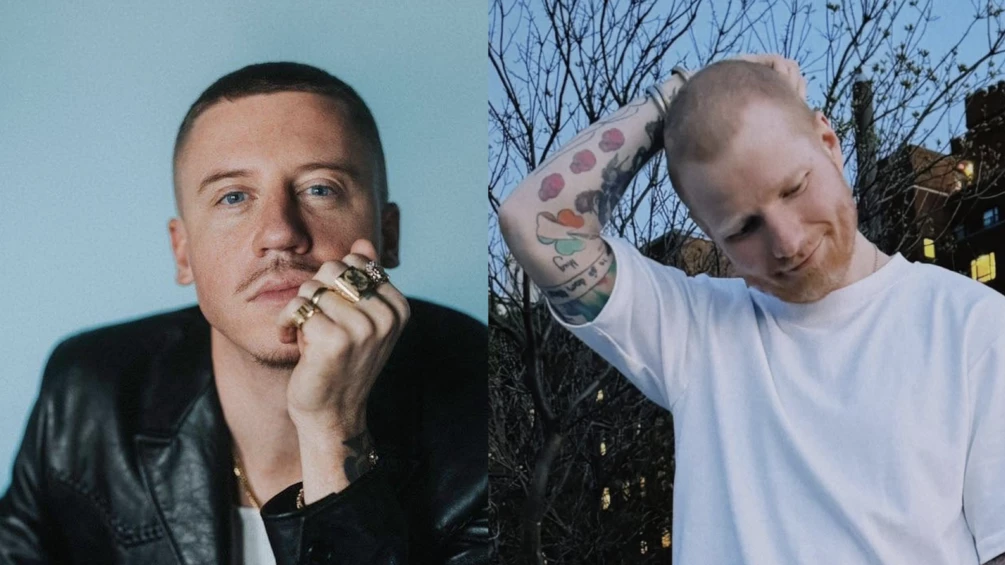
HangupsMusic.com – New York, the intersection of stadium-level pop stardom and high-stakes geopolitical activism has reached a fever pitch following the high-profile removal of Macklemore from Ed Sheeran’s ongoing "Loop" tour. What began as a collaborative celebration of two of the industry’s most recognizable figures has dissolved into a complex legal and ethical standoff involving some of the most powerful stadium owners in the United States. The controversy, which centers on Macklemore’s vocal advocacy for Palestinian rights, has exposed a deep rift between the expectations of corporate venue owners and the personal convictions of the artists who fill their seats.
The friction reached a breaking point following Macklemore’s performance at MetLife Stadium in New Jersey on September 4th. During his set, the Seattle-born rapper, whose legal name is Ben Haggerty, delivered a pointed address to the crowd, shouting "Free Palestine!" and insisting that his message reach those living in Gaza and the West Bank. Beyond the verbal statement, his performance included his 2024 protest anthem "Hind’s Hall," a track dedicated to the memory of Hind Rajab, a five-year-old girl killed in Gaza. The performance was accompanied by stark visual imagery on the stadium’s massive screens, depicting the destruction of Gazan infrastructure resulting from Israeli military operations.
While Macklemore has been integrating this advocacy into his sets for several years, the visibility of the "Loop" tour—one of the highest-grossing musical events of the year—brought a new level of scrutiny. On September 14th, Macklemore revealed via a detailed Instagram post that he had been officially removed from the tour’s upcoming dates. He alleged that the decision was not a creative one, but rather the result of a coordinated ultimatum issued by a consortium of stadium owners, led by Robert Kraft, the billionaire chairman and CEO of the Kraft Group and owner of the New England Patriots.
According to Macklemore’s account, Kraft contacted Ed Sheeran’s management team with a direct threat: if Macklemore remained on the bill, the tour would be barred from performing at Gillette Stadium in Foxborough, Massachusetts, scheduled for late September. The pressure reportedly extended beyond a single venue. Reports from Rolling Stone indicate that seven major American stadiums joined the blockade, including Lincoln Financial Field in Philadelphia, Mercedes-Benz Stadium in Atlanta, and AT&T Stadium in Texas. The collective message was clear: the rapper’s presence had become a liability that the venue owners were no longer willing to host.
Robert Kraft’s response was swift and uncompromising. In a statement released through Variety, Kraft characterized Macklemore’s stage presence not as political expression, but as "hate speech." Kraft, who has dedicated significant resources over the last decade to the Foundation to Combat Antisemitism, argued that the rapper’s rhetoric and historical imagery were deeply offensive to the Jewish community. He maintained that while the loss of life in the conflict is tragic, Macklemore’s "selective information" and failure to acknowledge the actions of Hamas crossed a line into divisiveness. Kraft emphasized that Gillette Stadium is committed to a "welcoming environment" and that the decision to bar Macklemore was a matter of maintaining a platform free from what he deemed antisemitic sentiment.
The fallout has placed Ed Sheeran in an increasingly precarious position. Sheeran and Macklemore share a friendship spanning thirteen years, a bond Macklemore described as a "brotherhood." However, that personal history was tested by the financial and logistical realities of a global stadium tour. In his social media statement, Macklemore described Sheeran as being caught in a "fucked-up position," forced to choose between his long-term friend and the viability of his multi-million-dollar tour. Macklemore noted that Sheeran’s historically "apolitical" public persona was fundamentally challenged, as the British singer reportedly expressed that the Palestinian flag and the phrase "Free Palestine" were viewed as "hurtful" by many of his associates.
Sheeran eventually broke his silence with a lengthy statement of his own, seeking to clarify his role in the controversy. He denied that the removal was his personal choice, pointing out that Macklemore’s contract was technically with the tour’s promoters rather than with him directly. Sheeran claimed he spent days attempting to "build a bridge" between the activists, the promoters, and the venue owners, but ultimately, the decision of the stadiums was final. He defended his continued silence on the matter by framing his concerts as a "sanctuary" for fans of all ages and backgrounds, arguing that his audience does not attend his shows expecting a political forum. "I choose to use my fame and platform to be a place of safety," Sheeran wrote, asserting that there are "different approaches to being an advocate for change" that do not involve public shouting.
This stance of "neutrality," however, has drawn sharp criticism from fans and human rights organizations. Social media users were quick to point out a perceived hypocrisy, highlighting Sheeran’s very public support for Ukraine following the Russian invasion. Critics argued that the singer’s willingness to take a side in one conflict while remaining silent on another suggests that his "neutrality" is selective and influenced by corporate interests. This sentiment was further fueled by the resurfacing of photos and videos of Sheeran performing at Robert Kraft’s wedding in 2022, suggesting a level of personal and professional entanglement with the billionaire that may have influenced the tour’s dynamics.
The Palestinian Campaign for the Academic and Cultural Boycott of Israel (PACBI) has since entered the fray, calling for a total boycott of the "Loop" tour. The organization accused Sheeran of "bowing to billionaires’ pressure" and labeled the tour as "compromised." PACBI also highlighted the financial ties of other stadium stakeholders, mentioning figures like Miriam Adelson and various pro-Israel lobby groups, arguing that the tour has become an extension of a specific political agenda through its exclusion of dissenting voices.
Despite the professional separation, Macklemore has expressed a desire to maintain his friendship with Sheeran, stating that thirteen years of history should not disappear over a single "painful disagreement." He did, however, challenge the concept of neutrality in the face of humanitarian crisis. "There is no neutral position between the oppressor and the oppressed," Macklemore wrote, arguing that staying silent when one side possesses overwhelming military and financial support is, in itself, an act of taking a side.
The music industry at large has begun to react to the news, with a wave of artists coming forward to support Macklemore. The Irish hip-hop group Kneecap, known for their own political outspokenness, shared images of solidarity, while artists like Zara Larsson, Garbage, and Paloma Faith have signaled their support on social media. Even climate activist Greta Thunberg has amplified Macklemore’s message, suggesting that the rapper’s removal has turned him into a symbol of the struggle for artistic freedom in the face of corporate censorship.
As the "Loop" tour continues its trek through Philadelphia, Atlanta, and eventually into Latin America and Mexico, the shadow of the MetLife performance remains. The incident has sparked a broader conversation about the "stadium industrial complex"—the reality that a handful of billionaires and corporations control the venues necessary for an artist to reach the pinnacle of the music industry. For Macklemore, the cost of his advocacy has been measured in lost sponsorships, cancelled shows, and severed professional ties. For Ed Sheeran, the cost may be a permanent alteration of his public image, as the "safe space" he seeks to provide is increasingly viewed by some as a curated silence bought by the highest bidder.
The "Loop" tour is scheduled to conclude in December, but the debate it has ignited regarding the limits of political expression on the world’s biggest stages is likely to resonate long after the final curtain call. The question remains whether a modern artist can truly remain "apolitical" when the very ground they stand on is owned by those with deeply entrenched political and financial interests.
