
 By Azzam Bilal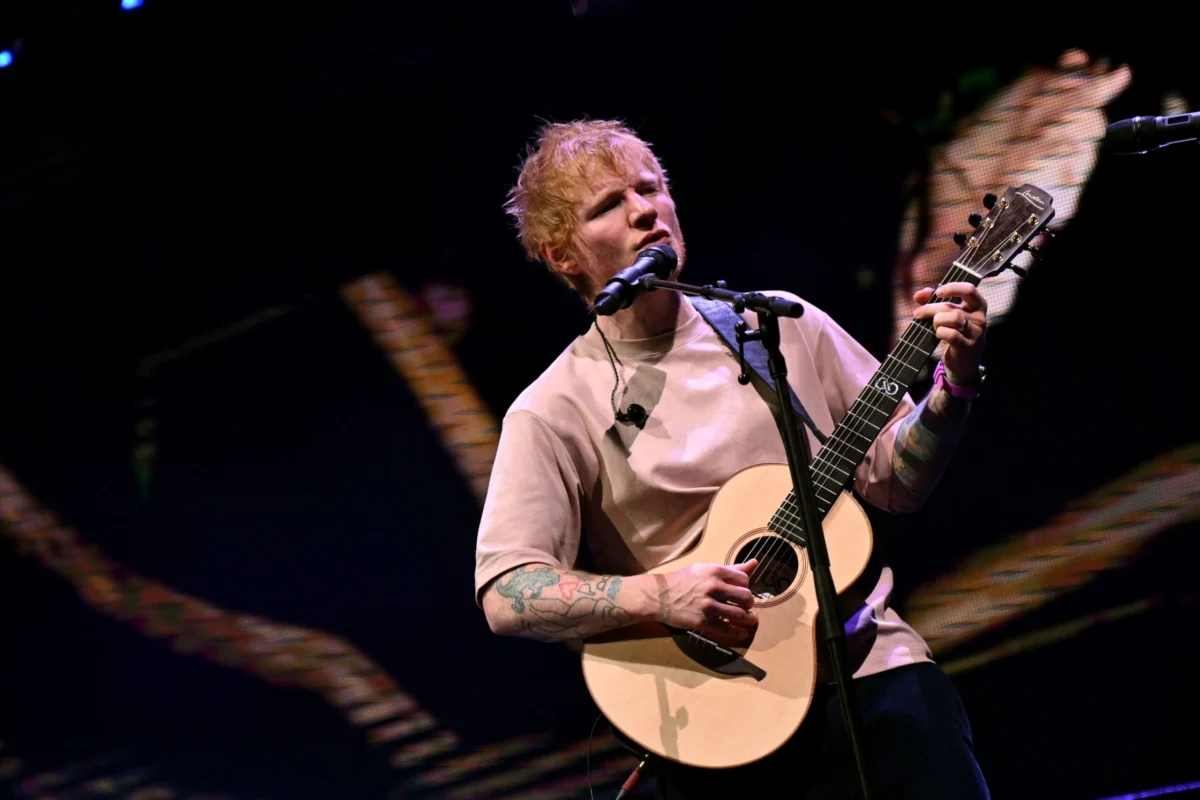
HangupsMusic.com – Philadelphia, The atmosphere at Lincoln Financial Field this past Saturday was charged with an intensity that transcended the usual high-energy pop spectacle associated with Ed Sheeran’s global tours. Following what the British singer-songwriter described as the most grueling week of his professional life, Sheeran took the stage not just to perform his chart-topping hits, but to confront a cascading series of controversies that have threatened to derail his public image and the very structure of his ongoing tour. Amidst a backdrop of high-profile resignations from his support acts and a mounting debate over artistic censorship, Sheeran utilized his headlining set in Philadelphia to offer a raw, multifaceted response to the removal of rapper Macklemore from his tour and the escalating humanitarian crisis in the Middle East.
The turmoil began in earnest on September 14, when Macklemore, the Seattle-based rapper known for his socially conscious lyrics, was abruptly pulled from the tour’s roster. The catalyst for this sudden departure was reportedly a performance at Gillette Stadium in Foxborough, Massachusetts. Macklemore alleged that Robert Kraft, the billionaire owner of the New England Patriots and Gillette Stadium, exerted immense pressure on Sheeran’s camp, threatening to cancel the scheduled performance unless Macklemore—who has been vocal in his criticism of Israel’s military actions in Gaza—was removed. While Sheeran initially pointed toward the promoter, Messina Touring Group, as the entity responsible for the logistical change, the narrative quickly shifted as Kraft himself acknowledged a level of involvement in the decision. However, Kraft remained silent regarding Macklemore’s further claims that the billionaire had actively lobbied other venue owners to blacklist the rapper from their stages as well.
For Sheeran, the fallout was instantaneous and devastatingly internal. The music industry, often a small and interconnected world, reacted with a swiftness that left the "Shape of You" singer isolated. In an unprecedented show of solidarity with Macklemore, Sheeran’s entire backing band, the acclaimed Irish folk-fusion group Beoga, resigned from the tour. They were joined by a list of prominent support acts and collaborators, including the Academy Award-winning producer and artist Finneas, Danish pop-soul outfit Lukas Graham, and musician Aaron Rowe. The mass exodus of his creative team forced Sheeran to scramble for replacements and, perhaps more significantly, forced a public reckoning with his long-held stance of remaining politically neutral.
Addressing the Philadelphia crowd before his set, Sheeran was visibly affected by the weight of the situation. He admitted to the audience that he had never harbored ambitions of becoming an "activist musician," preferring instead to create music that serves as a universal bridge for unity. However, the expulsion of Macklemore and the subsequent internal revolt had thrust him into the center of a "passionate argument about freedom of speech" and what he termed "the most complex political issue on the planet." Sheeran expressed a profound unease with the precedent set by Macklemore’s removal, stating that he is "deeply worried about the idea that venues should pre-approve content of performers." He noted that while such censorship is a reality in many authoritarian regions where he tours, it represents a dangerous erosion of values when it occurs within the "free world."
Despite the gravity of his words, Sheeran’s speech was also an exercise in careful navigation. He avoided mentioning Macklemore by name and did not explicitly take personal responsibility for the rapper’s ousting, instead framing the incident as a systemic failure of the industry and the pressures of venue ownership. This nuance did not go unnoticed by critics, yet Sheeran’s subsequent comments on the Israel-Palestine conflict were his most direct to date. He acknowledged the "horrific" nature of the October 7 attacks by Hamas, particularly the tragedy at the Nova Music Festival, noting that such events "compounded centuries of Jewish pain." Simultaneously, he delivered a stinging critique of the ongoing military response in Gaza, labeling it "catastrophic, unjustifiable, and disproportionate." His heartbreak, he told the crowd, stemmed from the "systemic injustice" unfolding in the West Bank and the staggering loss of civilian lives, particularly children.
The tension of the week was further highlighted by a financial tug-of-war involving the parties. Following his removal, Macklemore pledged to donate $1 million of his projected tour earnings to six different organizations providing aid to Palestinians. In a direct challenge, he called on Robert Kraft to match the contribution. At Sheeran’s personal request, Kraft eventually donated $2 million toward "aid in the region." However, the lack of specificity regarding which organizations would receive Kraft’s funds has left a lingering question of whether the gesture was intended to align with Macklemore’s humanitarian goals or serve as a separate, potentially divergent, philanthropic effort.
As the Philadelphia concert progressed, the physical reality of Sheeran’s professional isolation became clear. He introduced a brand-new backing band to the stage, praising them for their courage in joining him during a period of intense public scrutiny. "They said yes to being on stage with the knowledge that the world thought I was a certain type of person," Sheeran remarked, acknowledging the "hate" his new collaborators might face simply by association. The singer’s vulnerability was on full display as he admitted that the pressure to cancel the remainder of the tour had been nearly overwhelming. He confessed to the audience that he had questioned his future as an artist, feeling "abandoned" by friends, family, and colleagues who had urged him to walk away from the controversy.
The night concluded with an emotional finale that seemed to serve as a catharsis for the embattled star. Sheeran described the Philadelphia show as the "best of his life," a sentiment driven by the fact that 50,000 fans had remained loyal even as his professional circle fractured. "In these situations, you really find out who your friends are," he told the cheering crowd, positioning the fans as his ultimate support system in the face of industry-wide condemnation.
While the Philadelphia performance provided Sheeran with a temporary reprieve and a platform to clarify his stance, the broader implications for the music industry remain significant. The incident has reignited a fierce debate over the power stadium owners and billionaires hold over artistic expression. When a venue owner can dictate the political boundaries of an opening act, the line between private business and public censorship becomes increasingly blurred. Furthermore, the mass resignation of Sheeran’s band and peers signals a shift in the industry, where artists are increasingly unwilling to remain silent or complicit in decisions they perceive as a violation of creative freedom.
As Sheeran continues his tour with a new ensemble and a redefined public persona, the echoes of the "Macklemore incident" are likely to persist. For a musician who built a career on being the world’s most relatable, unproblematic pop star, the transition into a figurehead for a free-speech debate has been both involuntary and transformative. Whether Sheeran can successfully bridge the divide between his desire for "love, hope, and unity" and the stark, divisive realities of global politics remains to be seen. For now, he remains on the road, performing for the thousands who haven’t abandoned him, while the industry watches to see how the next chapter of this complex narrative unfolds. Sheeran’s commitment to "listening and learning" suggests that while he may not have wanted to be an activist, the events of the past week have ensured that his voice will now be heard far beyond the melodies of his songs.
