
 By Azzam Bilal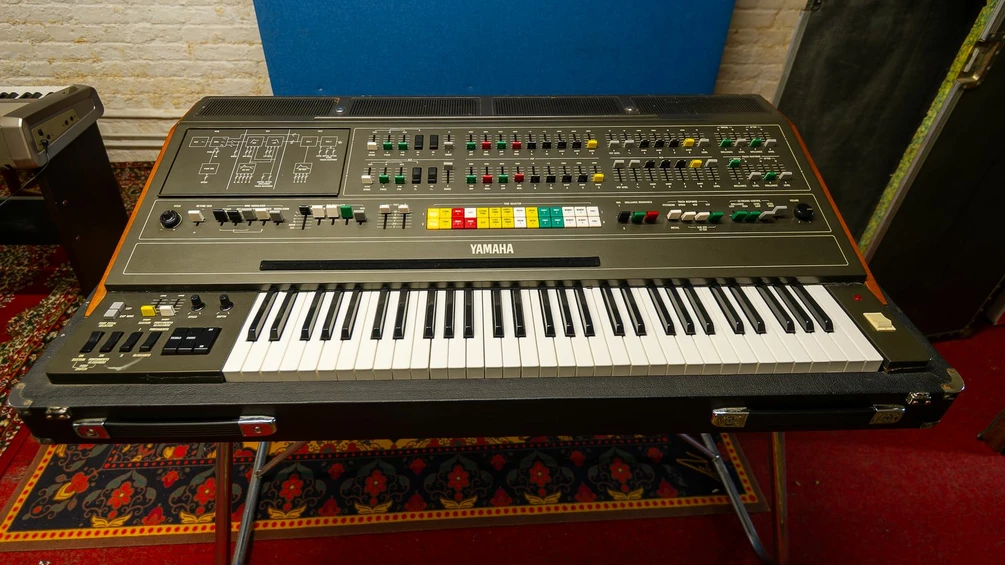
HangupsMusic.com – ATHENS, the world of electronic music has witnessed a landmark moment in the history of instrument collecting, as a Yamaha CS-80 synthesizer, long believed to have been a cornerstone of the late Vangelis’s personal collection, has officially shattered price records. The instrument was recently sold for a staggering £401,465, a figure that solidifies its status as the most expensive synthesizer ever to change hands in a public or private sale. This transaction marks a significant turning point for the vintage gear market, highlighting the intersection of technological rarity and the profound cultural legacy of one of the most influential composers of the 20th century.
The sale took place on the global gear marketplace Reverb, where an Athens-based seller listed the unit with a provenance that immediately caught the attention of historians and enthusiasts alike. According to the listing, which was promptly removed following the completion of the sale, this specific Yamaha CS-80 was not merely a standard production model but was purportedly the very first unit ever owned by Vangelis. Its history is deeply intertwined with the artist’s mid-70s output, specifically cited as a primary tool in the creation of his 1977 masterpiece, Spiral. For fans of the Greek pioneer, who passed away in 2022 at the age of 79, the instrument represents more than just a piece of hardware; it is a physical conduit to the "Golden Age" of electronic synthesis.
To understand the weight of this sale, one must first understand the mythos surrounding the Yamaha CS-80 itself. Often referred to by synthesists as the "Holy Grail" of analog instruments, the CS-80 was released in 1977 and quickly became legendary for its expressive capabilities. Unlike many of its contemporaries, which could feel clinical or rigid, the CS-80 offered a level of tactile sensitivity that mirrored acoustic instruments. It featured a weighted 61-note keyboard with polyphonic aftertouch—a feature that allows a player to affect the sound of individual notes by varying pressure after the initial strike. This, combined with a unique ribbon controller for smooth pitch glides, made it the perfect vehicle for Vangelis’s orchestral approach to electronic music.
The unit in question arrived with a physical history that tells its own story. Described as being in excellent condition and fully functional, it included its original stand and protective lid—rarities in themselves given the instrument’s notorious weight of over 200 pounds. However, the most evocative detail was a distinctive cigarette burn located on one of the A keys. In the world of high-end memorabilia, such "imperfections" often serve as a signature of authenticity, a tangible mark left by an artist during the heat of a creative session. Furthermore, the instrument lacked a standard serial number, leading experts to believe it was an early prototype or a pre-production model sent directly from Yamaha to the composer. This lack of a serial number adds a layer of exclusivity that likely contributed to the final record-breaking price.
Vangelis’s relationship with the CS-80 was nothing short of symbiotic. In a landmark 1984 interview with Electronics & Music Maker, he famously declared the instrument to be the most important synthesizer of his career and arguably the greatest analog design in history. While many associate the CS-80 with the haunting, neon-drenched soundscapes of the 1982 film Blade Runner, its presence was felt throughout his entire discography. On Spiral, the CS-80 provided the soaring, brassy leads and rich, evolving pads that defined his "symphonic electronic" style. Vangelis treated the synthesizer not as a machine to be programmed, but as a living entity to be performed. He was known for playing his instruments live in the studio, often capturing entire compositions in a single take, and the CS-80’s immediate, hands-on interface was central to this spontaneous philosophy.
The sale of this CS-80 arrives amidst a broader surge in the valuation of historic electronic music equipment. For decades, these machines were viewed as obsolete tools, often discarded in favor of digital workstations or software emulations. However, the last several years have seen a dramatic reversal of this trend. In 2023, a Sennheiser VSM-201 vocoder previously owned by Kraftwerk co-founder Florian Schneider fetched $256,000 at auction. While that sale was considered a high-water mark for the industry, the Vangelis CS-80 has nearly doubled that figure, signaling that the market for "investment-grade" synthesizers has reached a new echelon.
Collectors and institutions are increasingly viewing these instruments in the same light as Stradivarius violins or iconic guitars owned by rock legends. The provenance of a Vangelis-owned CS-80 carries a weight that transcends its technical specifications. It is an artifact of the era when electronic music was moving from the fringes of experimental academia into the mainstream of global culture. Through his work on Chariots of Fire, which earned him an Academy Award, and the atmospheric depth of Blade Runner, Vangelis proved that synthesizers could evoke a range of human emotion as broad and deep as a full philharmonic orchestra.
The technical complexity of the CS-80 also plays a role in its soaring value. Maintaining a vintage CS-80 is a labor of love and a significant financial undertaking. Its internal architecture is a maze of voice cards and delicate calibration points that are notoriously prone to drifting out of tune or failing due to age. A fully functional unit, especially one with a pedigree of this magnitude, is a rare find. The fact that this unit was described as being in excellent working order suggests it was meticulously cared for, likely by a technician familiar with the specific demands of Vangelis’s rigorous studio standards.
The transition of this instrument from a working tool in an Athens studio to a record-breaking auction item reflects the enduring fascination with the "human" element of electronic music. As digital technology becomes more perfect and predictable, musicians and collectors are drawn back to the unpredictable, warm, and often temperamental nature of vintage analog circuitry. The CS-80, with its massive oscillators and organic filters, represents the pinnacle of that era.
As the news of the £401,465 sale ripples through the music community, it prompts a reflection on the legacy of the man who made the machine famous. Vangelis was a self-taught musician who rejected the formal constraints of music theory in favor of a direct, emotional connection to sound. He often spoke of music as a fundamental force of the universe, and the synthesizer was his telescope. By pushing the boundaries of what the Yamaha CS-80 could do, he didn’t just create soundtracks; he created a new sonic language that continues to influence film composers, electronic producers, and ambient artists today.
While the identity of the buyer remains undisclosed, the significance of the purchase is clear. Whether the instrument finds its way into a private collection, a high-end recording studio, or a museum dedicated to musical innovation, it remains a monument to a specific moment in time. It is a reminder of when the future of music was being forged in the glow of vacuum tubes and transistors, and when a single artist with a visionary mind and a heavy Japanese synthesizer could change the way the world heard the future. The record set by this sale is a testament to the fact that while technology may evolve, the soul of the instruments that defined our musical heritage remains priceless.
