
 By Azzam Bilal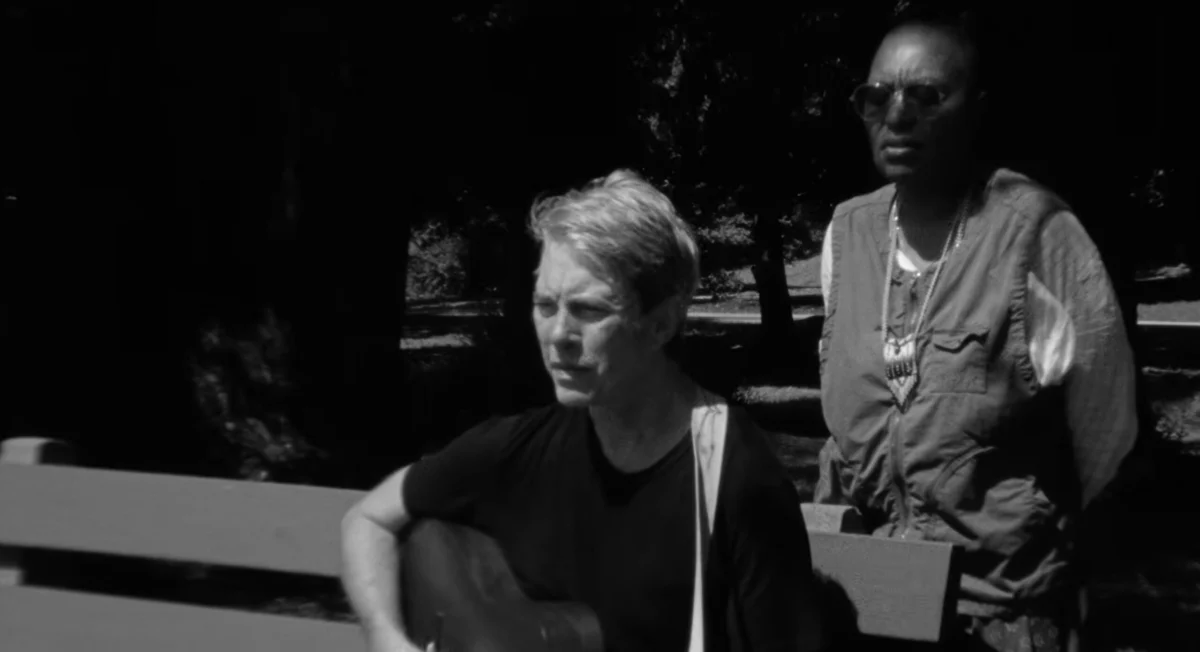
HangupsMusic.com – In an era where the reinterpretation of the American songbook has become a vital tool for social commentary, Meshell Ndegeocello continues to establish herself as one of the most profound architects of modern sound. As the release date for her highly anticipated collaborative project, Synonym, approaches on October 2, the multi-instrumentalist and songwriter has unveiled a striking new rendition of Bob Dylan’s "With God on Our Side." For this specific undertaking, Ndegeocello has enlisted the talents of two distinct voices in the contemporary folk and indie landscape: the baritone philosopher Bill Callahan and the virtuoso mandolinist and vocalist Chris Thile. The resulting track is not merely a cover but a structural reimagining that challenges the listener to confront the weight of historical narrative and the often-violent certainty of conviction.
The choice of "With God on Our Side" is particularly resonant given the current global climate. Originally appearing on Dylan’s 1964 landmark album The Times They Are a-Changin’, the song is a sprawling, ironic chronicle of military history and the theological justifications used to validate conflict. While Dylan’s original was characterized by a steady, folk-strummed cadence that emphasized the lyrics’ biting sarcasm, Ndegeocello’s version seeks a different emotional frequency. By her own admission, the arrangement is designed to lean into a sense of "aggression" that is often masked by the gentle delivery of traditional folk music. This shift in energy serves to highlight the underlying tension of the lyrics, transforming the song from a satirical folk ballad into a haunting, urgent meditation on power and providence.
Ndegeocello has spoken at length about the specific vocal textures she sought for this collaboration. In a statement accompanying the release, she described Bill Callahan’s voice as "enchanting," noting its unique ability to draw the listener into a narrative space. Callahan, who first rose to prominence under the moniker Smog before transitioning to his own name, is known for a delivery that is both deadpan and deeply emotive. His involvement brings a certain gravitas to the track, his low-register vocals acting as a grounded counterpoint to the song’s loftier philosophical questions. Complementing Callahan is Chris Thile, whom Ndegeocello refers to as an "angel." Thile, a MacArthur Fellow and a founding member of Nickel Creek and Punch Brothers, is celebrated for his technical mastery of the mandolin, but it is the "earthiness" of his voice that Ndegeocello highlights here. Thile’s presence adds a layer of organic vulnerability to the arrangement, bridging the gap between the song’s intellectual rigor and its human cost.
The process of deconstructing a work as iconic as a Bob Dylan classic is no small feat, and Ndegeocello approaches the task with the precision of a scholar and the intuition of a seasoned improviser. She describes the act of rearranging as "putting together a puzzle with all these little pieces." For Ndegeocello, this is not about changing the song for the sake of novelty, but rather about showing "respect" to the original composition by finding new ways to make its core message felt. By altering the rhythmic structure and the tonal palette, she forces the audience to hear familiar words as if for the first time. The "aggression" she mentions is not necessarily loud or abrasive; rather, it is a psychological intensity—a refusal to let the listener remain comfortable while contemplating the cycles of history.
Accompanying the single is a music video directed by Damani Baker, a filmmaker known for his ability to capture intimate human moments within larger social frameworks. The visual presentation is deceptively simple, centered on a park bench. This setting serves as a powerful metaphor for the public square—a place of rest, observation, and conversation. By stripping away cinematic artifice, Baker allows the performances and the lyrics to take center stage. The choice of a park bench also evokes a sense of timelessness, suggesting that the debates regarding war, faith, and national identity are ongoing dialogues that occur in the most mundane of settings. It reflects the "grounded" nature that Ndegeocello praised in her collaborators, rooting the high-minded concepts of the song in the physical reality of everyday life.
Synonym is shaping up to be one of the most ambitious projects in Ndegeocello’s storied career. The album is a testament to her role as a curator of talent and a bridge-builder between disparate musical genres. The guest list for the record reads like a "who’s who" of contemporary artistry, featuring legendary figures alongside modern innovators. Among the confirmed contributors are the iconic Chaka Khan, the powerhouse Americana singer-songwriter Brandi Carlile, the ethereal Moses Sumney, and the transformative ANOHNI. This follows the release of last month’s lead single, a cover of The Human League’s "Don’t You Want Me," which featured the unmistakable vocals of Cat Power. Each choice of collaborator appears meticulously curated to fit the specific emotional architecture of the song being covered, suggesting that Synonym will be a cohesive exploration of influence and reinterpretation.
The album arrives at a point where Meshell Ndegeocello is enjoying a period of renewed critical acclaim. Her 2023 album, The Omnichord Real Book, earned her a Grammy Award for Best Alternative Jazz Album, further cementing her reputation as an artist who defies easy categorization. Throughout her three-decade career, she has moved fluidly between neo-soul, funk, jazz, and rock, always maintaining a focus on lyrical depth and social consciousness. With Synonym, she seems to be turning her gaze outward, looking at the songs that have shaped the cultural landscape and asking how they might be refracted through her unique lens.
The collaboration with Callahan and Thile on "With God on Our Side" is a microcosm of the album’s broader intent. It brings together the world of indie-folk, bluegrass virtuosity, and experimental soul to interrogate a piece of 1960s protest music. In doing so, Ndegeocello highlights the enduring nature of Dylan’s writing while simultaneously asserting her own artistic agency. The "puzzle" she is solving is one of relevance—how to take a song written during the Cold War and the Civil Rights Movement and make it feel essential for the 2020s.
As the music industry continues to grapple with the role of covers and "re-imaginings" in the digital age, Ndegeocello’s approach offers a masterclass in how to honor the past without being beholden to it. She does not treat these songs as museum pieces to be preserved in amber; instead, she treats them as living organisms that can grow and change in different environments. By introducing "aggression" into the folk structure, she acknowledges the anger and frustration that often fuel political change, providing a sonic outlet for the complexities of the modern experience.
Fans and critics alike are eagerly awaiting the full release of Synonym on October 2. The project promises to be a significant addition to Ndegeocello’s discography, offering a deep dive into the art of the collaboration. By bringing together voices as varied as Chaka Khan and Bill Callahan, Ndegeocello is creating a space where different musical histories can intersect and inform one another. "With God on Our Side" serves as a poignant preview of this journey—a track that is as intellectually stimulating as it is musically rich. In the hands of Ndegeocello, Callahan, and Thile, Dylan’s old questions feel entirely new again, demanding our attention and challenging our assumptions about the world we inhabit. Through this work, Ndegeocello continues to prove that she is not just a musician, but a vital cultural commentator whose work remains as essential today as it was when she first burst onto the scene.
