
 By Azzam Bilal
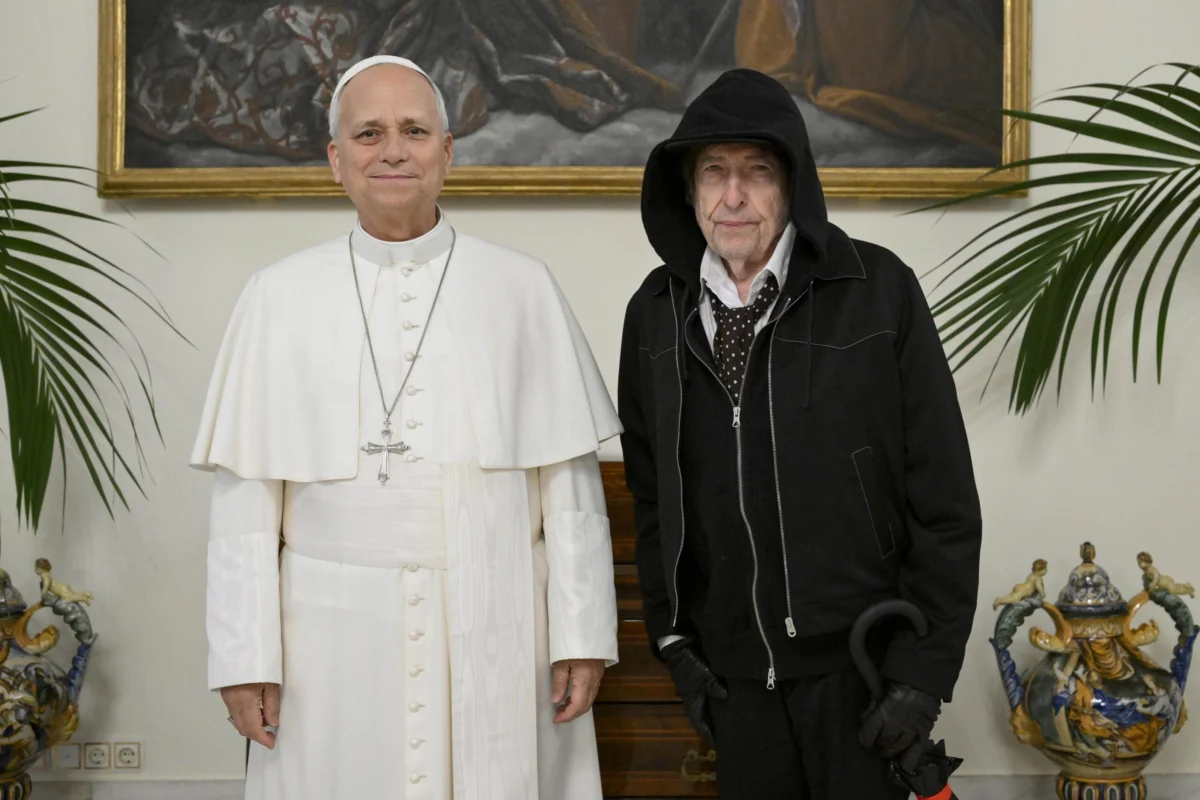
HangupsMusic.com – Vatican City, In a moment that bridged the gap between the high altars of the Catholic Church and the grit of American folk-rock history, Bob Dylan was granted a private audience with Pope Leo XIV at the Vatican on the morning of November 4. The meeting, which took place within the storied walls of the Apostolic Palace, serves as a remarkable testament to Dylan’s enduring cultural gravity and the current papacy’s apparent fascination with the icons of the 1960s counterculture. Coming just months after the Vatican welcomed punk-poetess Patti Smith in July, the encounter further solidifies the Holy See’s burgeoning "downtown" credentials, signaling a sophisticated engagement with the architects of modern lyrical expression.
Dylan, who has spent the better part of six decades cultivating a persona defined by reticence and an almost supernatural avoidance of public scrutiny, arrived for the meeting in a manner that was characteristically understated yet visually striking. Eschewing the formal attire typically expected for a papal audience, the 83-year-old Nobel laureate opted for his signature "Never Ending Tour" aesthetic. According to photographs released by the Vatican’s Dicastery for Communication, Dylan wore a black hoodie, with the hood pulled up and seemingly supported by a black baseball cap underneath. It was a look that felt less like a breach of protocol and more like a continuation of Dylan’s career-long commitment to authenticity over artifice.
One particularly poignant image captured by Vatican photographers shows Dylan, having removed a single glove, signing a book for the Pontiff. The gesture—a Nobel Prize-winning author presenting his work to a Pope who has increasingly positioned himself as a champion of the arts—offered a rare glimpse into a private exchange between two men who, in their respective spheres, command the attention of millions. While the specifics of their conversation remain confidential, the visual evidence suggests a meeting of mutual respect, one that transcends the traditional boundaries of religious and secular authority.
The intersection of Bob Dylan and the Vatican is not a new phenomenon, but it is one fraught with a complex theological history. Born Robert Zimmerman and raised in a Jewish household in Duluth and Hibbing, Minnesota, Dylan’s spiritual journey took a sharp, public turn in 1978. Following what he described as a visionary experience in a hotel room, Dylan converted to evangelical Christianity. This "Born Again" period resulted in a trilogy of albums—1979’s Slow Train Coming, 1980’s Saved, and 1981’s Shot of Love—that initially alienated a significant portion of his secular fanbase. During this era, Dylan’s live performances were often punctuated by fire-and-brimstone sermons, as he swapped his protest anthems for gospel-infused warnings of the coming judgment.
However, as the 1980s progressed, Dylan’s overt religious fervor appeared to mellow, or at least become more subterranean. He returned to his Jewish roots in various ways, including appearances at Chabad telethons, while never fully disavowing his Christian phase. In recent decades, his relationship with the divine has been expressed through a more eclectic and often humorous lens. Fans frequently point to his 2009 album, Christmas in the Heart, as a prime example of this later-period spirituality. While some critics dismissed the collection of traditional carols as a "ludicrous" or ironic project, others saw it as a sincere, if idiosyncratic, expression of faith from a man who has always found truth in the "old, weird America" of traditional songcraft.
This is not Dylan’s first high-profile encounter with the papacy. In 1997, he performed at the World Eucharistic Congress in Bologna, Italy, in front of Pope John Paul II. That event was a landmark moment in Dylan’s career, as the aging Pope listened to "Knockin’ on Heaven’s Door" and "A Hard Rain’s A-Gonna Fall," later delivering a homily that riffed on the lyrics to "Blowin’ in the Wind." While the Vatican’s then-Prefect of the Congregation for the Doctrine of the Faith, Cardinal Joseph Ratzinger (the future Pope Benedict XVI), was reportedly skeptical of Dylan’s presence, John Paul II embraced the singer as a "prophet" of sorts.

The current relationship between Dylan and Pope Leo XIV, however, appears to be built on an even deeper intellectual foundation. Pope Leo has proven himself to be something of a "Dylanologist," a term usually reserved for the obsessive scholars who pore over Dylan’s bootlegs and lyrical variations. The Pope recently surprised many in the literary and religious worlds by quoting a deeply obscure Dylan lyric in the preface to his new anthology of speeches, Unarmed and Disarming: Peace Is a Gift.
The lyric in question comes from "Go Away You Bomb," a piece Dylan wrote in 1963 for an unpublished book of anti-nuclear poetry. The poem, which dates back to Dylan’s early years as a firebrand in the Greenwich Village folk scene, is a stark, visceral plea for nuclear disarmament. By unearthing such a rare piece of Dylan’s catalog, Pope Leo XIV has signaled that his interest in the singer is not merely a PR exercise but a genuine engagement with Dylan’s role as a moral voice in the 20th and 21st centuries. The Pope’s use of the lyric highlights a shared concern for global peace and the existential threats facing humanity—themes that have permeated Dylan’s work from "Masters of War" to his 17-minute 2020 epic "Murder Most Foul."
The meeting at the Vatican also reflects a broader shift in how the Catholic Church interacts with modern culture. Under Pope Leo XIV, there has been a concerted effort to reach out to artists who may not fit the traditional mold of "religious" creators. By welcoming figures like Patti Smith and Bob Dylan—artists who rose to prominence during a time of radical social upheaval and who often challenged institutional authority—the Vatican is attempting to find common ground in the search for meaning and justice.
For Dylan, the meeting is another chapter in a late-career renaissance that has seen him move from "legacy act" to a venerated elder statesman of world literature. Since winning the Nobel Prize in 2016, Dylan has continued to tour relentlessly and release critically acclaimed albums that grapple with history, philosophy, and mortality. His visit to the Vatican, dressed in the garb of the common man, underscores the duality that has always defined him: he is both the "everyman" in a hoodie and the "prophet" in the palace.
As the news of the audience spreads, music historians and theologians alike are beginning to parse the significance of this encounter. Does it represent a final reconciliation between Dylan and the institutional church? Or is it simply another stop on the "Never Ending Tour," a moment where the "joker and the thief" of his lyrics found themselves in the presence of the "high priest"?
Whatever the case, the image of Bob Dylan signing a book for Pope Leo XIV, one gloved hand and one bare, remains a powerful symbol. It is a reminder that even in an increasingly fractured and secular world, the power of the word—whether sung in a raspy baritone or written in a papal encyclical—still holds the capacity to bring disparate worlds together. In the quiet halls of the Vatican, the man who once sang that "the times they are a-changin’" found himself face-to-face with an institution that measures time in centuries, proving once again that Bob Dylan’s influence is as timeless as it is unpredictable.
