
 By admin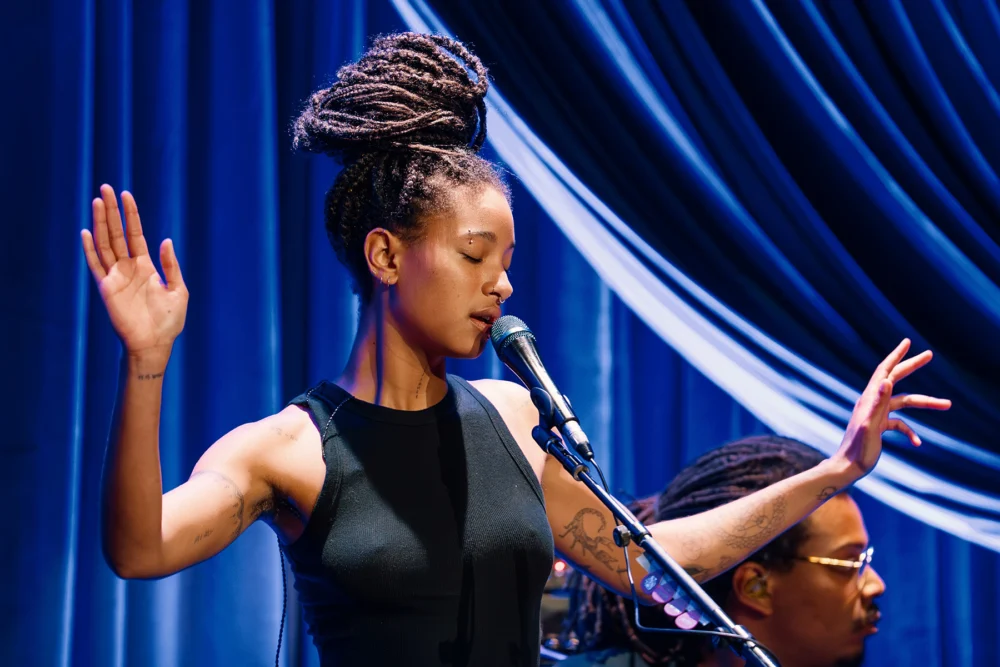
HangupsMusic.com – Los Angeles, The moniker "Willow," unburdened by a surname, has long been synonymous with an artist whose trajectory defies easy categorization. In a landscape often quick to label and constrain, Willow Smith has consistently navigated a path of bold self-discovery, culminating in her latest sonic opus, petal rock black. This album, a testament to her ever-evolving artistry, arrived as a surprise drop on February 16th, marking a pivotal moment in her career: her first entirely self-produced recording. To celebrate this deeply personal achievement, Willow offered two intimate performances at Hollywood’s esteemed Blue Note Jazz Club, transforming the venerable space into a crucible for her raw, unencumbered expression.
The atmosphere within the Blue Note was charged with anticipation. The late set, a packed affair, saw a diverse audience eager to witness the live unveiling of petal rock black. The club, known for its plush intimacy and reverence for musical virtuosity, provided the perfect canvas for Willow’s intricate new sound. As the lights dimmed, a hush fell, broken only by the murmurs of excitement. Willow, choosing simplicity in her attire – a modest black dress, her signature long braids initially gathered – took the stage with a quiet confidence that belied a confessed nervousness. This vulnerability, however, only served to forge a deeper connection with a crowd already captivated by her enigmatic presence.
Near the conclusion of her spellbinding performance, Willow shared a moment of profound personal significance with the audience. "My album is out and it was 100 percent produced by me," she announced, a tremor of pride in her voice. "It was my first time ever doing that." This declaration was met with enthusiastic applause, acknowledging not just the musical accomplishment but the sheer artistic sovereignty it represented. For a 25-year-old artist who has navigated the public eye since childhood, taking complete creative control signifies a potent reclaiming of narrative and sound.
petal rock black emerges as a continuation, and indeed, a significant expansion, of the experimental journey Willow embarked upon with her preceding works, particularly 2024’s Grammy-nominated empathogen. While empathogen saw her collaborating with luminaries like Jon Batiste and St. Vincent, petal rock black pushes the boundaries of independent creation. The album’s title itself hints at a duality, a convergence of natural softness ("petal"), grounding strength ("rock"), and profound depth ("black"). It suggests a nuanced exploration of her internal landscape, expressed through a sonic palette that is both delicate and unyielding.

The album opens with a spoken-word introduction from none other than the "funk father" himself, George Clinton. This unexpected collaboration, while potentially hinting at buoyant grooves, actually serves to set a more esoteric and poetic tone, preparing listeners for an auditory journey that prioritizes introspection over conventional rhythms. It’s a bold statement, signaling Willow’s willingness to subvert expectations and draw from an incredibly wide well of influences. Following Clinton’s evocative prelude, the album unfurls with tracks like "Vegetation," a breezy, loop-driven piece infused with a bebop sensibility, which Willow fittingly chose to open her live set.
"Vegetation" transitioned seamlessly into the breathy allure of "Hear Me Out," a track that delves into the intricate dynamics of human relationships, a recurring lyrical theme throughout Willow’s discography. While her early explorations of love and connection have been present, her self-reflections have always resonated with a particular authenticity, and petal rock black offers an abundance of these introspective moments. The album, therefore, isn’t just a collection of songs; it’s an auditory diary, a series of meditations on existence, connection, and the intricate workings of the self.
Willow’s journey in music began at a remarkably young age, with the infectious dance-pop hit "Whip My Hair" when she was just ten. Growing up in the intense glare of the public eye as the daughter of Will and Jada Pinkett-Smith, and sister to Jaden Smith, has undoubtedly presented unique challenges. Yet, her early exposure to a vast array of musical genres – from hip-hop and pop to the raw energy of her mother’s rock band, Wicked Wisdom – clearly cultivated an eclectic and adventurous musical palate. This foundational experience allowed her to absorb and synthesize diverse sounds, preventing her from being confined to any single genre.
For those who have diligently followed Willow’s discography, her talent has never been in question. Her vocals possess a remarkable robustness and an almost haunted resonance, lending a distinctive character to every project she undertakes. This was evident in her notable collaborations in 2022, a year that also saw her family facing intense public scrutiny. Working with artists like Machine Gun Kelly and Travis Barker on "Emo Girl," Yungblud on "Memories," and PinkPantheress on "Where Are You?" showcased her versatility across rock and alternative genres, demonstrating an undeniable vocal prowess that transcends stylistic boundaries. It’s plausible that the personal and public challenges of that year further fueled her drive for creative liberation, propelling her towards deeper artistic exploration.
By 2023, Willow had truly blossomed as both a performer and a songwriter. Her electrifying performance at Coachella that year was a standout, solidifying her reputation as a formidable live artist. This was followed by her acclaimed Tiny Desk concert in 2024, where she further showcased her nuanced musicianship. The deluxe version of empathogen, titled ceremonial contrafact, featured the revered composer and saxophonist Kamasi Washington, a collaboration that hinted at the sophisticated jazz leanings now more fully realized on petal rock black. Washington returns on the hypnotic track "Play," a definite highlight of the new album, his saxophone weaving intricate textures through Willow’s atmospheric soundscape. Another shimmering collaboration, "Omnipotent," sees her joining forces with Oakland’s experimental duo Tune-Yards, further demonstrating her commitment to pushing sonic boundaries. While she refrained from performing her effects-laden cover of Prince’s "I Would Die 4 U" during the observed set, the enduring influence of the iconic artist on Willow’s overall musical ethos is undeniably palpable.

Throughout her performance, Willow exuded a captivating blend of fragility and strength. Dressed simply, she initially kept her long braids tied up, only to release them near the show’s conclusion, a symbolic gesture of liberation. She openly spoke of feeling a "bit nervous" on stage, a relatable confession that endeared her further to the audience. Reflecting on the broader socio-emotional climate, she acknowledged 2025 as a challenging year, marked by "some weird shit going on," but added an empowering observation: that "right now, we’re all finding our spiritual warrior type energy." This sentiment resonated deeply, suggesting a collective search for resilience and inner strength in turbulent times.
Willow channeled this "spiritual warrior type energy" directly into her performance, seamlessly transitioning between guitar and microphone. Her vocal delivery was a masterclass in versatility, shifting from soft, breathy croons to bold, ruminant declarations. These dynamic shifts, supported by her skilled band – piano, drums, and bass – evoked comparisons to a spectrum of formidable female artists, from the soulful depth of Erykah Badu to the introspective intensity of Tori Amos. She graciously highlighted her band members, allowing each to shine, even featuring an impressive drum solo, underscoring her collaborative spirit. She also spoke warmly of the Blue Note’s significance, recalling her attendance at its opening the previous summer, illustrating her genuine connection to the venue.
Attempting to codify petal rock black into a single genre proves challenging, and deliberately so. It is unequivocally not a pop or rock record in the conventional sense. Instead, it leans most heavily into soulful jazz fusion, interwoven with elements of tribal rhythm, creating a sound perfectly suited for the intimate, reverent space of the Blue Note. While it remains to be seen if this deeply experimental work will appeal to the broader Gen Z audience who have propelled her to independent stardom, Willow appears unconcerned with mainstream hit potential at this juncture. Indeed, she possesses the unique luxury of being able to explore novel ideas and collaborate with artists purely based on artistic synergy. However, she also seems acutely aware of what a profound blessing this artistic freedom represents, embracing it with both responsibility and gratitude.
As highlighted in the album’s promo trailer, petal rock black is fundamentally focused on deep personal expression, meticulously crafted alone in the studio. Her record release performance served as a powerful demonstration that the most challenging, yet ultimately rewarding, aspect of self-discovery is the courage to share it with others. Through her vulnerability, her technical mastery, and her unwavering artistic vision, Willow not only pulled it off but solidified her standing as a truly unique and compelling voice in contemporary music. petal rock black is more than just an album; it is a declaration of artistic independence, a vibrant tapestry woven from self-reflection and sonic innovation, cementing Willow’s legacy as an artist perpetually in bloom.
