
 By admin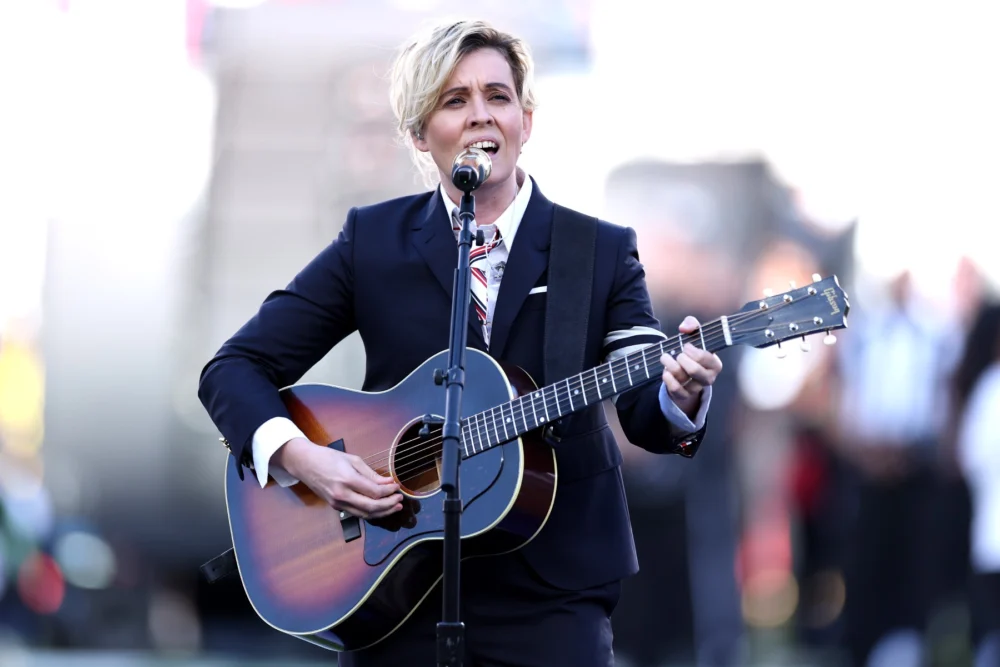
HangupsMusic.com – Minneapolis, Minnesota,
The air inside the Target Center crackled with an almost spiritual energy, a palpable blend of musical reverence and simmering defiance. Brandi Carlile, the GRAMMY-winning troubadour, had just concluded a nearly two-and-a-half-hour performance, a monumental stop on her "Human" arena tour. The night, branded "Be Human: A Concert for Minneapolis," was more than a mere gig; it was a powerful communion, a direct response to the escalating humanitarian crisis unfolding in the city at the hands of federal immigration enforcement. As the final notes faded, leaving the sold-out crowd in a roaring ovation, Carlile, still radiating the raw emotion of the stage, retreated backstage to offer her candid reflections to Rolling Stone, her brow still marked by the imprint of a red bandana, her eyes burning with a determined, unyielding passion.
The concert itself had been an extraordinary display of solidarity. For the poignant closing number, Carlile was joined by a local collective known as the Singing Resistance, their voices merging in a powerful anthem that has become a rallying cry across Minneapolis in recent weeks: "It’s Okay to Change Your Mind." The chorus, a simple yet profound invitation – "It’s okay to change your mind / And you can join us / Join us here any time" – echoed through the arena, a message of hope and reconciliation directed not only at those directly impacted by the crisis but also at those who might reconsider their stances.
While Minneapolis was a pre-scheduled stop on Carlile’s tour promoting her critically acclaimed 2025 LP, Returning to Myself, the escalating tensions and alleged human rights violations perpetrated by ICE transformed the event into something far more significant. Carlile felt an inescapable imperative to leverage her platform, stating early in her 24-song, career-spanning set, "It pained me not to be with you guys [in recent weeks]. You have been through so much, and you’ve been on my mind every second of every day. This is home to me." The concert was broadcast globally, with all proceeds directed to The Advocates for Human Rights, an organization tirelessly working on the front lines. At the time of this publication, the event had successfully generated over $600,000, and the performance remains available for streaming for a limited time, extending its reach and impact.
"It’s very clear that this administration is not interested in legal immigration," Carlile asserted backstage, her voice firm, despite the exhaustion of the performance. "They’re interested in violent theater. Violent theater and dominance over other people. I don’t believe most people signed up for that. Even people who voted for Trump, who I’m angry with, I don’t think they voted for this and I do think that they can still change their minds." Her words cut through the usual post-show chatter, highlighting the depth of her conviction.
Carlile is no stranger to social activism. Her career has long been punctuated by moments where she has used her voice not just for song, but for advocacy. Yet, in her candid conversation, it was evident that while the current political climate, particularly the administration’s inhumane immigration policies, filled her with a profound sense of disgust, it had not extinguished her characteristic hope. Despite describing herself as an inherently optimistic person, Carlile emphasized the urgency of the moment, a call to immediate, resolute action.
"We can’t let down our guard. We have to be resilient and loud and unwavering in our commitment to justice," she insisted, leaning forward slightly, her gaze unwavering. "We can overpower oppression by deciding to not be disenfranchised. We can change the outcome of this oppressive regime. We can resist and not submit." It was a rallying cry, not just for Minneapolis, but for a nation grappling with its moral compass.
When asked about her immediate reactions to the unfolding events in Minneapolis, Carlile’s anger was palpable. "I was really angry," she admitted. "My heart is on the side of displaced people. I think about displaced people – economic migrants, immigrants, asylum seekers, and refugees – all the time. I think about the displaced movement of people globally as the test of our humanity in this time and age. I’m concerned about it all the time." She further articulated a frustration with what she perceives as a selective outrage. "I don’t like the part of the argument where people are pontificating about what an injustice it is that these things are happening to American citizens or in America. The fact that these things are happening to black and brown people is just as important as what happened to Renee Good and Alex Pretti." She spoke of the universal nature of suffering, convinced that those directly affected would echo her sentiments. "I know if both of them were sitting here right now, they would say the exact same thing to me. I don’t know how people on the right can wax philosophical about doing it ‘by the book’ when ICE is literally zip-tying people on the floor of their immigration hearings."
The recurring theme of "changing minds" during the concert resonated deeply, and Carlile was pleased to hear it acknowledged. "Do you have time for a story?" she asked, a mischievous glint in her eye, before launching into a personal anecdote that illuminated her philosophy.
"When I first moved out of my parents’ house, I was poor, poor, poor," she began, painting a vivid picture of her early struggles. "I got payday loans, I pawned everything that I had: I pawned CDs for a dollar, I pawned my tools, my guitars, I got my power shut off all the time; I was working doing roofing labor and as a barista. I was in the shit."
Then came the turning point: "One day a vacuum salesman came to my door. He treated me like someone that had money, like someone that was important. And he started talking to me about this vacuum cleaner and he took this little fucking strip out of his pocket and he dipped it in a bottle of water and he told me that my entire house was toxic. I don’t know how he did it, but he sold me a vacuum cleaner. He told me I wasn’t going to have to pay for it, that I could make really tiny payments. He was going to talk to his boss and see if he could just give this one to me… it was going to be fine. So, he leaves and he leaves this vacuum cleaner – so heavy I can’t even pick the damn thing up. And a few days later I got a bill in the mail for $1500."
Her reaction unfolded in stages. "I was first really embarrassed. I was ashamed. And it wasn’t too long before I was just fucking mad. Because I realized the situation I was in. I realized I was vulnerable at the time. I realized the guy looked me in the eye and made me feel important. And I called the company that he worked for and I said, ‘I know what this guy looks like. And I know where he goes. And I’m going to go to Kinko’s and I’m going to make a stack of flyers and I’m going to follow this dude door to door and go to every house he goes to before he gets there.’" Her determination paid off. "Anyway, they came and they picked up the vacuum and they didn’t make me pay for it."
The metaphor, Carlile suggested, was starkly clear. "Donald Trump is the ultimate vacuum cleaner salesman." She elaborated on the connection: "So, you got fucking scammed. We’re living in a scammy time. That’s what people do. You can’t even pick up your phone without getting scammed. Doesn’t mean you have to double down. It doesn’t mean you have to pay for the fucking vacuum cleaner. And I just think there are a whole lot of people out there right now feeling duped and feeling ashamed and embarrassed. What they need to feel is angry. They need to get mad and change their minds. Get past the embarrassment, get past the shame that we got duped by a con artist. Get mad enough to change your mind."
Despite ICE’s claims of scaling down operations in Minneapolis, Carlile acknowledged the enduring fear among those targeted. "Their fear is warranted," she stated, her voice softening slightly, "And that shatters my heart into a thousand pieces." Yet, even in this despair, she found a sliver of hope. "If there’s any hope in that, it’s that I hope that those immigrants, those people who left their homes for the promise of safety or a better life, I hope they know how much we love them. I hope they can see they are welcome with open arms. That we believe in their contributions to this country and we believe that they belong here." She envisioned a radically different role for immigration authorities. "That’s what I wish ICE did: I wish ICE found ways for paths to legal immigration for people. That they helped them with computers and forms. What if ICE just started giving everybody rides to immigration court instead of detaining them?"
The sheer scale of collective action, the thousands of individuals unifying under a single banner of compassion and defiance, clearly moved Carlile deeply. "I was on the verge of tears the whole time," she confessed. "When I feel that way I have to remind myself to get out of the way; it’s not about me. I have to remember I’m a surrogate of sorts for something else." She underscored the profound responsibility that comes with her platform. "I can tell we’re living in a deeply troubled time and music and art are so important to people and being able to stand in that violent threshold and be a conduit for it is a high honor and a big responsibility."
She concluded by emphasizing the power of the collective, not just her individual voice. "It’s maybe the most sacred responsibility that somebody has with a microphone and a platform right now, to show people how powerful that can be en masse. It’s not me: I may have pointed to an open door but it’s all these people coming together as a collective. It’s a very dangerous and very potent concept. Because we can become huge. We can overpower oppression by deciding to not be disenfranchised."
Looking toward the future, Carlile expressed profound optimism for the nation. "Incredibly hopeful," she affirmed. "I’m so lucky to have this job because – and I said it out there onstage – it’s not lost on me that I may have limited access to all kinds of people. It’s not lost on me that unless I’m singing at the Super Bowl, I may only really get to speak to and sing for one kind of person for the most part. But it trickles out. It aggregates. Because everybody has got brothers and sisters and moms and dads and family members. And if the message gets potent and cohesive enough, it’ll make it." Her words were a testament to the enduring power of music, compassion, and the unwavering belief that even in the darkest times, humanity’s collective spirit can triumph.
