
 By Azzam Bilal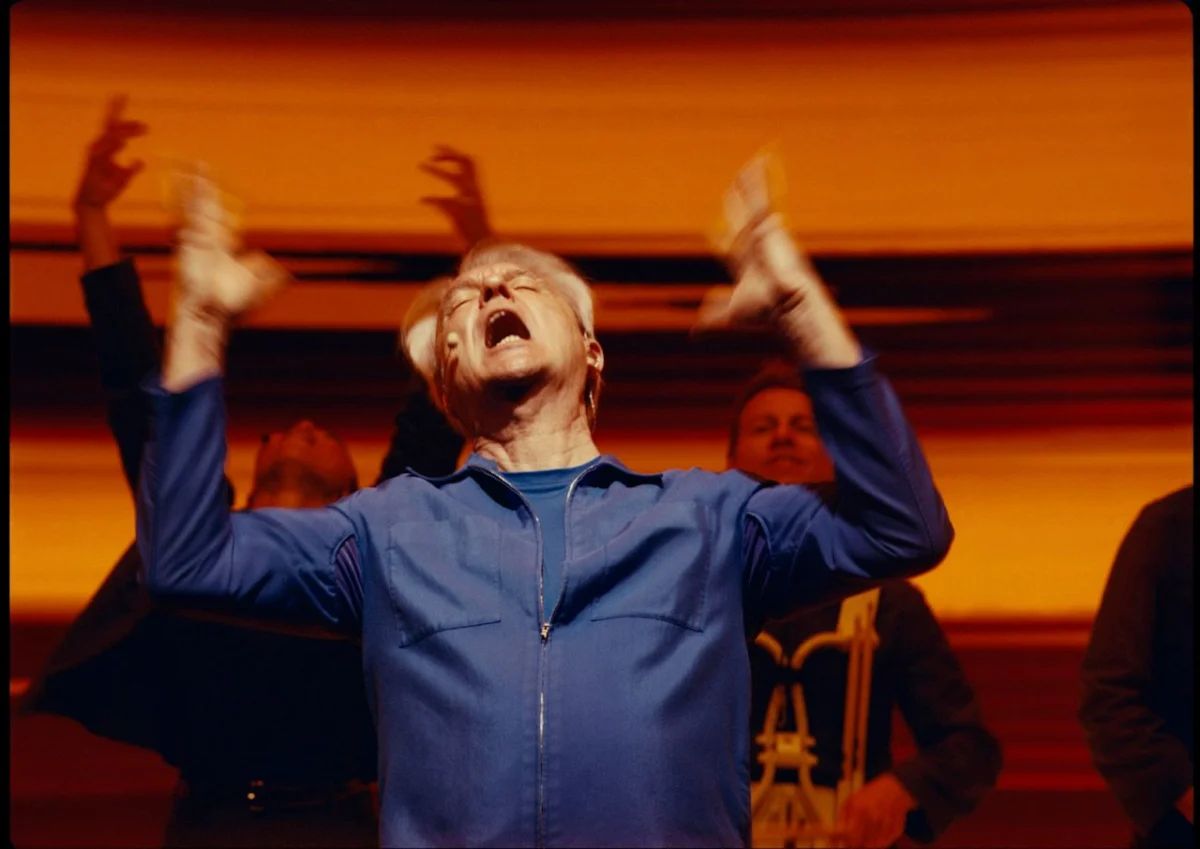
HangupsMusic.com – Baltimore, The landscape of music cinematography is poised for a monumental shift as legendary avant-garde icon David Byrne prepares to unveil his latest celluloid venture, Who Is the Sky? This upcoming concert film marks a significant collaboration between the former Talking Heads frontman and the critically acclaimed writer-director Brady Corbet, whose recent work on The Brutalist has cemented his reputation as one of the most ambitious voices in modern cinema. Captured over a series of performances in Byrne’s own hometown of Baltimore, the project represents a convergence of high-art filmmaking and the kinetic energy of live performance, shot entirely on 70mm film to ensure a visual experience of unprecedented scale.
While David Byrne is no stranger to the intersection of stage and screen, Who Is the Sky? arrives as a spiritual and technical successor to his 2023 collaboration with Spike Lee, the filmed version of the Broadway sensation American Utopia. However, where Lee’s approach focused on the intimacy and social connectivity of the stage, Corbet’s vision appears to be leaning into the grand, panoramic possibilities of the medium. By choosing to shoot in 70mm—a format typically reserved for sweeping historical epics or the high-concept blockbusters of directors like Christopher Nolan—Corbet and Byrne are signaling that this is not merely a document of a concert, but a cinematic event designed to be felt as much as heard.
In a personal statement regarding the project, Byrne expressed a sense of genuine awe at the results of Corbet’s technical choices. The musician admitted that when the director first proposed the idea of utilizing 70mm film, he did not fully grasp the transformative nature of the format. It was only after viewing initial frames and test shots that Byrne realized the immense difference in clarity, depth, and scope. According to Byrne, the wide-screen visual field captured by the 70mm cameras managed to translate the physical breadth of his live show in a way he had never previously witnessed. This endorsement suggests that Who Is the Sky? will offer a perspective on Byrne’s choreography and stagecraft that transcends the traditional limitations of the concert film genre.
The choice of Baltimore as the filming location adds a layer of emotional resonance to the production. Although Byrne is often associated with the downtown New York art scene of the 1970s and 80s, his roots trace back to the Maryland city. Filming the tour’s definitive visual document in his hometown provides a sense of full-circle narrative, grounding the high-concept production in a place of personal history. The performances captured for the film were part of Byrne’s most recent touring cycle, which continued his exploration of untethered movement and ensemble-driven musicality.
To understand the weight of this announcement, one must look at the pedigree of the director involved. Brady Corbet has spent the last decade transitioning from a respected actor to a formidable filmmaker known for his uncompromising aesthetic and intellectual depth. His films, such as The Childhood of a Leader and Vox Lux, often deal with the intersection of public persona and historical trauma, utilizing a visual language that is both stark and opulent. His most recent triumph, The Brutalist, further demonstrated his mastery of the 70mm format, earning him widespread acclaim at international film festivals. Bringing this "prestige cinema" sensibility to a David Byrne concert film suggests a project that will be as much a piece of visual art as it is a musical showcase.
The technical decision to use 70mm film is perhaps the most intriguing aspect of Who Is the Sky?. In an era where digital cinematography is the industry standard for its convenience and lower cost, the use of large-format film is a deliberate, artisanal choice. 70mm offers a resolution and color depth that digital sensors struggle to replicate, providing a "larger-than-life" quality that can make the figures on screen feel three-dimensional and immediate. For a performer like Byrne, whose stage shows rely heavily on geometry, lighting, and the physical relationship between bodies in space, the high fidelity of 70mm allows every micro-movement and lighting cue to be preserved with startling clarity.
.jpeg)
This project also serves as a new chapter in what is arguably the greatest legacy of concert films in music history. In 1984, Byrne and the Talking Heads collaborated with director Jonathan Demme to create Stop Making Sense, a film widely regarded as the gold standard of the genre. By stripping away the tropes of the typical rock documentary—such as backstage interviews or crowd reaction shots—Demme and Byrne focused entirely on the build-up of the performance itself. Decades later, Byrne returned to the format with Spike Lee for American Utopia, which adapted his Broadway residency for a global audience. Who Is the Sky? appears ready to take its place alongside these masterpieces, offering a contemporary lens on Byrne’s ever-evolving artistic philosophy.
While specific release dates and distribution details for Who Is the Sky? remain under wraps, the anticipation within both the music and film communities is palpable. The film is being produced by Deep End Films, a company that has become synonymous with pushing the boundaries of independent cinema. The partnership between Byrne’s playful, inquisitive musicality and Corbet’s rigorous, cinematic grandiosity promises a final product that defies easy categorization.
Beyond the technical specifications, the film is expected to capture the thematic essence of Byrne’s recent work. Throughout his solo career and his "Reasons to be Cheerful" initiative, Byrne has focused on themes of human connection, the joy of collective effort, and the importance of looking at the world with a sense of renewed wonder. The title itself, Who Is the Sky?, suggests a continuation of these existential and observational inquiries. When paired with the visual majesty of Corbet’s direction, these themes are likely to be amplified into something truly immersive.
The "untethered" nature of Byrne’s recent tours—where every musician on stage is mobile, carrying their instruments without the need for cables or stationary drum kits—has revolutionized what a live concert can look like. It turns the stage into a fluid, dancing landscape. Capturing this fluidity on 70mm film requires a specific kind of directorial choreography, one that Corbet is uniquely suited to execute. The result is expected to be a film that doesn’t just show the audience what happened on stage, but places them within the rhythmic heart of the performance.
As the industry awaits further news on when Who Is the Sky? will hit theaters, the project stands as a testament to David Byrne’s refusal to settle for the status quo. Even after fifty years in the spotlight, he continues to seek out new collaborators and new technologies to recontextualize his art. By teaming up with a filmmaker of Brady Corbet’s caliber and insisting on the highest possible visual standard, Byrne is ensuring that his latest live era will be preserved not just as a memory, but as a monumental piece of cinema.
For fans of Byrne, the film represents an opportunity to see the artist in a new light—quite literally. The 70mm format’s ability to capture the nuance of stage lighting and the texture of the performers’ grey suits will likely offer a sensory experience that rivals being in the front row of the Baltimore theater where it was recorded. For cinephiles, it is a rare chance to see a contemporary director apply the most prestigious of film formats to the vibrant, unpredictable world of live music.
As the curtain prepares to rise on Who Is the Sky?, the conversation around the concert film as an art form is being reinvigorated. In a digital age, David Byrne and Brady Corbet are making a loud, beautiful case for the enduring power of celluloid. Whether it is the homecoming energy of the Baltimore setting or the sheer ambition of the 70mm frame, this project is set to be a landmark release, proving once again that when it comes to the fusion of sight and sound, David Byrne remains in a league of his own.
