
 By Azzam Bilal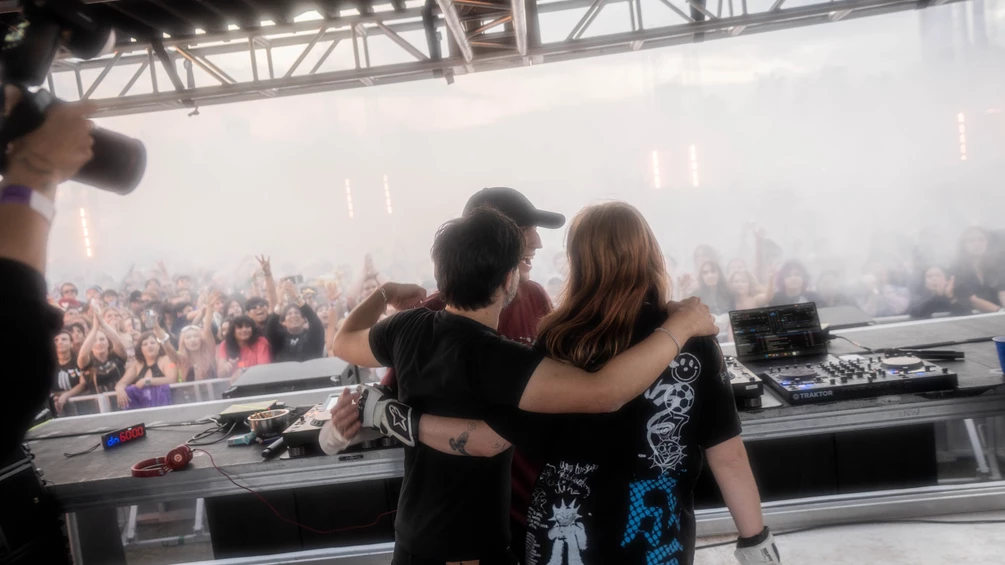
HangupsMusic.com – Seattle, the emerald city of the Pacific Northwest, became the epicenter of the electronic music world this past Saturday, August 29th, as an unprecedented gathering of titan-level talent descended upon the historic Gas Works Park. In a curated "Day Party" takeover that felt more like a cultural summit than a standard concert, Skrillex made his triumphant return to the city after a fourteen-year hiatus, bringing with him a hand-picked roster of innovators including Porter Robinson, Ninajirachi, Dylan Brady, Underscores, and Nick León. The event, which was shrouded in a strict no-phones policy, emphasized a return to the communal, ephemeral roots of rave culture, set against the rusted, industrial majesty of Lake Union’s most iconic landmark.
The significance of the location cannot be overstated. Gas Works Park, with its towering, skeletal remains of a coal gasification plant, provided a stark, beautiful contrast to the cutting-edge digital soundscapes being projected from the stage. For many in attendance, the event was a full-circle moment. The last time Sonny Moore, the man known globally as Skrillex, performed a formal set in Seattle was back in 2012, when he headlined the Bumbershoot festival at KeyArena. In the decade and a half since, Moore has evolved from the poster child of the American dubstep explosion into a sophisticated, multi-genre auteur. This return was not just a performance; it was a demonstration of his current artistic philosophy—one centered on collaboration, spontaneity, and the human experience.
The structure of the day was intentionally fluid, eschewing traditional "opening" and "headlining" slots in favor of a series of back-to-back (B2B) and back-to-back-to-back (B3B) performances. This format, organized personally by Skrillex, allowed for a rare level of creative cross-pollination. The highlight of the afternoon was undoubtedly the triple-threat set featuring Skrillex, Porter Robinson, and the rising Australian phenom Ninajirachi. The chemistry between the three was palpable, blending Skrillex’s rhythmic precision and heavy-hitting low end with Robinson’s emotive, synth-pop sensibilities and Ninajirachi’s crystalline, hyper-detailed production style.
The no-phones policy played a crucial role in the day’s atmosphere. In an era where most live music experiences are viewed through the glowing rectangles of smartphones, the organizers’ decision to prohibit photography and video recording forced the thousands in attendance to engage directly with the music and each other. This choice created a palpable sense of presence. Without the distraction of capturing content for social media, the crowd’s energy remained focused on the stage and the surrounding environment. It was a bold move that echoed a growing sentiment within the electronic community—led by artists like Lane 8 and Damian Lazarus—that the sanctity of the dancefloor must be protected from digital intrusion.
Despite the ban on personal recording, the sensory impact of the day was undeniable. At one poignant moment, as the sky over Lake Union began to shift into shades of amber and violet, Skrillex paused the music to acknowledge the natural beauty of the Pacific Northwest. He gestured toward the horizon, encouraging the audience to turn away from the stage and take in the view. "Everyone turn around and look at the sunset; this is what I’m seeing," he reportedly told the crowd, adding a heartfelt, "Shoutout to sunsets." It was a humanizing moment that broke the "rockstar" barrier, reminding everyone that even global superstars are susceptible to the simple awe of a summer evening.
The musical palette of the day was as diverse as the lineup itself. Skrillex utilized the set to showcase a vast array of material, weaving together classic tracks that defined his early career with unreleased IDs and cuts from his most recent projects. The inclusion of Dylan Brady (one half of the experimental duo 100 gecs) and Underscores highlighted Skrillex’s ongoing fascination with the hyperpop and "digicore" movements. These artists, known for their frantic, glitch-heavy aesthetics, provided a sharp edge to the day’s proceedings, while Nick León brought a rhythmic, Latin-influenced flair that kept the energy moving through the afternoon heat.
The event comes at a particularly prolific period for Skrillex. After years of relatively quiet output, Moore has returned to the forefront of the industry with a relentless schedule of releases and high-profile performances. In June of 2026, he surprised the world with the release of SOMA, an album that further solidified his transition into a more experimental, club-oriented sound. SOMA has been praised by critics for its intricate sound design and its ability to bridge the gap between underground techno sensibilities and mainstream appeal. This was preceded by "Rumpta," a collaborative single with the legendary Solomun, which has become a staple of the European summer circuit.
Beyond his musical output, Skrillex has also been more vocal about his views on the state of the industry. In his first formal interview in ten years, he recently addressed the looming influence of Artificial Intelligence in music production. His stance was one of cautious optimism tempered by a fierce defense of human emotion. He argued that while AI-generated songs have the potential to go viral or achieve technical perfection, they lack the essential quality of "feeling seen." According to Moore, the connection between an artist and an audience is predicated on a shared human experience—a sentiment that was perfectly illustrated by the phone-free, sunset-watching crowd at Gas Works Park.
The Seattle "Day Party" also served as a spiritual successor to Skrillex’s recent high-energy appearances abroad, including a much-discussed set at Boomtown 2026 where he brought out drum and bass legends Chase & Status. That performance, much like the Seattle takeover, showcased his ability to act as a bridge between different generations and subgenres of electronic music. Whether he is performing at a massive UK festival or a curated park party in the US, the common thread is a commitment to the "vibe" over the spectacle.
For Porter Robinson, the Seattle event was another chapter in a transformative year. Following the success of his genre-bending project SMILE! 😀, Robinson has been exploring a more colorful, indie-adjacent sound that perfectly complemented the outdoor, daytime setting of Gas Works. His long-standing friendship with Skrillex—dating back to the early days of Moore’s OWSLA label—was evident in their seamless B2B transitions. Meanwhile, Ninajirachi’s presence on the bill signaled her ascent into the upper echelon of the global scene. Her ability to hold her own alongside two of the biggest names in the genre was a testament to her technical skill and unique sonic identity.
As the final notes echoed across the water and the industrial ruins were bathed in the last light of the day, the significance of the event became clear. This wasn’t just a concert; it was a statement of intent. By choosing a non-traditional venue, enforcing a no-phones rule, and focusing on collaborative sets, Skrillex and his team managed to create something that felt genuinely "exclusive" in an age of over-exposure. It was a reminder of why Seattle remains a vital hub for music culture, and why Skrillex, despite nearly two decades in the spotlight, remains one of the most influential and unpredictable figures in modern music.
The Gas Works Day Party will likely go down as a landmark moment in Seattle’s electronic music history. It bridged the gap between the dubstep-heavy nostalgia of 2012 and the experimental, multi-faceted landscape of 2026. For those lucky enough to be within the park’s perimeter, the lack of digital evidence will only serve to make the memory more vivid. In an industry increasingly driven by algorithms and data, Skrillex and his collaborators proved that there is still no substitute for a sunset, a sound system, and a shared moment of human connection.
