
 By Azzam Bilal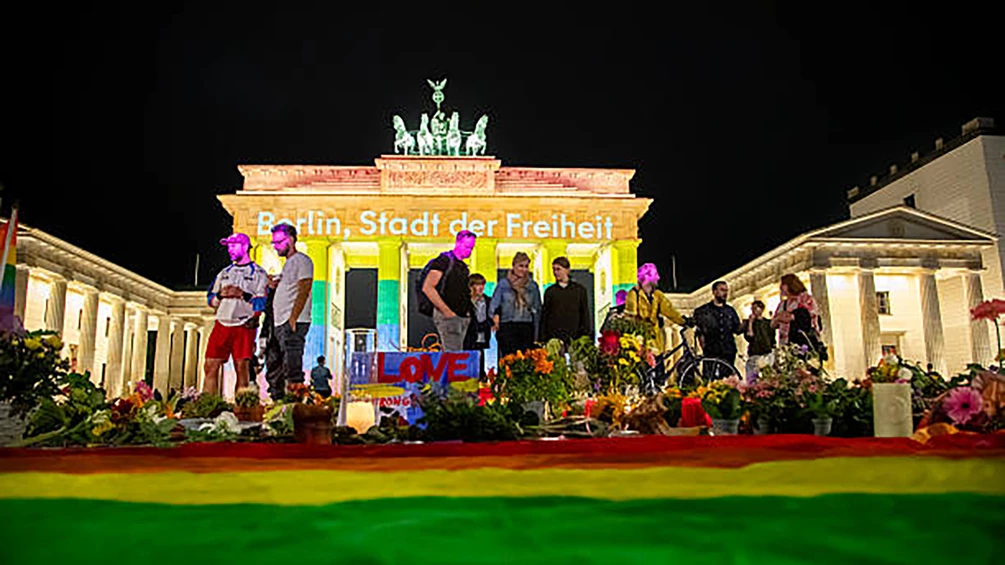
HangupsMusic.com – Berlin, what was intended to be a weekend of liberation, visibility, and vibrant celebration in the heart of Germany’s capital was abruptly transformed into a scene of mourning and national reflection. On Saturday, July 25th, the annual Christopher Street Day (CSD) celebrations—one of the largest and most significant LGBTQ+ gatherings in Europe—were shattered by a violent assault that has since been classified by authorities as a suspected Islamist terror attack. The incident, which took place in the shadows of the historic Brandenburg Gate, has left one person dead and dozens injured, sending shockwaves through Berlin’s globally renowned queer community and its interconnected nightlife industry.
The attack unfolded at approximately 10:00 PM on Saturday night, just as the day’s massive parade and festivities were reaching their twilight. According to police reports, a vehicle was driven intentionally into a dense crowd of attendees near Tiergarten park. The chaos did not end with the vehicular assault; the suspect, later identified as 21-year-old German national Abdul Ballout, allegedly exited the vehicle and began attacking bystanders with a blade. The frantic scene resulted in the death of a 65-year-old Polish woman and caused injuries to at least 29 other individuals, many of whom remain hospitalized.
In the immediate aftermath, Berlin’s security services launched a massive manhunt for the perpetrator. The search concluded on Sunday, July 26th, when police tracked Ballout to an allotment garden complex in the city’s Spandau district. During the confrontation, Ballout was shot and killed by law enforcement officers. As the investigation deepened, federal prosecutors and security officials began piecing together a profile of a young man who had long been on the radar of German intelligence services.
Abdul Ballout was not a stranger to the legal system. His criminal record included previous convictions for robbery and assault, but it was his ideological leanings that had previously drawn the most serious attention from the state. Reports indicate that Ballout had previously attempted to travel to the Middle East to join the Islamic State (ISIS). He was intercepted and arrested in Lebanon before being repatriated to Germany. Upon his return, he was charged with "preparing a serious act of subversive violence." However, in a detail that has sparked intense debate regarding judicial leniency and extremism monitoring, he was sentenced as a juvenile to 22 months in prison, a sentence that was ultimately suspended. This history has led many to question how an individual with known extremist aspirations was able to carry out such a high-profile attack in the center of the capital.
The political response was swift and somber. German Chancellor Friedrich Merz condemned the violence in the strongest possible terms, labeling the attack "heinous" and a direct assault on the fundamental values of German society. Speaking at a vigil held at St. Mary’s Church on Sunday, Merz addressed the grieving crowd and the wider LGBTQ+ community. "We will not allow this poison of terrorism to spread further in our society," the Chancellor declared. He urged the public to remain steadfast in the face of fear, emphasizing that the primary objective of such acts is to fracture the social fabric. "Don’t let yourselves, let us not let ourselves be intimidated. These acts have only one purpose: they aim to divide our society. They want to take away from us the most important thing we have: namely our openness and our freedom."
While the political sphere grappled with policy implications and security failures, the organizers of Berlin CSD focused on the humanitarian and social impact. In a statement released shortly after the tragedy, a spokesperson for the organization called for unity and cautioned against the weaponization of the tragedy for political ends. "We don’t want this act to be exploited for political purposes or for people to be placed under general suspicion," the spokesperson noted. They characterized the violence as a calculated attempt to incite hatred between different segments of the population, reaffirming that the spirit of Pride is rooted in the refusal to be divided by such malice.
For Berlin, a city where the lines between political activism and nightlife often blur, the clubbing community has been particularly vocal in its response. Berlin’s electronic music scene is world-famous not just for its sound, but for its role as a sanctuary for marginalized groups. In the wake of the attack, major promoters, DJs, and venues have stepped forward to offer solidarity.
Homies, a prominent LGBTQ+ club night that was hosting an event at Oxi club on the night of the attack, shared a poignant reflection on the nature of Pride. They reminded their followers that the event’s origins are rooted in struggle rather than mere celebration. "Moments like these remind us why Pride has never simply been a party," the collective stated. "When hate tries to push queer people out of public space, our answer cannot be to disappear. Our answer is to hold each other a little closer. To check in on one another. To mourn together. And to celebrate each other."
The Berlin Club Commission, an organization representing the interests of the city’s nightlife industry, also issued a statement expressing profound devastation. They extended their sympathies to the victims and their "chosen families," a term of particular significance within the queer community. The Commission highlighted the visibility and self-determination that Christopher Street Day represents, asserting that the attack was a direct strike against the right of queer people to exist safely in the public eye.
Individual artists have also utilized their platforms to process the trauma. Cormac, a respected Irish DJ and a long-time fixture of the Berlin scene, offered a nuanced perspective on the current cultural climate. He spoke of the ways in which modern media and digital algorithms can amplify division and outrage, suggesting that such environments provide fertile ground for the radicalization that leads to violence. "I believe in queer joy. I believe it is powerful," Cormac wrote. "But tonight, joy is harder to find. There is a time and space for joy, and there is a time for grief, for outrage, for setting boundaries, for pushing back, for standing together and demanding better."
Similarly, the international party collective He.She.They, which was hosting a Pride event at RSO Berlin when the news broke, linked the attack to a broader global trend of reactionary rhetoric. They argued that the demonization of minorities by various political actors creates a permissive environment for such tragedies. "This attack is what happens in a world where politicians and others demonize LGBTQIA+ people and minorities for power and control," the collective stated. They vowed that the community would not be silenced by fear, but would instead respond by living "louder and prouder."
The attack comes at a time of heightened tension across Europe, as governments struggle to balance security with the preservation of open, liberal societies. In Berlin, the focus has now shifted to supporting the survivors and the families of the deceased, while the city’s club scene prepares to move forward with a renewed sense of purpose. The resilience shown by the participants of CSD and the nightlife industry suggests that while the tragedy has left a deep scar, it has also reinforced the bonds of the community.
As the investigation into Abdul Ballout’s motives and potential accomplices continues, the city remains on high alert. However, the message from the streets of Berlin is clear: the values of diversity, visibility, and inclusion that define the city will not be abandoned. The upcoming weeks are expected to see further vigils and community-led discussions on how to better protect vulnerable spaces while maintaining the radical openness that makes Berlin a global beacon for the LGBTQ+ community. In the end, the response to the Tiergarten attack is being framed not just as a security challenge, but as a cultural one—a collective refusal to let hate dictate the terms of public life.
