
 By Azzam Bilal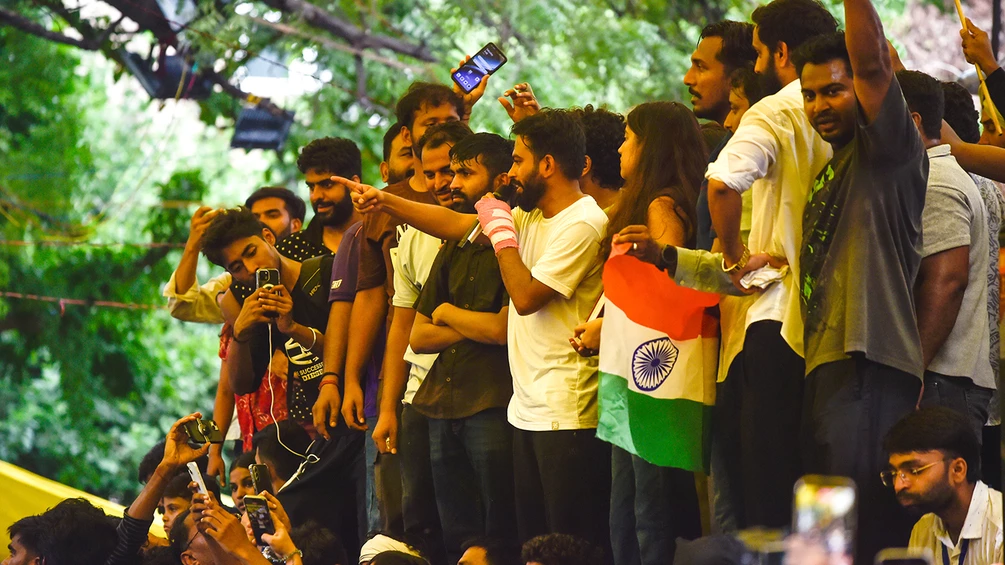
HangupsMusic.com – New Delhi, the air in India’s capital has recently been thick with more than just the usual summer heat and urban haze. It has been vibrating with the basslines of a generation that refuses to be silenced. Over the past two months, a seismic shift has occurred within the Indian socio-political landscape, driven by a Gen-Z-led movement that has successfully leveraged the power of electronic music, digital satire, and grassroots mobilization to challenge the highest echelons of power. Known as the Cockroach Janta Party (CJP), this youth-led collective has not only dominated social media feeds but has forced tangible political accountability, culminating in the high-profile resignation of Education Minister Dharmendra Pradhan. For the artists within India’s burgeoning electronic and hip-hop scenes, this is more than a moment of political friction; it is a cultural awakening where the dancefloor and the protest line have become one.
The genesis of the CJP is rooted in a profound sense of institutional betrayal. The movement was ignited by two primary catalysts: a massive scandal involving leaked entrance exam papers for medical colleges and a series of disparaging remarks from a Supreme Court Justice. When Justice Surya referred to unemployed youth and activists as "lazy cockroaches" and "parasites," he intended to dehumanize a struggling demographic. Instead, he handed them a symbol. Reclaiming the slur with defiant irony, Boston University graduate Abhijeet Dipke launched the Cockroach Janta Party as a satirical social media account. It quickly metastasized into a legitimate political force, amassing millions of followers and providing a platform for those frustrated by the skyrocketing cost of living, rampant corruption, and a perceived lack of future prospects for anyone outside the nation’s wealthy elite.
As the movement moved from the digital sphere to the streets of Delhi, the aesthetic of the protest began to mirror the vibrant, chaotic energy of India’s underground music scene. Observers have dubbed this phenomenon "Gen Z Protest-Core." It is a multi-sensory experience where cockroach costumes and street theater meet live DJ sets and improvised electronic mixes. In this environment, the traditional slogan-shouting of older generations has been augmented—and at times replaced—by the rhythmic thud of kick drums and the sharp stabs of synthesizers. This sonic rebellion has caught the attention of major figures in the electronic music world, both within India and across the global diaspora.
Prominent artists have been vocal in their solidarity. Jyoty, a London-based DJ and former DJ Mag cover star, used her massive platform to educate her international audience on the nuances of the CJP struggle, sharing detailed resources that contextualize the movement’s demands. Within India, the hip-hop community has been equally proactive. Viral producers and rappers, including Emiway Bantai, Ikka, Yungsta, Gravity, and GhAatak, have released tracks that serve as unofficial anthems for the protesters. Meanwhile, global breakout stars like Hanumankind and Raftaar have utilized their social media presence to signal that the music industry is no longer content to remain apolitical while its primary audience—the youth—is being targeted by state forces.
However, the creative energy of the movement has been met with a harsh response from the state. The situation reached a violent zenith on a recent Monday when a student march toward Parliament was intercepted by riot police. The resulting crackdown was brutal, involving the use of tear gas, water cannons, and pellet guns. Reports from Delhi hospitals detailed a harrowing array of injuries among the three hundred hospitalized students, ranging from bone fractures and head trauma to permanent eye damage. Despite this display of force, the students remained undeterred, occupying protest sites and maintaining a presence that eventually made Dharmendra Pradhan’s position untenable. His resignation on Saturday was hailed as a historic victory for youth mobilization, yet the celebration was short-lived.
The CJP has since accused the government of reneging on promises of amnesty. Despite assurances that charges against protesters would be dropped, a wave of arrests has swept through states like Assam, West Bengal, and Bihar. This perceived betrayal has led the CJP to threaten a restart of nationwide demonstrations, highlighting a deeper, systemic struggle against a government that frequently labels dissent as "anti-national."
For Taru Dalmia, the New Delhi-based artist known as Delhi Sultanate, the movement’s power lies in its ability to "scramble the matrix" of state control. As a co-founder of the BFR Sound System and a veteran of the dub and reggae scene, Dalmia views the reappropriation of the "cockroach" label as a sophisticated linguistic maneuver. He notes that the term was originally used to justify oppression—to suggest that the youth were something to be "smashed." By embracing the term, the youth have stripped the insult of its power, introducing a new political language that the regime is ill-equipped to handle. Dalmia suggests that this shift reflects a general loss of fear among the youth, drawing parallels to recent government-toppling movements in neighboring Bangladesh, Sri Lanka, and Nepal.
The international perspective remains equally focused on the systemic nature of these protests. Steve Savale of the UK’s Asian Dub Foundation observed that the removal of a single minister, while significant, is only the beginning. He emphasized that for a government controlling nearly 1.5 billion people, the fact that a youth-led movement could force such a high-level resignation is a testament to its momentum. Savale encouraged the CJP to view this as a building block for broader systemic change rather than a "flash in the pan" victory.
The movement’s expansion seems inevitable. While the initial spark was the education crisis—compounded by a botched digital grading system that led to the tragic suicides of over twenty students—the CJP is increasingly looking toward broader issues. These include environmental destruction, land rights, and the ongoing human rights concerns in regions like Manipur and Ladakh. The movement is becoming a catch-all for a generation that feels the current system is fundamentally rigged against them.
Kiss Nuka, a multi-disciplinary artist who splits her time between Mumbai and Barcelona, spoke emotionally about the power of this collective action. Currently on tour in Japan, she noted that the speed and scale of the mobilization have been extraordinary. For her, the CJP represents a generation that refuses to accept silence as their only option. She points out that the generational divide in India is being bridged not by ideology, but by the "quantifiable results of lived realities." When unemployment, inflation, and religious conflict become unavoidable, even the most conservative segments of the older generation are forced to take notice.
The role of the artist in this landscape is being redefined. Kiss Nuka argues that those with visibility have a moral obligation to stand with those who do not. The electronic music scene, often dismissed as escapist, is proving to be a vital site of political imagination. By integrating the sounds of the underground into the architecture of protest, these artists are helping a new generation envision a future that is not dictated by authoritarianism or patriarchal structures.
As India prepares for what could be another wave of nationwide unrest, the legacy of the "Cockroach" movement is already secured. It has demonstrated that creativity, humor, and a relentless beat can be as effective as any traditional political strategy. The resignation of a minister was the first major blow, but as the artists and activists of the CJP have made clear, the struggle for the soul of the nation’s democracy is far from over. The music continues to play, and the youth continue to march, proving that even those labeled as "pests" can bring a superpower to its knees.
