
 By Azzam Bilal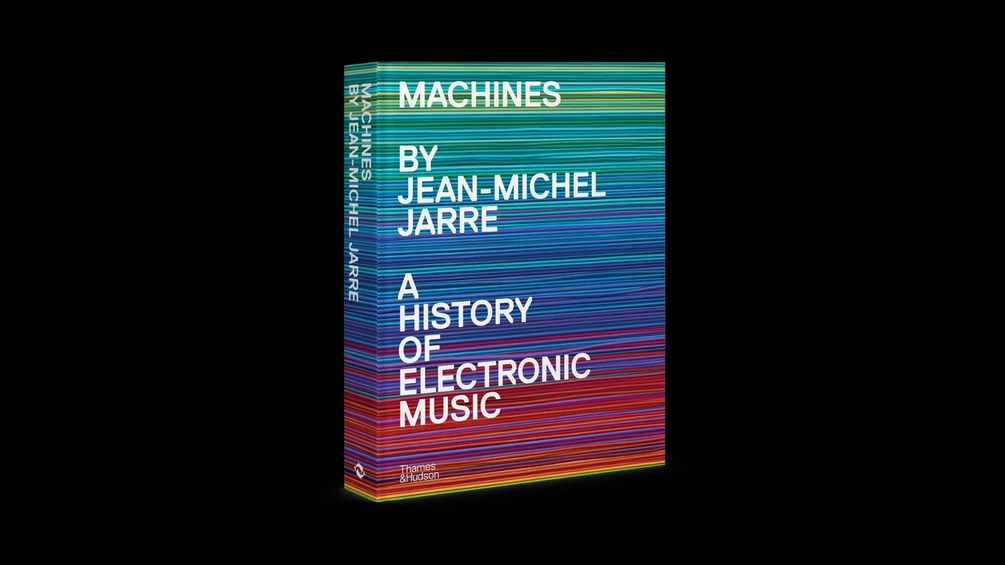
HangupsMusic.com – Paris, the landscape of modern music is often viewed through the lens of digital convenience, yet the physical tools that birthed the electronic revolution remain objects of profound fascination and historical weight. Jean-Michel Jarre, a man whose name is synonymous with the global expansion of the synthesizer, has announced the upcoming release of a comprehensive new literary project titled Machines: A History of Electronic Music. Set to be published by the prestigious house of Thames & Hudson on November 24th, the book is being positioned as the ultimate illustrated compendium of the sounds that redefined the 20th and 21st centuries. This volume does not merely catalog equipment; it seeks to narrate a century-long odyssey of human ingenuity and sonic exploration.
At the heart of Machines lies Jarre’s own formidable collection of instruments—a curated assembly of 150 electroacoustic and electronic devices that have served as the building blocks of his career and the genre at large. For Jarre, these machines are not just tools of the trade; they are historical artifacts that represent specific milestones in the evolution of how we perceive sound. By opening his personal archive, Jarre provides a rare, tactile perspective on the transition from the experimental laboratory sounds of the early 1900s to the stadium-filling textures of the modern era. The book is bolstered by over 800 high-quality illustrations, offering a visual feast for gear enthusiasts and cultural historians alike.
The narrative depth of the book is further enriched by a curated roster of contributors who represent the various branches of the electronic music family tree. Jarre has enlisted a "who’s who" of pioneers and contemporary masters to provide context and personal insight into the gear that defined their respective sounds. Among the voices featured is Gary Numan, the dark-wave pioneer who brought the Moog synthesizer into the UK Top 40, and Hans Zimmer, the legendary film composer whose use of modular systems has reshaped the sonic architecture of modern cinema. The inclusion of Vince Clarke—a founding member of Depeche Mode, Yazoo, and Erasure—highlights the pop sensibility of the synthesizer, while New Order’s Gillian Gilbert provides a perspective on the integration of electronics within the post-punk and alternative rock movements.
The scope of the project also bridges the gap between the underground and the mainstream. Techno visionary Richie Hawtin and guitar-legend-turned-electronic-experimentalist Johnny Marr offer their unique viewpoints, alongside the trance-inflected insights of Armin van Buuren. This diversity of contributors ensures that Machines is not a monolithic history, but rather a multifaceted exploration of how different artists have interfaced with technology to express their creative visions. It examines the philosophy of the "interface"—the point where the human hand meets the voltage-controlled oscillator—and how that interaction has shifted from the tactile complexity of patch cables to the sleek precision of modern interfaces.
Jean-Michel Jarre’s authority on this subject is unquestionable. As one of the few artists who can legitimately claim to have brought electronic music to the masses, his career serves as a roadmap for the genre’s growth. His 1976 masterpiece, Oxygène, remains a foundational text in the history of the synthesizer. Recorded in a makeshift home studio using a modest array of instruments like the Eminent 310 and the ARP 2600, the album bypassed the traditional gatekeepers of the music industry to become a global phenomenon. It proved that electronic music could be melodic, atmospheric, and profoundly human, rather than just cold and mechanical. Followed by the equally influential Équinoxe, Jarre established a template for the "electronic spectacular," eventually performing for record-breaking crowds in cities like Paris, Houston, and Moscow.
The timing of the book’s release precedes a significant period of celebration for Jarre and the wider electronic community. As the industry looks ahead, Jarre has been named the guest of honor for the 30th anniversary of the Amsterdam Dance Event (ADE) in 2026. This milestone for the world’s leading electronic music summit will coincide with the 50th anniversary of Oxygène. To mark the occasion, Jarre is scheduled to perform a landmark opening concert at AFAS Live on October 21st, 2026. This performance is expected to be more than a mere retrospective; it will likely be a showcase of Jarre’s ongoing commitment to technological innovation, possibly incorporating the immersive audio and visual techniques he has championed in recent years.
Jarre’s recent activities suggest that he remains as relevant today as he was during the analog boom of the 1970s. In 2024, he took center stage at the closing ceremony of the Paris Paralympics, leading a massive celebration of French electronic music. Performing alongside a new generation of artists such as Cassius, Kitten, and Anetha, Jarre demonstrated the continuity of the genre. The event served as a reminder that the "French Touch" and the broader electronic movement owe a significant debt to the groundwork Jarre laid decades ago. His ability to share the stage with techno-focused DJs and modern producers speaks to his status as a bridge between the genre’s origins and its future.
The book Machines arrives at a moment of renewed interest in analog synthesis and the physical history of music production. In an age where a laptop can emulate almost any sound ever recorded, the tactile reality of a Minimoog or a Fairlight CMI carries a certain romanticism and gravitas. Jarre’s book documents these machines not as obsolete relics, but as the DNA of contemporary sound. Each of the 150 instruments featured in the book tells a story of a specific technological hurdle overcome or a new tonal frontier discovered. From the early experiments with magnetic tape and vacuum tubes to the birth of MIDI and the digital revolution, the book promises to be an exhaustive resource.
The collaboration with Thames & Hudson is also significant. Known for producing high-end art and design books, the publisher is well-equipped to handle the visual complexity of Jarre’s collection. The 800 illustrations are expected to include rare archival photographs, close-ups of internal circuitry, and iconic promotional imagery from the manufacturers who built these legendary devices. For collectors and academics, the book will likely serve as a primary reference for identifying and understanding the evolution of synthesis.
Furthermore, the involvement of figures like Richie Hawtin and Armin van Buuren suggests the book will touch upon the evolution of the DJ and the live performer. The shift from the studio-bound "composer" to the "live performer" who manipulates machines in real-time for tens of thousands of people is a narrative arc that Jarre himself helped create. His perspective, combined with those of his peers, will offer a holistic view of the culture that surrounds the hardware.
As pre-orders for Machines: A History of Electronic Music begin to circulate, the anticipation within the audiophile community is palpable. It is rare for an artist of Jarre’s stature to provide such a transparent look into their creative arsenal. For those who have followed his journey from the experimental studios of the Groupe de Recherches Musicales to the heights of global stardom, the book represents a chance to understand the "why" behind the "how." It is a tribute to the capacitors, oscillators, and filters that gave a voice to the future.
In the broader context of Jarre’s legacy, this book and the upcoming ADE celebrations represent a closing of the circle. By documenting the history of the machines that made his career possible, Jarre is ensuring that the technical heritage of electronic music is preserved for future generations. Whether through the pages of this illustrated history or the speakers of a massive arena in Amsterdam, the message remains the same: the machine is an instrument of the soul, and its history is far from over. November 24th will mark a significant date for anyone who has ever been moved by a synthesized melody, as Jarre finally shares the blueprints of his sonic universe.
