
 By admin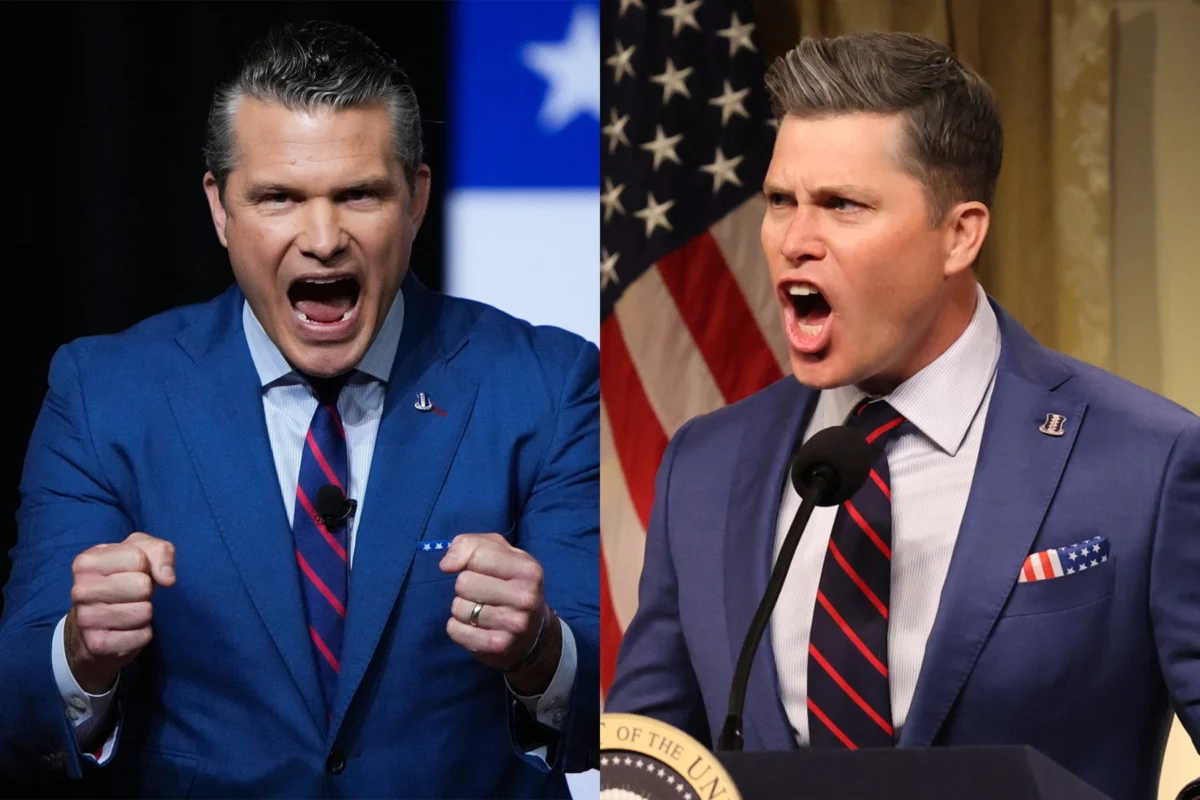
HangupsMusic.com – In an era where political discourse often feels like a performance, the line between earnest communication and theatrical spectacle has never been blurrier. This phenomenon is vividly illustrated by the recent public appearances of Defense Secretary Pete Hegseth, whose distinctive approach to briefing the press on the ongoing conflict with Iran has become a subject of both serious analysis and widespread comedic lampooning. The traditional solemnity of the Pentagon podium has, under Hegseth’s tenure, transformed into an unexpected stage, where pronouncements on national security sometimes echo the very parodies designed to mock them. This blurring of reality and satire poses intriguing questions about contemporary political messaging, media consumption, and the enduring power of late-night comedy to shape public perception, even when faced with a reality that often outpaces comedic exaggeration.
For decades, the daily press briefing at the Pentagon has served as a critical, albeit often dry, conduit for information between the United States Department of Defense and the global media. Typically characterized by a meticulous exchange of information, where spokespersons deliver carefully worded statements and field intricate questions laced with military acronyms and strategic jargon, these briefings are essential for transparency and understanding complex defense operations. They are rarely considered a source of public entertainment, instead functioning as a vital component of the fourth estate’s oversight of governmental action, particularly in matters of national security and international conflict. The expectation is one of gravitas, precision, and an unwavering focus on the factual contours of defense policy and operational updates.
However, the recent period of heightened tension and active engagement concerning Iran has ushered in a markedly different dynamic. This is largely due to the prominent and frequent personal appearances by Defense Secretary Pete Hegseth himself, who has taken a central role at the briefing podium. His presence has fundamentally altered the established rhythm and decorum of these sessions, injecting an idiosyncratic flair that stands in stark contrast to the conventional approach. Where previous secretaries might have reserved personal appearances for major policy announcements or critical junctures, Hegseth has adopted a more continuous, almost performative, engagement with the press corps.
Secretary Hegseth’s background as a former television host, particularly for a cable news network known for its opinionated and often confrontational style, appears to heavily influence his current communication strategy. His transition from a media personality to a senior cabinet official has brought with it a rhetorical style more attuned to cable news debates than diplomatic pronouncements. This often translates into a combative posture, an insistence on projecting an image of unyielding strength, and a communication cadence that prioritizes impact and repetition over nuanced explanation. He frequently employs vivid, almost hyperbolic language to describe military capabilities and intentions, often circling back to themes of decisive action and overwhelming force with a rhythmic emphasis that can be jarring in the context of a defense briefing.
Adding another layer to this personalized approach is the widely reported installation of a "beautification studio" adjacent to the briefing room. This detail, while seemingly trivial, underscores a broader emphasis on presentation and image management that deviates from the traditional no-frills environment of military communications. It signals a shift towards a more polished, media-conscious delivery, where the visual aspect of the message is given significant weight. This focus on aesthetic control, combined with Hegseth’s inherent showmanship, transforms the briefing into a more theatrical event, designed perhaps as much for direct public consumption via broadcast media as for informing the immediate press pool.
Such a distinctive communication style, particularly from a figure holding the immense responsibility of Defense Secretary during a period of active conflict, inevitably attracts the attention of cultural commentators and satirists. Among the most prominent institutions to seize upon this new reality is Saturday Night Live. With a legacy spanning nearly five decades, SNL has long held a unique position as America’s preeminent political satirist, a cultural mirror reflecting and often amplifying the absurdities of the nation’s leadership. From Chevy Chase’s bumbling Gerald Ford to Dana Carvey’s "thousand points of light" George H.W. Bush, and more recently, Tina Fey’s iconic portrayal of Sarah Palin, SNL‘s impressions have frequently become indelible parts of the collective American consciousness, sometimes even overshadowing the real-life figures they caricature.

Indeed, the show’s capacity to distill complex political personalities into memorable, often exaggerated, archetypes has profoundly influenced public perception. The catchphrases and mannerisms invented by SNL writers and performers often seep into everyday lexicon, becoming shorthand for the politicians they represent. This phenomenon highlights the potent intersection of comedy, media, and politics, where satire not only comments on reality but actively shapes it, embedding specific narratives and perceptions deep within the cultural fabric. For many, the comedic rendition becomes the primary lens through which they understand or remember a public figure.
In the case of Secretary Hegseth, SNL has found a particularly rich vein of material. "Weekend Update" co-anchor Colin Jost has taken on the recurring role, delivering a portrayal that masterfully captures and exaggerates Hegseth’s perceived public persona. Jost’s interpretation often emphasizes a "frat-boy" bravado, a performative masculinity, and an almost casual approach to grave matters of state. His Hegseth refers to the escalating conflict with Iran not as a "war" but a "situationship," a term borrowed from contemporary dating jargon that trivializes the gravity of international relations. The parody also frequently includes allusions to an "alleged drinking problem," further painting a picture of a leader whose public composure might be more precarious than projected.
What makes this particular satirical dynamic so compelling, and at times unsettling, is the observation that the real-world pronouncements from the Pentagon podium occasionally seem to defy the very possibility of comedic exaggeration. There are moments when Secretary Hegseth’s actual rhetoric, with its distinct rhythm, aggressive declarations, and unique turns of phrase, approaches a level of theatricality that can feel indistinguishable from its late-night comedic counterpart. This blurring of lines challenges the traditional understanding of satire, where the humor derives from exaggerating an existing reality. When reality itself adopts characteristics often reserved for parody, the satirist’s task becomes doubly complex, and the public’s ability to discern fact from comedic fiction is tested.
This phenomenon speaks to a broader cultural moment where the boundaries between news, entertainment, and political messaging have become increasingly porous. In an age of constant media consumption, short attention spans, and the viral spread of content, highly stylized or even absurd communication can often cut through the noise more effectively than conventional, measured discourse. The irony is that while SNL aims to critique and mock, the very style it parodies might, in some instances, be a deliberate strategy to capture public attention and project an image of unconventional strength or directness.
The implications of this convergence are significant. When the language of the nation’s defense secretary begins to echo the script of a late-night comedy sketch, it can have multifaceted effects on public trust and understanding. On one hand, it might make complex geopolitical issues more accessible, albeit in a highly simplified or dramatized form. On the other, it risks desensitizing the public to the profound seriousness of war and international diplomacy, reducing vital policy discussions to a form of public spectacle. The effectiveness of satire, too, faces a challenge: if reality consistently provides its own form of hyper-reality, does the parody lose its sting, or does it become an even more crucial lens through which to process an increasingly surreal political landscape?
Ultimately, the unfolding narrative around Secretary Hegseth’s Pentagon briefings and their rapid assimilation into popular culture by shows like Saturday Night Live serves as a fascinating case study in contemporary political communication. It highlights the pervasive influence of media backgrounds on public officials, the increasing theatricality of statecraft, and the enduring, yet evolving, role of satire in holding power to account. As the real and the parodied continue to converge, the cultural discourse around national security finds itself navigating an unprecedented terrain, where the most serious of pronouncements can, by virtue of their delivery, become indistinguishable from the most biting of jokes. This unique dynamic ensures that the performances from both the Pentagon podium and the late-night stage will continue to be subjects of intense scrutiny, analysis, and, perhaps most surprisingly, entertainment.
