
 By admin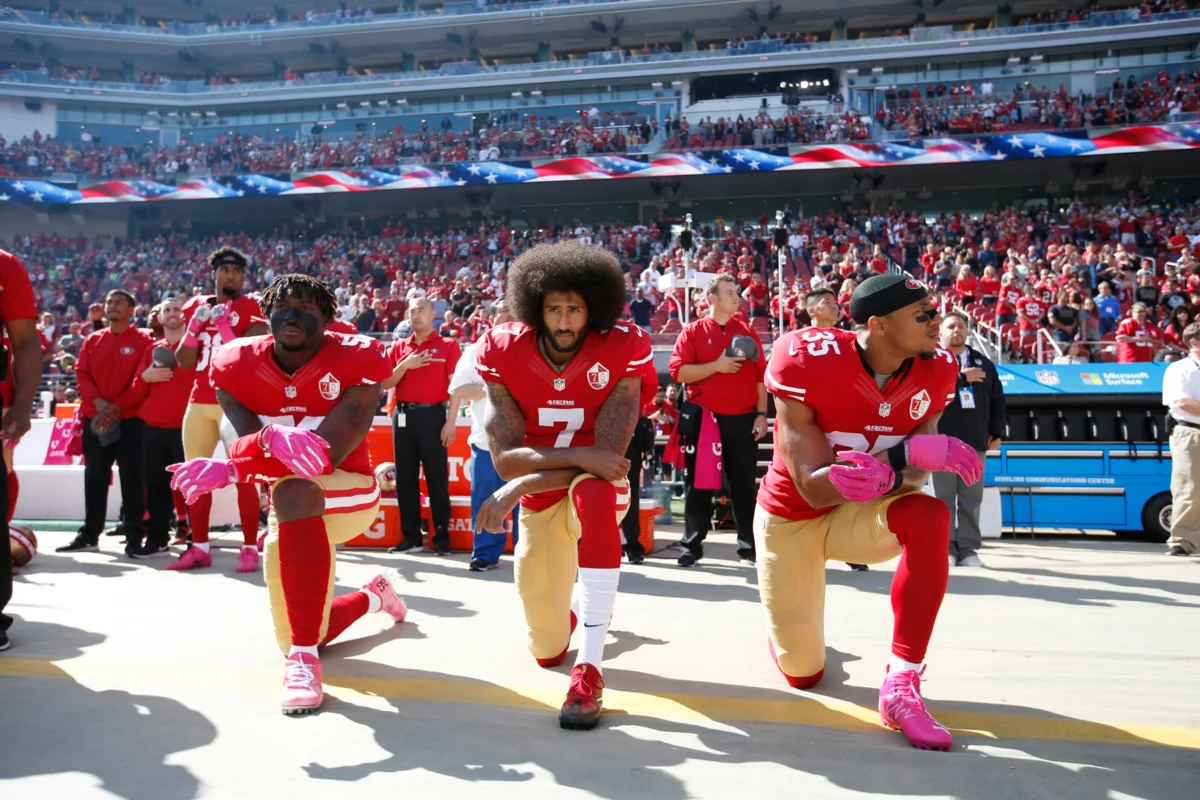
HangupsMusic.com – The act of kneeling has long been imbued with profound symbolism, traditionally signifying honor, reverence, or deep humility. For decades, it was a commonplace sight on football fields when players and coaches would drop to a knee in a gesture of shared concern for an injured athlete. However, on September 1, 2016, when San Francisco 49ers quarterback Colin Kaepernick knelt during the national anthem alongside teammate Eric Reid, the gesture took on a radically different, and profoundly polarizing, meaning. Kaepernick had articulated his stance weeks prior, stating his refusal to "stand up to show pride in a flag for a country that oppresses Black people and people of color." This singular act ignited a firestorm, transforming a simple posture into a potent emblem of resistance against systemic injustice.
The repercussions for Kaepernick were immediate and severe. By February of the following year, he found himself without an NFL contract, effectively blacklisted from the league. Yet, in the ensuing decade, his courageous protest has solidified his status as a global icon of athlete activism. Beyond the gridiron, Kaepernick has forged a formidable path as a social justice advocate, securing major sponsorships, notably with Nike, and establishing the Know Your Rights Camp. This organization empowers citizens with crucial knowledge regarding their legal protections against law enforcement, even launching a free private autopsy initiative in 2022, which notably funded the independent examination for Mississippi teen Nolan Wells. Further cementing his legacy, Kaepernick is set to release his memoir, The Perilous Fight, a title drawn from the very anthem his protest recontextualized.
Despite Kaepernick’s undeniable prominence, the narrative often overlooks the many athletes who stood in solidarity with him, some even initiating their own forms of protest before his seminal kneel. A significant moment arrived in July 2016 when the Minnesota Lynx, a WNBA team spearheaded by co-captain Maya Moore, became the first professional team to collectively demonstrate in support of Black lives. Dr. Drew Brown, a professor of sociology and African American studies at the University of Florida, highlights the unique nature of this early movement: "Black women were leading as whole teams, which hadn’t been seen before." He points to the pervasive issue of "misogynoir" and the comparatively lower financial stature of women athletes at the time as reasons for the limited media attention. While male athletes risked multi-million-dollar contracts, the WNBA players, despite risking their livelihoods, did not generate the same "spectacle" in mainstream media.
For many male professional athletes who joined the movement, including Miami Dolphins receiver Kenny Stills and Oakland A’s catcher Bruce Maxwell, their careers often faced premature ends, leaving them to forge new paths with minimal corporate backing. While 2020 saw a fleeting corporate embrace of the Black Lives Matter movement – with MLB confronting its segregated past, the NFL pledging $250 million towards anti-racism initiatives, and the NBA pausing playoff games in response to the police shooting of Jacob Blake – the earlier, harsh backlash had already cast a long, chilling shadow over future athlete activism.
Kenny Stills, who departed the NFL in 2021 due to diminishing playing time and injuries, observes a noticeable decline in vocal athlete protest within the U.S. "It seems like there have been less athletes using their voice," Stills remarks. He notes, however, a contrasting trend among international players. "I was excited to see Lamine Yamal from Barcelona wave the Palestinian flag in their parade. He’s one of the biggest stars at the moment and that’s inspiring for the next generation." Yet, the fear of reprisal remains palpable for many. "A lot of guys are afraid because they understand the consequences, whether it be something like Colin, or my situation, slowly being eased out."
A decade on, as the NFL maintains its position as the nation’s most-watched sport, Kaepernick is widely revered as the catalyst for modern sports activism. Yet, this cultural reduction to a single figurehead inadvertently diminishes the crucial contributions of countless others. The compelling stories of leaders like Moore, Stills, and Maxwell, who championed the cause within their respective leagues and teams, often recede into obscurity. Dr. Harry Edwards, a pivotal organizer of the 1968 Olympics protest and a consultant to the 49ers in 2016 (though he is critiqued by Kaepernick in Perilous Fight), emphasizes this point. "People remember the NBA work stoppage. People remember Kaepernick," he states, drawing a parallel to a lesser-known civil rights figure. "Every now and then, somebody asks me where the next Dr. King is coming from but I’m not looking for that. I’m looking for the next Claudette Colvin," referring to the overlooked pioneer who defied segregation on a Montgomery bus months before Rosa Parks. Edwards concludes, "People follow Dr. King’s pattern, because it is the pattern in American society. Sports recapitulates society."
To commemorate the tenth anniversary of Kaepernick’s powerful protest, Rolling Stone connected with Maya Moore, Bruce Maxwell, and Kenny Stills – athletes from different leagues, each with unique experiences, who all took a stand in the summer of 2016 and beyond.
Maya Moore: A Champion’s Sacrifice for Justice

The week of July 4, 2016, unfolded in a grim sequence of events. On Tuesday, July 5, Alton Sterling was killed by police in Baton Rouge, Louisiana. The following day, as the Lynx traveled to New England, Philando Castile was fatally shot during a routine traffic stop in Falcon Heights, Minnesota, a mere twenty minutes from the Lynx’s home arena.
"Because the WNBA is made up of majority Black women, it wasn’t a shock to us," Moore reflects. "But as a community in Minneapolis, when Philando Castile happened in our backyard, that triggered our collective past as Black folks, or just humanity. You don’t have to be Black to feel the devastation of violence." Moore recounts how head coach Cheryl Reeve approached the team, offering support: "She said, ‘I know y’all are probably hurting, and if you want to do something, do it.’" That very evening, as the Lynx battled the Connecticut Sun in overtime, five Dallas police officers were ambushed and killed by a sniper during a Black Lives Matter protest.
The following Saturday, before their game against the Dallas Wings, the Lynx leadership formulated a plan. During warm-ups, Moore and her co-captains led the team in a silent demonstration, donning black T-shirts that proclaimed, "Change Starts With Us – Justice & Accountability." The back of the shirts bore the names of Sterling and Castile, above the Dallas police shield, with "Black Lives Matter" printed below. Moore articulated their message in a pre-game press conference: "If we take this time to see that this is a human issue…we can greatly decrease fear and create change. Tonight we will be wearing shirts to honor and mourn the losses of precious American citizens and to plead for change in all of us."
Activism was deeply ingrained in Moore’s life long before 2016. In 1998, when she was just nine, 18-year-old Jonathan Irons received a 50-year sentence for a burglary and assault he did not commit. Two years into his incarceration, Irons began music classes with Moore’s great-uncle, who ran a prison ministry choir program. "My great uncle has a passion for music, with a big heart for prison ministry. He saw something in [Jonathan] and challenged him to be a leader," Moore recalls. Irons’ case frequently came up in family discussions, and he became an honorary family member through her godparents’ consistent visits. In the summer of 2007, before leaving for the University of Connecticut, Moore visited Irons for the first time. "My life wasn’t the same [after that]," she says, describing the formation of a deep friendship.
Inspired by Irons’ plight, Moore delved into legal studies and his case. The deaths of Trayvon Martin in 2012 and Michael Brown in 2014 further fueled her commitment. By the time Sterling and Castile were killed, Moore had reached her breaking point. She believes women basketball players inherently possess an "activism strand in our DNA, because of how hard we’ve worked to have a place in this industry." Indeed, in 2014, Ariyana Smith, a Black player for Knox College, had already become the first athlete to protest on behalf of Black Lives Matter during a game, kneeling and then collapsing for four and a half minutes to symbolize Michael Brown’s exposure.
In 2019, at the pinnacle of her WNBA career, Moore made the extraordinary decision to step away from the sport to dedicate herself fully to advocacy and Irons’ freedom. In September 2020, Irons’ conviction was overturned, leading to his release. The two married and now co-authored a book, Love and Justice: A Story of Triumph on Two Different Courts, and continue their work in criminal justice reform. "This is what my life’s journey was calling for and I was sensing my purpose needed to shift," Moore states, explaining her decision to prioritize the demanding fight for Jonathan’s freedom and their shared advocacy.
Bruce Maxwell: The Lonely Stand in Baseball
Bruce Maxwell’s connection to baseball was cultivated from a young age by his father, a Black Army veteran. "It was my primary sport my whole life," Maxwell shares. "My training was different. It wasn’t a game to me." Growing up biracial in Huntsville, Alabama, presented unique challenges. Despite the city’s thriving Black community, the cultural echoes of Jim Crow laws, abolished just 28 years before his birth in 1990, remained potent. "My neighbors were racist as shit," Maxwell recounts, sharing how his father was called "darky" and his parents received racial slurs from both sides of their families. His first personal encounter with racism on the field came at age eight or nine. "I was called a n-gger," he says, a word he had heard throughout his life. Trips with his traveling team through the Deep South often brought racist threats, yet his passion for baseball endured.
After college, Maxwell was drafted by the Nashville Sounds, a Milwaukee Brewers affiliate. His life took a dramatic turn on July 22, 2016, when he was called up to the Oakland Athletics. He enjoyed a successful rookie season, becoming the first Black catcher in MLB in nearly two decades and one of the league’s hottest hitters that September. "I thought I belonged, and I played with the notion of I can make a difference. Unfortunately, my career got cut short."

The catalyst for Maxwell’s protest came on Friday, September 22, 2017. During a rally in Huntsville, President Trump vehemently attacked kneeling NFL players. "Wouldn’t you love to see one of the NFL owners, when somebody disrespects our flag, say ‘Get that son of a bitch off the field right now?’" Trump declared to a roaring crowd. "Some owner…is going to say, ‘That guy who disrespects our flag, he’s fired.’" With only a year in the league, Maxwell was incensed. "I watched these people in the town I was raised, stand up, and support that shit," he recalls. "It sent me over the edge, I was pissed. I was a nobody still, but this was bigger than my paycheck. Bigger than baseball."
Before his next game, Maxwell consulted his father, who, instead of dissuading him, "educated me on what was coming." Returning to the locker room, he met with his team managers. "I was like, ‘If you guys don’t want me to do this, I’ll find another way.’ Both of them looked at me and said, ‘You have our full support. We’ll stand behind you.’" He then addressed his teammates. Only Trevor Plouffe spoke up: "He said, if I were you, I wouldn’t do it, but I’m not you," Maxwell recounts. "He goes, ‘Whatever you do, I’ll sit right here and support you.’"
On September 23, as Serene Smith Wheelwright sang the anthem at the Oakland-Alameda County Coliseum, Maxwell knelt, his green and gold A’s cap over his heart, while teammate Matt Canha placed a hand on his shoulder. "I got a whole lot of boos, a whole lot of cheering and [had] a whole lot of shit coming my way," he says. "It was kind of the end all be all after that."
The impact was swift and severe. While some former players offered support, Maxwell felt abandoned by his team once the backlash intensified. "I didn’t do it to get notoriety," he explains, "But I had no support system. It was a pretty rough time." By September 25, death threats poured in, targeting his family with threats of bombs, lynching, and violence.
As the season concluded on October 1, Maxwell plunged into depression, becoming reclusive. "I lost a lot of [people] who I thought were friends in the game," he reflects. "They stopped talking to me because I was too hot to touch. To this day, I haven’t talked to a lot of my teammates." His parents conducted a wellness check, and friends tried to help him. However, events took a darker turn later that month. According to a podcast interview, still reeling from the threats, Maxwell was arrested after an incident involving a delivery driver. Mistaking a knock for a threat, he grabbed his gun, startling the driver who then called the police, leading to Maxwell’s apartment being surrounded by officers. (Maxwell declined to elaborate on the arrest for Rolling Stone).
In April 2018, Maxwell, projected to start as catcher, pleaded guilty to disorderly conduct, receiving probation and community service. His spring training was unproductive, and by June, he was demoted to the minors. At season’s end, the A’s released him, and despite multiple attempts, he was never re-signed. "I went to Mexico in 2019 and [won] two championships," he notes. "I got back to the states to play for the Mets and got passed over during Covid. It was politics." In 2020, following the highly publicized deaths of Breonna Taylor and George Floyd, some players expressed remorse for their previous silence. "I felt like a sell out," Cleveland outfielder Delino DeShields told a news station. "I should’ve been out there with him." Yet, for Maxwell’s baseball career, it was too late. He now runs a private security team, having "just lost the love for everything."
Kenny Stills: From Gridiron to Activism’s Frontline
By August 2016, Kenny Stills was experiencing a profound awakening. He began closely monitoring news coverage, observing the disproportionate rate at which Black men, his own demographic, were being killed by police. With Barack Obama’s presidency nearing its end and five months remaining until the election, Stills was preparing to cast his first vote. On the outskirts of Miami, he witnessed a disturbing sight: Trump flags flying alongside Confederate banners. "You’d be parked at a stop light and all of a sudden it’s trucks with flags waving at 7 a.m.," Stills recalls. "Just felt ass backwards."
Born in 1992 in Edina, Minnesota, to Kenneth Stills Sr., a former NFL player, and Annette Delao, Stills grew up in Oceanside, California, near major Naval and Marine bases. His paternal grandfather was a Marine, and military influence permeated his childhood, with many coaches having military ties. Retired Marine Joe Mascarenaz Sr., his childhood best friend’s father and his little-league coach, was particularly influential. "Playing for Coach Joe instilled a strong work ethic," Stills wrote in his memoir, Still Growing, Still Learning, Still Me. "He emphasized toughness…discipline and ran us just like the Marines." This dedication led him to a full scholarship at the University of Oklahoma and, in 2013, to being drafted by the New Orleans Saints.

By 2016, playing for the Miami Dolphins, Stills was at the height of his career, and his worldview was expanding. "I grew up in a family that didn’t talk about politics," Stills tells Rolling Stone. "In order for me to vote, I started paying attention, watching the news. I saw Colin [Kaepernick] and Eric [Reid] and people were upset. I also saw the continuous deaths of Black and brown people."
On September 11, the NFL’s official opening week, the Dolphins were scheduled to play the Seattle Seahawks. Stills planned to kneel for the first time, alongside teammates Arian Foster, Jelani Jenkins, and Michael Thomas. However, he felt apprehensive about such a politically charged act in Seattle, a city with a rich military history. He called his revered former coach, Joe Mascarenaz. "I asked him not to take a knee," Mascarenaz told Sports Illustrated in 2019. "I told him, ‘Remember, your grandfather wore that uniform. I wore that uniform. People are dying in Afghanistan and Iraq. Don’t disrespect them.’" Despite this advice, Stills proceeded with his silent protest. As team captain, he held a players’ meeting to inform them of his decision. "Guys were screaming and shouting over each other. Some said they couldn’t support the protest because of their military families," Stills detailed in his book. "Others were concerned how it could affect their paycheck…a few just wanted to play…and stay out of the drama. And then, there were those who didn’t give a fuck."
As the anthem swelled through CenturyLink Field, an American flag nearly spanning the entire 100-yard field, Stills, along with four other teammates, knelt. The Mascarenaz family stopped speaking to him. "It felt minuscule to the actual problems we were dealing with but it was frustrating," Stills tells Rolling Stone. "I was trying to do the right thing, and it was being misconstrued." When Stills dropped a pass during the game and the Dolphins lost, the backlash intensified. "They tried to use the outcome of the game as the reason to not support what we were doing," he explains. "My teammates, the coaching staff, and ownership was making us feel like the reason was because we were involved in the protest." Nevertheless, Stills continued to kneel and play, contributing to the Dolphins’ first playoff appearance in eight years.
During the offseason, Stills immersed himself in the works of James Baldwin and documentaries on Angela Davis. He soon received an invitation to an Israeli government-sponsored trip with several other NFL players. However, a letter from Angela Davis and 1968 Olympian activist John Carlos urged him and the other players to reconsider. Stills withdrew from the trip.
In the summer of 2019, as Trump campaigned for re-election, Stills maintained his protest. On August 9, Dolphins owner Stephen Ross hosted a Trump fundraiser at his Hamptons estate, raising nearly $13 million. Stills responded by reposting a tweet from Ross’s RISE initiative, a nonprofit dedicated to eradicating racial discrimination in sports, adding his own commentary: "You can’t have a nonprofit with this mission statement then open your doors to Trump." By August 31, he was traded to the Houston Texans. "[Ross] was playing the good guy in public, but behind closed doors was pressuring us to not be a part of the protest," Stills reveals. Ross never publicly addressed the issue. "Then he decided to have the Trump thing at his private estate, so I just sent the tweet. I did not care." Stills continued to kneel in Texas but was released from his contract the following year in a mutual parting. He briefly joined Buffalo’s practice squad before returning to the New Orleans Saints in 2021, but his career momentum had waned. By December, Stills was out of the league.
"When I got to Texas, it was like, ‘You can’t protest here. Nobody’s ever taken a knee in the Texan stadium.’ That’s when it hit. Miami sent me to Texas as a way of putting a stranglehold on me," he recounts. The year after his trade, George Floyd was murdered in Minnesota, and the league "switched their tune." However, Stills felt his activism had already stifled his career. "That started the decline of my career. Not getting on the field anymore and having the statistics. I didn’t feel connected to the league. But after George Floyd was killed, they switched their tune."
Today, these three athletes have embarked on new chapters. Maxwell has established his own private security business and resides in southern Alabama. Moore is raising her son with Irons, continuing their advocacy work together. Stills has launched an initiative in Colorado, introducing Black individuals to skiing and snowboarding, sports where representation for marginalized communities is strikingly low. "I played football, I was involved in activism. I’ve written a book," Stills says. "I had to get more comfortable with my identity. I was very lucky I found snowboarding and was really passionate about surfing, attacking, one of my fears."
Despite their personal growth and new endeavors, the nation continues to grapple with the pervasive issue of racism. Maxwell, who occasionally coaches young athletes, witnessed familiar racial dynamics during the recent World Cup in America. "I’ve been seeing reports on these racist ass fucking teams saying shit to the black and brown players," Maxwell notes. "I’ve been seeing players complaining on racist remarks coming from teams and their fans. They’re chanting monkey and shit to Black players. I tell people all the time, bro, racism is everywhere."
