
 By Azzam Bilal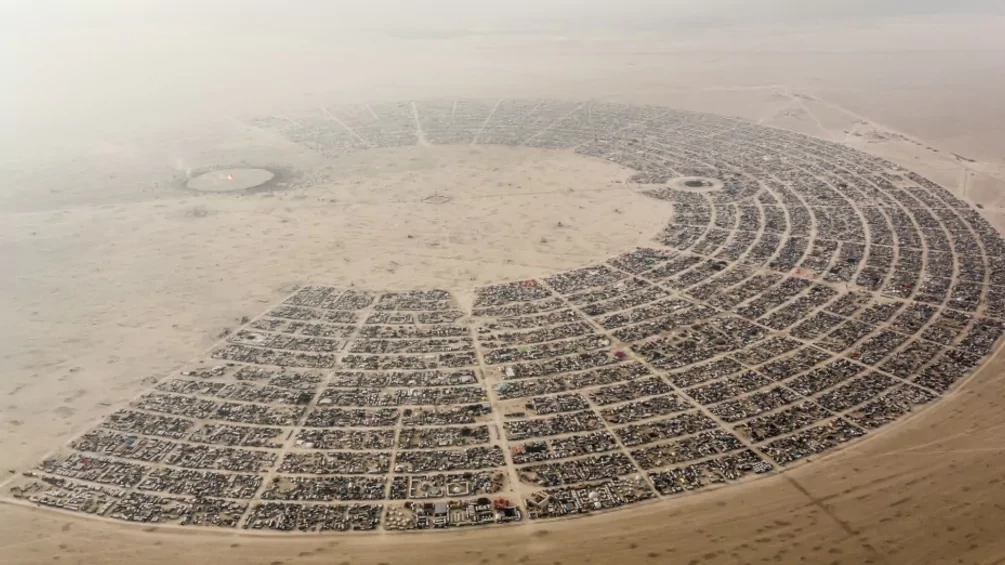
HangupsMusic.com – San Francisco, the annual pilgrimage to the Black Rock Desert has long been framed as a journey toward radical self-expression and communal effort, but for one of its original architects, the flame has largely flickered out. John Law, a co-founder of the event who helped move the gathering from San Francisco’s Baker Beach to the Nevada wilderness in 1990, has issued a scathing critique of the modern festival. In a detailed essay published by the San Francisco Standard, Law argues that the event has undergone a "Disneyfication" that has stripped away its transgressive, anarchist roots, replacing them with a polished, commercialized "escape hatch" designed for the global elite.
Law’s reflections come at a precarious time for the Burning Man Project. While the event remains a cultural juggernaut, drawing tens of thousands to its temporary metropolis known as Black Rock City, it has faced increasing scrutiny over its accessibility, environmental impact, and shifting demographics. Law, who hasn’t stepped foot on the playa since 1996, describes the current iteration as "barely recognisable" from the gritty, experimental expedition he helped launch decades ago. His departure in the mid-90s was a pivot away from a project he felt was already beginning to buckle under its own weight, but his recent public commentary suggests that the "immersive spectacle" of today has finally reached a point of total ideological departure.
The essay paints a picture of a festival that has traded its "anarchist soul" for a high-priced facsimile of rebellion. Law characterizes the modern Burn as a "fabulous Disneyland for the well-heeled," a playground where the middle-class creative class services the whims of Western elites. This critique strikes at the heart of the festival’s Ten Principles, particularly those of Radical Inclusion and Decommodification. According to Law, the reality of the desert today is one of luxury camping, private chefs, and personal stylists—a far cry from the days when participants survived on grit and shared supplies. The presence of chartered planes and "plug-and-play" camps has, in his view, turned a week of survivalist art into a curated vacation for those with the capital to bypass the event’s inherent hardships.
To understand Law’s disillusionment, one must look back at the origins of the movement. Burning Man was not birthed in a vacuum of "wellness" or corporate networking. It grew out of the Cacophony Society and the Suicide Club—underground, anti-authoritarian art-prank networks that thrived on transgression and unpredictability. In 1990, when the first desert burn took place, there were roughly 70 attendees. They slept in sleeping bags on the alkaline dust, driven by a desire to build something that existed outside the boundaries of societal control. Law describes this era as an adventurous playground for "free thinkers to roam," where the danger was real and the art was temporary and unmonetized.
The explosion of the festival’s popularity is something Law largely attributes to the rise of the internet and the subsequent "Silicon Valley takeover." By 1999, the attendance had surged to 25,000, and the culture of the tech industry began to weave itself into the fabric of the event. Law notes that the captains of the new internet economy—including figures like Elon Musk, Jeff Bezos, Mark Zuckerberg, and Google founders Larry Page and Sergey Brin—adopted the event as a mandatory pilgrimage. What was once a strange desert expedition became a "required" networking event for the tech intelligentsia, a shift that Law believes fundamentally altered the chemistry of the gathering.
This sentiment is echoed loudly across digital communities. On platforms like Reddit, long-time "Burners" and observers alike have voiced agreement with Law’s assessment. The modern festival is frequently described by critics as "Coachella with more dirt and a bigger price tag." The focus, many argue, has shifted from the internal experience of "getting lost" to the external curation of the "Instagram moment." One commentator described the current state of the festival as "performative anarchy," suggesting that while the aesthetic of rebellion remains, the actual risk and radicalism have been sanitized for mass consumption and social media clout.
The organizational challenges facing Burning Man in recent years have only added fuel to the fire. In 2025, the festival introduced a controversial tiered ticket pricing model, which was met with fierce backlash. Critics argued the system lacked transparency and further exacerbated the class divide within a community that ostensibly prides itself on radical inclusion. The logistical nightmare of the 2025 edition also made headlines, as severe dust storms and high winds caused massive traffic delays and stranded thousands of participants. These environmental hurdles, once seen as a badge of honor for the "hardcore" attendee, are increasingly viewed as symptoms of a festival that has outgrown its infrastructure and its original mission.
Safety and security have also become pressing concerns, casting a shadow over the "peace and love" narrative. The festival was rocked by a homicide investigation following the death of 37-year-old Vadim Kruglov, a tragedy that brought a grim reality to the temporary city. Additionally, the electrocution and subsequent airlifting of another attendee during a storm highlighted the inherent dangers of the desert environment—dangers that some argue are being downplayed by the festival’s glossy marketing. These incidents have forced a conversation about whether the "radical self-reliance" ethos is being used as a shield to deflect responsibility for the safety of 70,000 people.
The cultural footprint of Burning Man is now so large that it has become the subject of mainstream media deconstruction. Earlier this year, HBO released "The Man Will Burn," a four-part documentary series that explores the festival’s evolution and its various controversies. The series, available on HBO Max, provides a visual timeline of the transition from a small-scale bonfire to a global brand. For Law, however, no documentary can capture the loss of the "wild" spirit that defined the early years. He views the event’s current status as a "commercialised escape hatch," a place where the wealthy can temporarily discard their real-world identities without ever truly challenging the systems that provide them with their privilege.
Despite his harsh words, Law’s essay is tinged with a sense of melancholy rather than pure bitterness. He acknowledges that he moved on to other pursuits long ago, but the persistent questions from the public eventually forced him to address the legacy of the monster he helped create. His critique serves as a cautionary tale for any countercultural movement: the more successful it becomes, the more susceptible it is to being absorbed and neutralized by the very forces it originally sought to defy.
As the 2026 edition of Burning Man continues, the tension between its anarchist roots and its corporate present remains unresolved. For the 70,000 people currently on the playa, the experience may still feel transformative and unique. But for John Law and those who remember the raw, unscripted chaos of the 1990s, the "Man" that burns today is a hollow effigy, a symbol of a movement that traded its soul for a seat at the table of the global elite. Whether Burning Man can ever reclaim its radical edge or if it will continue its slide into "fabulous Disneyland" territory remains the central question of its enduring, albeit controversial, legacy.
