
 By Azzam Bilal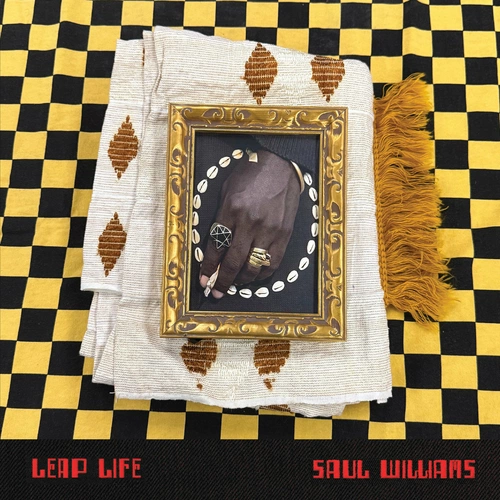
HangupsMusic.com – New York, the career of Saul Williams has never been one characterized by the predictable or the mundane. Since he first commanded the stage at the Nuyorican Poets Cafe in the mid-1990s, Williams has functioned as a bridge between disparate worlds: the grit of New York’s underground poetry scene, the experimental edges of industrial rock, and the rhythmic foundations of hip-hop. With the release of his latest studio effort, Leap Life, Williams breaks a four-year silence, delivering a project that is as intellectually demanding as it is sonically adventurous. This is not an album designed for casual background listening; it is a dense, layered, and deeply philosophical work that requires the listener to slow down and engage with its complex architecture.
The title Leap Life carries a personal significance that informs the album’s broader themes of time and existence. Born on February 29, a date that appears only once every four years, Williams has often occupied a unique temporal space. This "leap year" identity serves as a metaphor for an artist who has always seemed to exist slightly outside of the conventional timeline of contemporary music. If his earlier works, such as the Rick Rubin-produced Amethyst Rock Star in 2001, utilized the aggressive energy of boom-bap and rap-rock to deliver his message, Leap Life finds Williams in a more contemplative, perhaps even more authoritative, phase of his creative evolution.
The transition in his vocal delivery is one of the most striking elements of the new record. The rapid-fire, breathless flow of his youth has been replaced by a measured, gravitational cadence. At times, he adopts the tone of a secular preacher, his voice carrying a weight that commands silence. This shift allows the lyrics to take center stage, highlighting his status as one of the preeminent poets of his generation. On the opening track, "Baobab Constellations," Williams weaves together imagery of the natural world and the urban experience, posing questions that linger long after the track ends. When he asks, "What do fishermen dream?" amidst reflections on "project dreams" and the interpretation of rhythm, he is inviting the listener into a surrealist exploration of the subconscious and the ancestral.
Musically, Leap Life is a triumph of global fusion and avant-garde production. Williams has moved far beyond the traditional loops of hip-hop, instead opting for a soundscape that feels organic and futuristic simultaneously. The production is characterized by a "mountain fog" density—a thick atmosphere of ambient textures, jazz-inflected improvisations, and an unconventional array of instruments. One of the standout moments of sonic experimentation occurs on "Great, Great-Grandmother." Here, Williams incorporates the khaen, a traditional bamboo mouth organ from Laos, alongside "mouth strings" and bamboo flutes. The result is a haunting, ethereal piece of music that feels like a conversation across centuries, connecting the ancient traditions of Southeast Asia with the modern African diaspora.
This global perspective is a recurring theme throughout the album. Williams does not merely sample these sounds; he integrates them into a cohesive narrative about human connectivity. While the record is undoubtedly serious and at times somber, it avoids becoming overly austere by embracing the vibrant movements of modern global dance music. "The Dagger," for instance, draws heavily from the swing of Amapiano—the South African house subgenre that has taken the world by storm. By placing his poetic ruminations over these infectious, log-drum-heavy rhythms, Williams creates a fascinating tension between the physical urge to move and the intellectual urge to reflect.
The collaborative spirit of the album is further exemplified by the inclusion of Robert Del Naja, better known as 3D from the legendary trip-hop collective Massive Attack. Their collaboration, "Controlled Is Not Controllable," is a masterclass in tension and release. The track flirts with the frenetic energy of jungle and drum and bass, providing a jagged, nervous backdrop for Williams’ explorations of power and autonomy. It is a pairing that makes perfect sense; both artists have built careers on the intersection of political activism and electronic experimentation. Del Naja’s influence is felt in the track’s dark, cinematic atmosphere, which perfectly complements Williams’ critique of modern surveillance and social control.
In contrast to the more abstract movements of the record, "Robot Slave" offers a glimpse of Williams’ ability to craft a hook. Despite its heavy subject matter—a critique of technological dependency and the commodification of the human spirit—the track features an "earworm" chorus and a driving, irresistible bass line. It serves as a reminder that for all his complexity, Williams understands the power of the groove. It is this balance between the accessible and the esoteric that makes Leap Life such a compelling listen. He manages to address the "outrageous humanity" of our current era—its flaws, its beauty, and its contradictions—without ever sounding pedantic.
The album’s pacing is deliberate, reflecting the "mulligatawny soup" metaphor suggested by early listeners: it is rich, wholesome, and filled with ingredients that reveal themselves slowly. To "wolf down" this record would be a disservice to the craftsmanship involved. Each track functions as a chapter in a larger discourse on what it means to be alive in a world that is increasingly digital and disconnected. Williams seems to be advocating for a return to the sensory and the ancestral, using his platform to remind us of the "baobab constellations" that still hang above us, even if we are too distracted by our screens to see them.
As a writer and actor, Williams has always been preoccupied with the power of the word. In Leap Life, he demonstrates that the word is most powerful when it is allowed to breathe. The space between his sentences is often as important as the sentences themselves. This use of silence and "slow-motion" delivery forces the listener to sit with his ideas, turning the act of listening into a form of meditation. In an era of three-minute singles designed for viral social media clips, Williams’ insistence on a four-year development cycle and a dense, long-form album format is a radical act in itself.
Ultimately, Leap Life stands as a testament to Saul Williams’ enduring relevance. He remains an artist who refuses to be pigeonholed, navigating the realms of literature, music, and activism with equal ease. By drawing on a global palette of sounds—from Laotian flutes to South African house to Bristolian trip-hop—he has created a work that feels truly universal. It is an album that celebrates the "leap"—the moments of transition, the unexpected dates on the calendar, and the courageous jumps into the unknown that define the human experience. For those willing to invest the time, Leap Life offers a profound reward: a glimpse into the mind of a visionary who continues to find new ways to interpret the rhythm of existence. It is a record that bubbles with life, squirming with the raw energy of an artist who is still, after three decades, finding his voice anew.
