
 By admin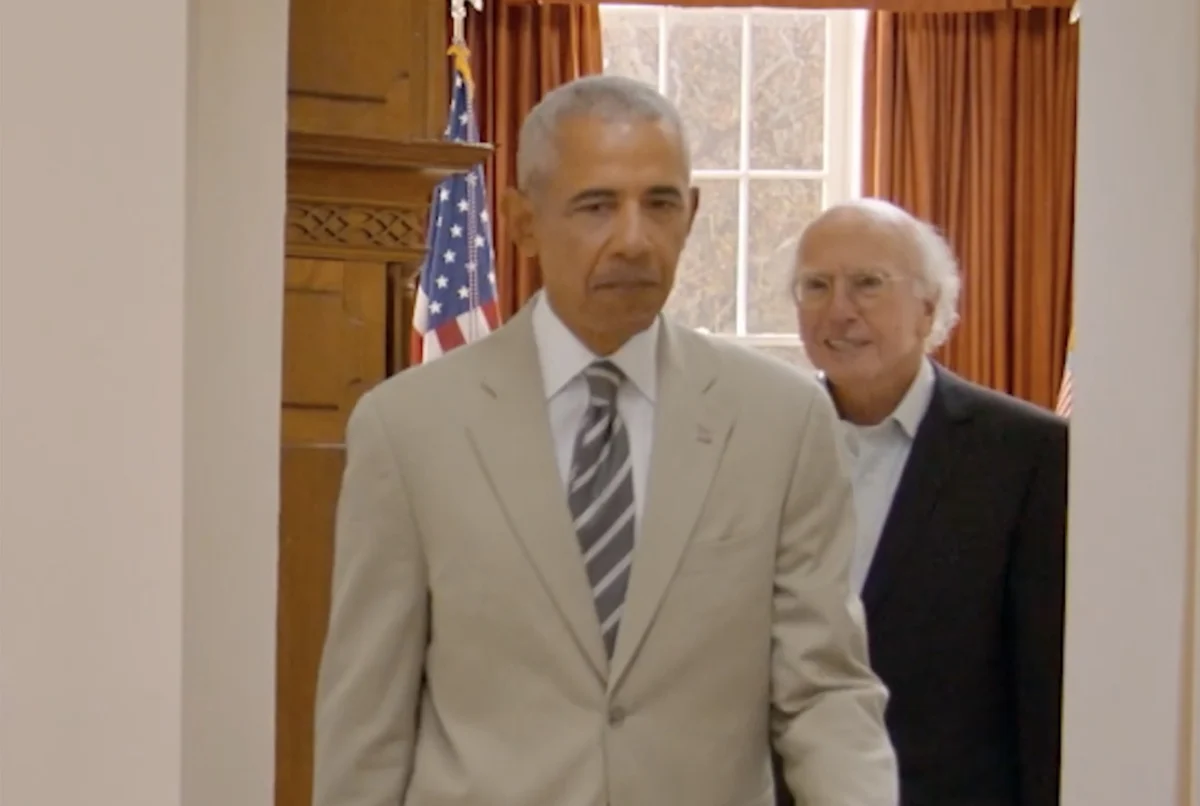
HangupsMusic.com – The final curtain call for HBO’s critically acclaimed, history-bending comedy Life, Larry, and the Pursuit of Unhappiness delivered an unexpected comedic bombshell, as former President Barack Obama made a pivotal guest appearance, finally addressing one of the most trivial yet enduring controversies of his time in office: the infamous tan suit. In a moment of meta-humor that seamlessly blended political legacy with pop culture, Obama not only poked fun at the widely scrutinized wardrobe choice from 2014 but also, through the show’s narrative, offered a hilariously improbable origin story, placing the blame squarely on the shoulders of the show’s co-creator and star, Larry David. This highly anticipated finale episode, co-produced by the Obamas’ Higher Ground production company, provided a masterclass in self-deprecating humor and narrative control, allowing a former leader to reframe a past media kerfuffle with a knowing wink.
The buzz began to build when Obama himself took to social media, sharing a clip from the episode with a caption that instantly ignited anticipation: "People always ask me where the tan suit came from. I think it’s time the truth finally came out." This pre-broadcast tease signaled a playful willingness to engage with the absurdity that often characterizes public memory, particularly concerning minor political gaffes. For years, the tan suit had existed as a curious footnote in Obama’s presidency—a seemingly innocuous fashion choice that somehow managed to provoke a disproportionate wave of criticism from various media factions, eager to dissect everything from its perceived casualness during a serious press conference about ISIS to its supposed symbolic implications. It was a controversy so bizarre that it even merited its own entry on Wikipedia, a testament to the hyper-scrutiny faced by public figures in the digital age.
The premise of Life, Larry, and the Pursuit of Unhappiness itself provided the perfect vehicle for this comedic revisionism. Known for its "history-rewriting" comedic structure, the show, much like David’s iconic Curb Your Enthusiasm, thrives on placing its protagonist in hilariously awkward, often self-inflicted predicaments that ripple outwards with unforeseen consequences. In this particular narrative twist, the show posits that the sartorial decision that once consumed cable news cycles was not, in fact, Obama’s own spontaneous choice, but rather the result of David’s inimitable, somewhat manipulative charm. The segment portrays David suggesting the tan suit, casually remarking that it was "Casual Friday" – a notion entirely alien to the decorum of the Oval Office. He then employs his signature, repetitive endorsement, "pretty, pretty, pretty, pretty good," to coax the then-President into wearing the unconventional attire to a high-stakes press conference. The irony is palpable as David, in the fictionalized encounter, confidently assures Obama, "People are going to be talking about this for a long, long time," a line that now resonates with a delicious, self-aware humor, acknowledging the real-world impact of a decision born from a fictional comedic interaction.
This appearance marked a significant moment for both Obama and the show. While Barack and Michelle Obama’s Higher Ground production company had been instrumental in bringing Life, Larry to fruition, with Barack previously providing an on-screen introduction for its debut episode, this full-fledged comedic performance allowed the former president to showcase a different facet of his public persona. Known for his calm demeanor and measured rhetoric, Obama has always possessed a subtle, dry wit, often deployed during speeches or press briefings. His comedic chops were undeniably on display as he navigated the awkward, yet ultimately endearing, world of Larry David, demonstrating a capacity for self-effacement that few global leaders could match. His willingness to not only participate but actively contribute to a joke at his own expense speaks volumes about his comfort in the post-presidency phase, embracing a role as a cultural commentator and entertainer alongside his continued advocacy.
The tan suit controversy, for all its triviality, became a cultural touchstone, emblematic of the polarized political landscape where even a simple fashion choice could be weaponized. Critics at the time ranged from those who deemed it disrespectful to the office of the presidency, to others who saw it as a symbol of Obama’s alleged detachment from serious issues. The absurdity of the outrage, in retrospect, has often been a source of bemusement for many, and Obama’s decision to finally engage with it through comedy offers a cathartic release. It’s a powerful reclaiming of a narrative, transforming what was once a point of contention into a shared laugh. By attributing the decision to a fictionalized Larry David, the show cleverly satirizes the often-ridiculous nature of media sensationalism, suggesting that some of the most intense political debates can stem from the most inconsequential origins.
Higher Ground executive producer Ethan Lewis articulated the overarching ambition behind this particular plotline, telling Variety, "From the very beginning, my dream was to close the book on the tan suit once and for all." This statement underscores the strategic and deliberate nature of Obama’s involvement. It wasn’t merely a cameo; it was a carefully orchestrated narrative intervention designed to provide comedic closure to a lingering, albeit minor, public memory. Lewis further enthused about the on-set dynamic, remarking, "The banter was phenomenal. Being a fly on the wall in that room was incredible." This paints a vivid picture of the synergy between two distinct public figures – one renowned for his presidential gravitas, the other for his curmudgeonly comedic genius – finding common ground in humor.
Co-creator Jeff Schaffer offered additional insight into the unique behind-the-scenes atmosphere, particularly the rare instance of Larry David being directed. "The funny thing was watching him go, ‘Larry, you’re coming in late!’ He was the president, so he’s used to telling people what to do. Larry was in the odd position of being told what to do, which never happens on a Larry set," Schaffer observed. This anecdote highlights the inherent power dynamics at play, even in a comedic setting. Obama, accustomed to commanding rooms and adhering to precise schedules, naturally stepped into a directorial role, playfully asserting his authority over the notoriously improvisational and free-spirited David. It’s a delightful reversal of expectations, underscoring Obama’s comfort in this new, less formal arena, and David’s willingness to cede control for the sake of the comedic gold.
The collaboration between the Obamas’ Higher Ground and Larry David represents a fascinating convergence of entertainment and political legacy. Higher Ground, established with a mission to produce diverse and impactful stories, has ventured into various forms of media, from documentaries like American Factory to podcasts and scripted series. Their involvement in a comedy that actively recontextualizes historical events, especially one involving a former president, showcases a sophisticated understanding of how culture shapes perception. It demonstrates a belief in humor as a powerful tool for engagement, education, and even revisionism, allowing public figures to engage with their past in ways that are both authentic and entertaining.
In an era where the lines between politics, entertainment, and personal brand management are increasingly blurred, Obama’s appearance on Life, Larry, and the Pursuit of Unhappiness serves as a poignant example of how public figures can control their own narratives. By engaging with the tan suit controversy directly and comically, Obama disarms its lingering power, transforming a source of past criticism into a shared joke. It’s a move that not only entertains but also subtly comments on the often-absurd nature of political discourse and media obsession with superficial details. The finale, therefore, wasn’t just a send-off for a beloved comedy; it was a clever, pre-pre-pretty good statement on legacy, humor, and the enduring quest for authenticity in the public eye.
