
 By Azzam Bilal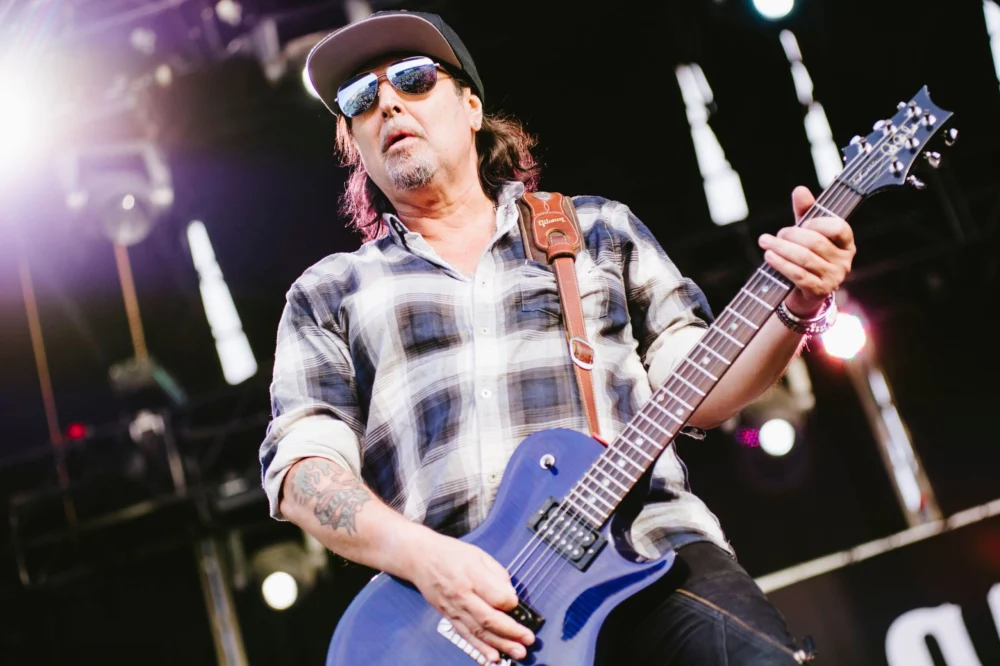
HangupsMusic.com – Cardiff, The international heavy metal community is in mourning following the announcement that Phil Campbell, the long-standing guitarist for the legendary British band Motörhead, has passed away at the age of 64. The news was confirmed by his current band, Phil Campbell and the Bastard Sons, in a somber social media update on March 14. According to the statement, Campbell’s death followed a protracted and "courageous battle" in intensive care, which occurred after he underwent a complex and significant surgical procedure. The family noted that he passed away peacefully, surrounded by the echoes of a life defined by volume, grit, and an unwavering commitment to the ethos of rock and roll.
The loss marks the end of an era for heavy music. While Campbell was perhaps best known as the man who stood to the left of Lemmy Kilmister for over three decades, his influence stretched far beyond his tenure in one of the world’s loudest bands. To his family, he was more than a rock icon; the band’s statement painted a picture of a "devoted husband, a wonderful father, and a proud and loving grandfather," known to his grandchildren by the affectionate Welsh moniker "Bampi." The tribute emphasized that while his music would remain a permanent fixture in the annals of metal history, his personal warmth and humor would be missed just as much as his searing guitar solos.
Born Philip Anthony Campbell in Pontypridd, Wales, in 1961, the future guitar hero’s journey began at the age of ten. In the culturally rich landscape of the early 1970s, Campbell found himself drawn to the expressive power of the electric guitar, citing a diverse array of influences that included the psychedelic mastery of Jimi Hendrix, the technical precision of Jimmy Page, and the eclectic pop-rock sensibilities of Todd Rundgren. This blend of blues-based rock and high-energy aggression would eventually become the hallmark of his playing style—a sound that was simultaneously dirty, melodic, and relentlessly driving.
In a twist of fate that seems scripted for a Hollywood biopic, a young Campbell first met his future collaborator and mentor, Lemmy Kilmister, when he was just 12 years old. The meeting took place at the Cardiff Capitol Theatre, where Kilmister was performing with the space-rock pioneers Hawkwind. Campbell, a burgeoning fan, waited in the theater’s foyer in the hopes of catching a glimpse of the band. Lemmy was the only member to emerge, and he took the time to sign Campbell’s program, an act of kindness that left an indelible mark on the young musician. Years later, Campbell would recall the moment with wonder, noting that if someone had told him that day that he would eventually win Grammys and tour the globe alongside that very man, he would have dismissed the idea as total madness.
Before joining the ranks of Motörhead, Campbell cut his teeth in the UK’s vibrant pub and club circuit. His early career saw him performing with a variety of acts, ranging from the cabaret-style group Contrast to the pub-rock outfit Roktopus. However, it was his formation of the heavy metal band Persian Risk in 1979 that truly signaled his arrival in the New Wave of British Heavy Metal (NWOBHM) scene. Persian Risk became a respected name in the underground, releasing several singles that showcased Campbell’s ability to weave intricate riffs into a high-octane metal framework.
The pivotal moment of Campbell’s career arrived in 1984. Following the departure of guitarist Brian "Robbo" Robertson, Motörhead was in need of a new six-stringer. Campbell entered a high-stakes audition process that eventually narrowed the field down to him and Michael "Würzel" Burston. In a move that defied conventional band dynamics, Lemmy Kilmister found himself unable to choose between the two distinct talents. After hearing them play together, Lemmy decided that the only logical solution was to hire both, transforming Motörhead into a four-piece powerhouse.
This lineup change ushered in a new chapter for the band, and Campbell quickly became an indispensable part of the Motörhead machinery. His first studio outing with the group was the new tracks recorded for the 1984 compilation No Remorse, but it was 1986’s Orgasmatron that solidified his status as a key architect of the band’s sound. Over the next 31 years, Campbell would play on a staggering 16 studio albums. From the commercial heights of March or Die in 1992 to the late-career brilliance of Motörizer (2008) and Aftershock (2013), his guitar work provided the muscular backbone for Lemmy’s gravelly vocals and thundering bass.
Throughout his tenure, Campbell survived numerous lineup changes, eventually becoming the longest-serving member of the band aside from Lemmy himself. When Würzel departed in the mid-90s, the band reverted to a trio, placing even more weight on Campbell’s shoulders. He rose to the occasion, developing a "wall of sound" approach that allowed the three-piece to maintain the sonic density of a much larger ensemble. His contribution was formally recognized by the industry in 2005 when Motörhead won a Grammy Award for Best Metal Performance for their cover of Metallica’s "Whiplash."
The Motörhead journey famously came to an end in December 2015, following the death of Lemmy Kilmister. While many musicians would have taken that as a cue to retire, Campbell’s passion for the stage remained undiminished. In the wake of the band’s dissolution, he pivoted to a project that was deeply personal: Phil Campbell and the Bastard Sons. Formed alongside his three sons—Todd, Dane, and Tyla—the band allowed Campbell to continue touring and recording while fostering a family legacy. The group became a fixture on the festival circuit, proving that the "Motörhead spirit" was a generational torch that could be passed down.
In 2019, Campbell stepped into the spotlight as a solo artist with the release of Old Lions Still Roar. The album was a testament to the respect he commanded within the industry, featuring a "who’s who" of rock royalty. Guests included Rob Halford of Judas Priest, Alice Cooper, and Dee Snider, among others. The record allowed Campbell to explore musical avenues that didn’t always fit the strict Motörhead template, showcasing his versatility and his enduring relevance in a shifting musical landscape.
However, recent years had seen Campbell grappling with health challenges. The Bastard Sons had released their latest album, Kings of the Asylum, in 2023 to critical acclaim, and a rigorous tour schedule across Australia and Europe had been planned for the summer of 2024. Those plans were curtailed in February when the band announced the cancellation of the run, citing the need for Campbell to focus on his recovery. Despite the best efforts of medical professionals and his own fighting spirit, the complications following his major operation proved too great to overcome.
As news of his passing spread, the music world erupted in a chorus of tributes. Mikkey Dee, the drummer who played alongside Campbell in Motörhead for nearly 25 years, shared a particularly moving message. Dee described Campbell as the "funniest guy" he had ever known and "the best rock guitar player" he had ever had the privilege to share a stage with. He praised Campbell’s instinctive "vibe and feel" for rock music, noting that even after writing 12 studio albums together, Campbell never ceased to surprise him with his talent.
Other icons of the genre, including Tony Iommi of Black Sabbath, Duff McKagan of Guns N’ Roses, and Dee Snider of Twisted Sister, also expressed their grief. The common thread among all the tributes was a recognition of Campbell’s genuine nature. In an industry often characterized by ego and artifice, Phil Campbell was widely regarded as one of the "nicest guys" in the business—a man who loved life, cherished his family, and never lost the wide-eyed wonder of the 12-year-old boy who waited in a Cardiff foyer for an autograph.
The official Motörhead social media channels summarized his impact succinctly, stating that Campbell had "Motörhead in his veins." He was a musician who didn’t just play the music; he lived the culture. His legacy is etched into the grooves of millions of records and remembered in the ringing ears of fans who witnessed his thunderous performances across the globe. While the stage may be quieter today, the riffs of Phil Campbell will continue to roar as long as there is a guitar plugged into an amplifier and a heart that beats for rock and roll. He leaves behind a void that cannot be filled, but he also leaves behind a blueprint for a life lived with joy, loud music, and an unbreakable bond with his kin.
