
 By Azzam Bilal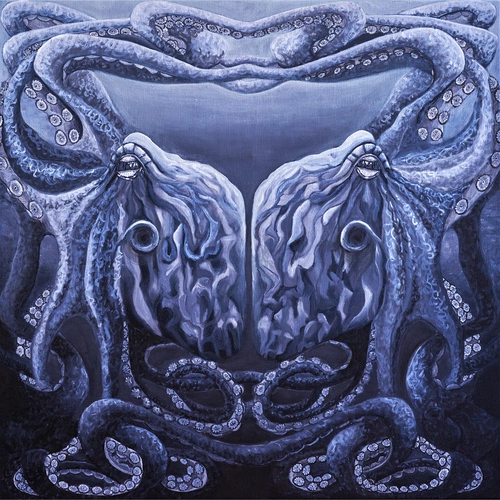
HangupsMusic.com – Berlin, the perennial crucible of electronic experimentation, has long been a sanctuary for artists seeking to dissolve the boundaries between geography and genre. In this fertile environment, the emergence of Los Pulpitos feels like a natural, albeit surreal, evolution of the city’s global-minded club scene. The duo, a formidable pairing of Felipe Salmon—one half of the celebrated Peruvian outfit Dengue Dengue Dengue—and Dirk Leyers of the acclaimed Africaine 808, has recently unveiled their collaborative opus, ‘Tentacletek’. The album is a masterclass in rhythmic dexterity, a project that functions as a multi-limbed organism, reaching into the depths of global bass, minimal techno, and ambient dub to pull together a sound that is as fluid as it is formidable.
The visual identity of ‘Tentacletek’ serves as an immediate portal into the sonic world contained within. The cover art, a striking piece by German artist Paula Kletschke, depicts a vibrant purple cephalopod. This creature is no ordinary inhabitant of the reef; it is polycephalic, possessing two heads that emerge from a single, pulsating core. This imagery is a perfect metaphor for Salmon and Leyers’ creative partnership. Much like the creature on the sleeve, Los Pulpitos operates with a singular heart but two distinct, brilliant minds, each directing a set of winding, unpredictable tentacles. To listen to the album is to be caught in the grip of these appendages—sometimes gentle and swaying, at other times constricting and intense, but always moving with a grace that defies conventional structure.
The pedigree of the artists involved sets a high bar for the listener. Felipe Salmon has spent years at the forefront of the "Neo-Cumbia" movement, blending the psychedelic traditions of the Amazon with the low-end frequencies of modern UK bass and techno. His work with Dengue Dengue Dengue is synonymous with a kind of tropical futurism. On the other side of the booth, Dirk Leyers has built a reputation for weaving intricate rhythmic tapestries that bridge the gap between European electronic precision and the polyrhythmic soul of African percussion. When these two forces collide, the result is a sound that feels unmoored from any single continent, instead inhabiting a submerged, internationalist space where the pressure is high and the colors are neon.
The album’s sonic journey is defined by its willingness to subvert expectations at every turn. Nowhere is this more evident than on the sprawling track ‘ii ii ii’. It begins in a state of atmospheric suspension, a gauzy ambient haze that suggests a tranquil drift through open water. However, this serenity is a feint. The track soon plunges the listener into a dense, cavernous bassline reminiscent of Durban’s Gqom scene. The heavy, dark thud of the low end creates a sense of claustrophobic tension, but Los Pulpitos are not content to stay in one lane. During an expansive breakdown, the duo flips the script entirely, shifting the rhythmic emphasis to the off-beat. Just as the listener begins to find their footing in this new cadence, the original drum pattern roars back to life, now augmented by a frenetic layer of racing tablas and sharp, metallic cowbells. It is a dizzying display of production prowess that highlights the duo’s ability to manage complex, competing rhythms without losing the dancefloor’s pulse.
This penchant for gradual, tension-building transformation is a recurring theme throughout the record. ‘Pannetronica’ follows a similar, though perhaps more subtle, trajectory. It starts as a piece of shuffly, stripped-back minimal techno—the kind of track that might feel at home in a sunrise set at Panorama Bar. Yet, as the minutes tick by, the arrangement begins to warp. Elements of breakbeat emerge, adding a jagged edge to the proceedings, and the track evolves into a swerving, high-tension builder that feels like it’s constantly on the verge of spilling over. It is a testament to Salmon and Leyers’ patience as composers; they understand that the most effective electronic music often lies in the slow-motion mutation of a groove.
The aptly titled ‘Catfishy’ offers a more playful, though no less disorienting, experience. It opens with a bumping, infectious energy that invites movement, but as it progresses, the layers of percussion become increasingly chaotic and layered. The result is a dizzying effect, a sonic vertigo that mirrors the experience of being caught in a swirling current. This sense of playfulness is also present in ‘Archipelago’, which stands out as one of the album’s most memorable moments. Here, the duo taps into the cinematic tropes of classic drum and bass, utilizing wide, expansive pads and rolling breaks. The track is punctuated by a robotic vocal sample that humorously declares, “I want my sabbatical,” a moment of levity that provides a human (or perhaps post-human) touch to the intricate machinery of the music.
For those who appreciate the more textured, organic side of electronic music, ‘Squidler’ is a revelation. Drawing comparisons to the murky, bongo-heavy rollers of Shackleton, the track is an effervescent exercise in percussive dub. Spongey bongos provide a soft, tactile foundation, while bright, resonant stabs cut through the mix like light refracting through water. It is a track that feels alive, breathing and twitching with a life of its own, further cementing the album’s aquatic theme.
However, ‘Tentacletek’ is not merely an exercise in high-octane rhythmic workouts. Much of its enduring charm lies in its moments of blissful, dubbed-out repose. The opening track, ‘Antennariidae’, sets the stage with a laidback, chillhouse sensibility that evokes the early, sun-drenched productions of Groove Armada. It is a welcoming entry point, inviting the listener to submerge themselves slowly before the deeper, more intense pressures of the mid-album tracks take hold. Similarly, the closing track ‘Mola Mola’ serves as a beautiful, hazy comedown. Its shimmering arpeggios carry echoes of Fatima Yamaha’s iconic ‘What’s A Girl To Do’, providing a sense of melodic closure and emotional resonance. These bookends act as the antithesis to the mind-bending drum workouts that dominate the center of the record, proving that Salmon and Leyers are just as capable of crafting moments of profound beauty as they are of engineering rhythmic assaults.
The collaborative spirit of Los Pulpitos is what ultimately makes ‘Tentacletek’ such a compelling listen. In an era where many electronic collaborations can feel like mere file-sharing exercises, there is a tangible sense of chemistry here. You can hear the dialogue between Salmon’s penchant for the "global bass" avant-garde and Leyers’ deep understanding of club dynamics. They have created a work that feels cohesive despite its wide-ranging influences, unified by a shared fascination with the deep, the dark, and the rhythmic.
As the Berlin scene continues to evolve, ‘Tentacletek’ stands as a significant marker of where the city’s sound is headed—away from the rigid structures of the past and toward a more fluid, inclusive, and experimental future. Los Pulpitos have delivered an album that is as intellectually stimulating as it is physically engaging. It is a record that demands repeat listens, with each spin revealing new layers of detail hidden within its many-limbed arrangements. Whether you are drifting in the ambient haze of the openers or lost in the Gqom-inspired depths of its mid-section, ‘Tentacletek’ is an immersive experience that confirms Felipe Salmon and Dirk Leyers as two of the most vital architects working in the electronic underground today. It is a vivid, pulsating reminder that sometimes, having two heads—and many tentacles—is exactly what is needed to navigate the complex currents of modern music.
