
 By Azzam Bilal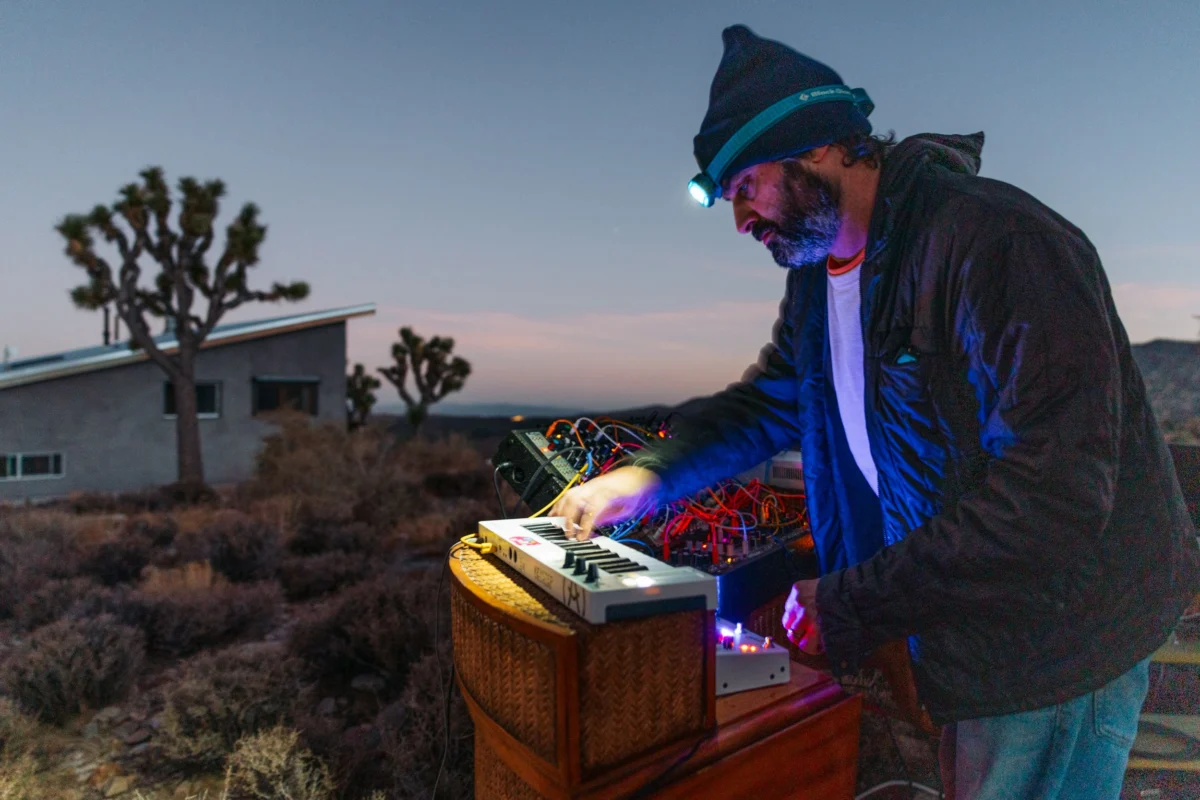
HangupsMusic.com – Joshua Tree, The high desert of California has long served as a sanctuary for artists seeking a connection to the celestial, offering a stark, silent landscape that invites deep contemplation and experimental fervor. In the latest chapter of this storied tradition, Brian Weitz—best known as Geologist, the sonic architect and founding member of the experimental collective Animal Collective—has bridged the gap between astronomy and electronic composition. During a residency at the Farrington Observatory in Joshua Tree, Weitz collaborated with visual artist Kyle Simon to create a project that literally harnesses the light of the cosmos. The result of this ambitious undertaking is The Sirens, a new album set for release on October 16 via the Outside Time label. This record represents a singular composition born from the light of the moon and stars, translated into the language of modular synthesis.
The technical process behind The Sirens is as fascinating as the music it produced. To achieve this lunar-driven sound, Kyle Simon outfitted a high-powered telescope with specialized optical sensors and light-sensitive detectors known as photodiodes. In the liner notes for the album, Simon explains the intricate mechanics of the setup. As the telescope is aimed at various celestial bodies—including the moon, distant planets, and flickering stars—it gathers raw light. This light is not merely observed but captured and converted into an electrical signal through an analog amplifier. This signal is then fed into Geologist’s modular synthesizer rig as control voltage (CV). In the world of synthesis, control voltage is the foundational language that allows one piece of hardware to tell another what to do. In this instance, the "instructions" were being sent by the universe itself. The fluctuations in light intensity from the night sky were used to modulate pitch, manipulate filters, and dictate rhythmic patterns in real time, creating a generative performance where the cosmos acted as the primary composer.
This method of "sonifying" light allows for a level of organic unpredictability that is difficult to replicate through traditional programming. The atmospheric turbulence that causes stars to twinkle or the shifting shadows on the lunar surface translate into subtle sonic tremors and evolving textures. For an artist like Geologist, who has spent decades exploring the intersection of natural environments and digital manipulation, this project feels like a natural evolution. His stage name itself reflects a career-long fascination with the physical world, and The Sirens takes that interest into the exosphere. By allowing the moon to dictate the movement of his synthesizers, Weitz removes the ego of the performer, placing the emphasis on the raw data of the natural world.
The album arrives during a period of remarkable productivity for Weitz. The Sirens marks his third full-length release of 2026, following a prolific streak that began earlier in the year. In January, he released the solo effort Can I Get a Pack of Camel Lights?, a project that showcased his ability to blend gritty, found-sound aesthetics with shimmering ambient passages. This was followed in May by Croz Boyce, a collaborative project with his longtime Animal Collective bandmate Avey Tare (Dave Portner). The synergy between Weitz and Portner has always been a cornerstone of their primary band’s success, and Croz Boyce allowed them to explore a more intimate, experimental dialogue away from the pressures of their main discography.
To give fans a glimpse into the ethereal world of The Sirens, a preview track titled “The Opening” has been released. The track serves as a perfect introduction to the album’s atmosphere, featuring drifting, undulating tones that seem to mimic the slow rotation of the earth under a starlit sky. There is a sense of vastness in the recording—a reflection of the wide-open Mojave Desert where it was conceived. The use of the modular synthesizer ensures that while the source material is celestial, the output remains grounded in the warm, tactile buzz of analog electronics. It is a marriage of the ancient and the modern, using 21st-century technology to interpret light that has traveled through the vacuum of space for eons.

The release of The Sirens on the Outside Time label further emphasizes the project’s experimental pedigree. Outside Time has become a home for music that defies easy categorization, focusing on artists who push the boundaries of how sound is generated and perceived. By releasing the album in mid-October, the label aligns the record’s debut with the cooling temperatures and longer nights of autumn, a fitting season for a project so deeply rooted in nocturnal observation.
Beyond his studio work, Geologist is preparing to take his collaborative energy back on the road. He and Avey Tare are scheduled to begin a new tour next month, bringing their unique brand of psychedelic exploration to live audiences across the country. The tour is highly anticipated, given the duo’s reputation for transforming their recorded material into immersive, improvisational live experiences. One of the early highlights of the trek will be a performance on September 8 in Asheville, North Carolina, a city known for its vibrant arts scene and appreciation for experimental music. While the tour will likely focus on their collaborative work, the influence of Geologist’s recent solo experiments is sure to bleed into the live sets, adding new layers of depth to their performance.
The collaboration with Kyle Simon at Farrington Observatory also highlights the growing intersection between visual art and sound design. Simon’s work often involves the physical properties of light, and his ability to bridge the gap between the telescope and the synthesizer was crucial to the success of The Sirens. The observatory itself, located in the heart of Joshua Tree, provided the perfect environment for this experiment. Away from the light pollution of major cities, the stars are more vibrant, providing a cleaner and more dynamic signal for the photodiodes to capture. This purity of signal is reflected in the clarity of the album’s compositions, which feel uncluttered and deeply focused.
As a founding member of Animal Collective, Brian Weitz has always been at the forefront of the "freak folk" and experimental pop movements. However, his solo work as Geologist often leans further into the abstract, favoring long-form drones and complex textures over traditional song structures. The Sirens is perhaps his most abstract work to date, yet it possesses a narrative arc dictated by the movement of the heavens. It challenges the listener to consider the source of the music they consume and the ways in which technology can be used to reconnect us with the natural world rather than isolate us from it.
The concept of "The Sirens" in the album’s title evokes the mythological figures whose songs drew sailors toward the rocks, but in Weitz’s hands, these sirens are the celestial bodies themselves. They are distant, beautiful, and possess a magnetic pull that has fascinated humanity since the beginning of time. By turning their light into sound, Weitz allows us to "hear" the moon in a way that is both alien and deeply familiar. It is an exercise in cosmic empathy, a reminder that we are part of a much larger system of energy and vibration.
As the October 16 release date approaches, anticipation continues to build within the experimental music community. The Sirens is not just an album; it is a document of a specific time and place, a sonic photograph of the night sky over Joshua Tree. For those who have followed Geologist’s career from the early days of Animal Collective to his current solo ventures, this record represents a peak of creative ingenuity. It proves that even after decades in the industry, Weitz remains committed to the spirit of discovery, looking upward and outward to find the next great sound. Whether through the hum of a modular synth or the silent glow of a full moon, Geologist continues to map the unknown territories of the musical landscape.
