
 By admin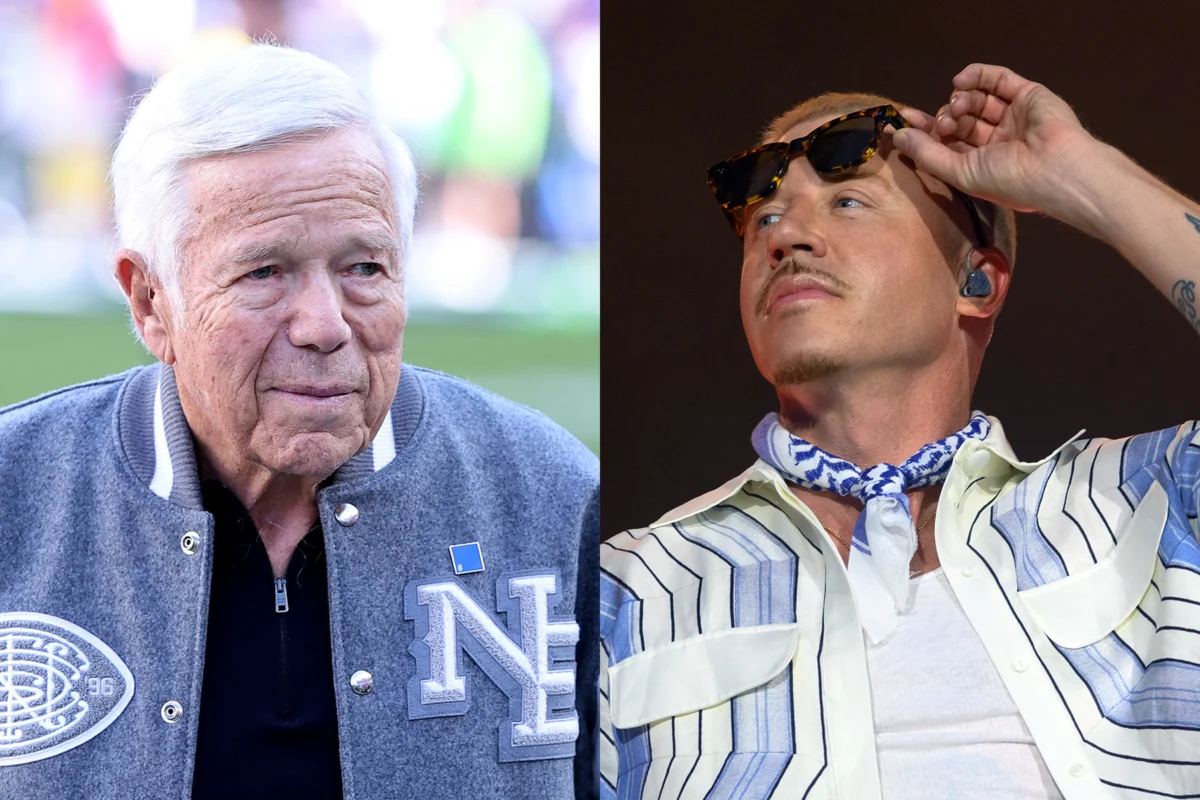
HangupsMusic.com – Foxborough, Massachusetts – A significant controversy has erupted within the music industry, as New England Patriots owner Robert Kraft confirmed his direct intervention to prevent rapper Macklemore from performing as the opening act for Ed Sheeran at Gillette Stadium. The decision, which has since seen Macklemore removed from the entirety of Sheeran’s ongoing "Loop" tour, stems from the Seattle artist’s recent outspoken support for Palestinians and his repeated calls for "Free Palestine" during live performances. The incident has ignited a fervent debate surrounding artistic freedom, venue owner discretion, and the sensitive intersection of music, politics, and geopolitical conflict.
In a formal statement provided to Rolling Stone, Kraft articulated that the drastic measure was a direct consequence of Macklemore’s "recent actions, material shared from the stage during Ed Sheeran’s shows in New Jersey, and a broader history of antisemitic rhetoric and imagery that we believe has been deeply offensive and hurtful to the Jewish community." This comprehensive indictment from Kraft pointed not only to the rapper’s contemporary expressions but also invoked a past controversy from 2014, where Macklemore faced accusations of donning an antisemitic caricature as a disguise. While the artist subsequently issued an apology, he maintained at the time that his intent was merely to remain incognito, not to cause offense.
Kraft, whose ownership extends to Gillette Stadium, emphasized the venue’s steadfast commitment to "providing a welcoming environment for all guests and ensuring that all events held at our venue do not provide a platform for hate speech." He concluded that allowing Macklemore to proceed with his scheduled performances at the two upcoming Gillette shows "would cross that line," cementing the decision that led to the rapper’s immediate and comprehensive removal from the remainder of the "Loop" tour itinerary.
The catalyst for this contentious fallout was Macklemore’s performances in early September, specifically during the initial two dates of the Ed Sheeran tour at MetLife Stadium in East Rutherford, New Jersey. It was during these appearances that the rapper, known for his socially conscious lyrics, veered into direct political commentary regarding the Israeli-Palestinian conflict. On stage, Macklemore vocally proclaimed "Free Palestine," expressed profound solidarity with the populations of Gaza and the occupied West Bank, and displayed stark images depicting the devastation wrought by Israel’s military campaign in Gaza. A pivotal moment in his set was the performance of his protest anthem, "Hind’s Hall," a track explicitly dedicated to the pro-Palestine student demonstrators at Columbia University and their broader movement.
Addressing the audience, Macklemore elucidated his motivations with conviction: "A big part of the reason why I wanted to do this tour in the first place is so I could stand up in stadiums like this and say two words that are very near and dear to my heart: ‘Free Palestine.’" He reiterated the phrase, emphasizing, "I want those words to be loud and clear, so that people all the way in Gaza to the occupied West Bank know that we have not forgotten about them." These powerful statements, delivered to tens of thousands, immediately garnered widespread attention and set the stage for the subsequent uproar.
Macklemore, in his own public statement released prior to Kraft’s confirmation, had leveled a significant allegation against the Patriots owner. He claimed that Kraft personally contacted Sheeran to convey that the rapper "would not be allowed to perform in his stadium." Furthermore, Macklemore escalated his accusation by asserting that Kraft "rallied some of the other stadium owners and collectively they gave [Sheeran] an ultimatum: If Macklemore stays on the tour, you will not be allowed to play in our venues." While Kraft’s statement confirmed his direct involvement in the Gillette Stadium decision, it conspicuously omitted any acknowledgment or refutation of Macklemore’s more far-reaching claim regarding a coordinated effort among multiple venue owners. A representative for Kraft did not immediately respond to inquiries seeking clarification on this particular allegation, leaving a crucial aspect of the unfolding drama unaddressed and adding a layer of intrigue to the dispute.
Robert Kraft, a prominent figure in American business and sports, is also a deeply committed philanthropist with strong ties to Israel and Jewish causes. Over decades, he has contributed millions of dollars to various initiatives supporting these interests and has been a leading voice in efforts to combat antisemitism. In his statement, Kraft referenced his personal responsibility, stating he feels compelled "to stand up when I believe that line has been crossed." He clarified that his decision was explicitly "not about diminishing the suffering of innocent Palestinians or denying anyone the right to advocate on their behalf." However, he firmly argued that such advocacy "should not come at the expense of the Jewish community or obscure the responsibility of Hamas."
Kraft further elaborated on his perspective, asserting, "Too many lives have been lost and there has been too much suffering, but only sharing selective information and ignoring the actions of Hamas is not honest and only advances more divisiveness and hate." He underscored his long-standing engagement with the region, noting, "Over many decades, I have directed resources to Palestine and created athletic and entrepreneurial opportunities for Palestinians who I admire and respect. Standing with the Palestinian people and standing against Hamas, antisemitism and hate should not be mutually exclusive." This nuanced stance from Kraft highlights the complexities he perceives in the discourse surrounding the conflict, emphasizing a distinction between supporting Palestinians and condoning specific actions or narratives.
Macklemore, both in his live performances and subsequent written statements, has consistently challenged the notion that expressing solidarity with Palestinians or critiquing the Israeli state and its military actions in Gaza and the West Bank constitutes antisemitism. Following his removal from the tour, he penned a resolute defense, stating, "Antisemitism is real. And that is exactly why the word matters too much to be used as a shield against criticism of the Israeli state." He articulated a widely debated point: "When criticizing Israel, opposing Zionism or saying ‘Free Palestine’ gets conflated with hatred of Jewish people, it doesn’t protect Jewish people. It protects Israel from accountability." This argument underscores the critical distinction many activists and commentators draw between criticism of a state’s policies and prejudice against an ethnic or religious group, a distinction central to the ongoing global conversation on the conflict.
The incident at Gillette Stadium, therefore, transcends a simple tour lineup change. It thrusts into the spotlight the increasingly fraught landscape for artists navigating geopolitical issues on public platforms. It raises fundamental questions about freedom of expression, the responsibilities of venue owners, and the potential for financial and professional repercussions when an artist’s political stance clashes with the convictions of powerful stakeholders. For Macklemore, an artist whose career has often been defined by his willingness to tackle social issues, this episode represents a significant moment of artistic and political defiance, albeit one with immediate professional consequences. For Robert Kraft, it is a reaffirmation of his personal and philanthropic commitments, underscoring his willingness to use his considerable influence to uphold what he perceives as a moral imperative against the spread of what he defines as hate speech.
In closing his statement, Kraft extended "tremendous respect" to Ed Sheeran, acknowledging his "unique ability to bring people together and spread joy." Significantly, he also expressed an openness to dialogue with Macklemore: "I would welcome the opportunity to sit down with Macklemore and discuss the facts, because ultimately our goal is the same — peace for all people, an end to suffering, and an end to all hate." This offer of a meeting suggests a desire for resolution and understanding, even amidst the sharp disagreements. However, as of the latest reports, a representative for Macklemore did not return requests for further comment, leaving the potential for such a dialogue, and indeed the broader resolution of this complex situation, uncertain. The incident stands as a potent reminder of the challenges inherent in balancing artistic expression, political advocacy, and commercial interests in a world increasingly polarized by global events.
