
 By Azzam Bilal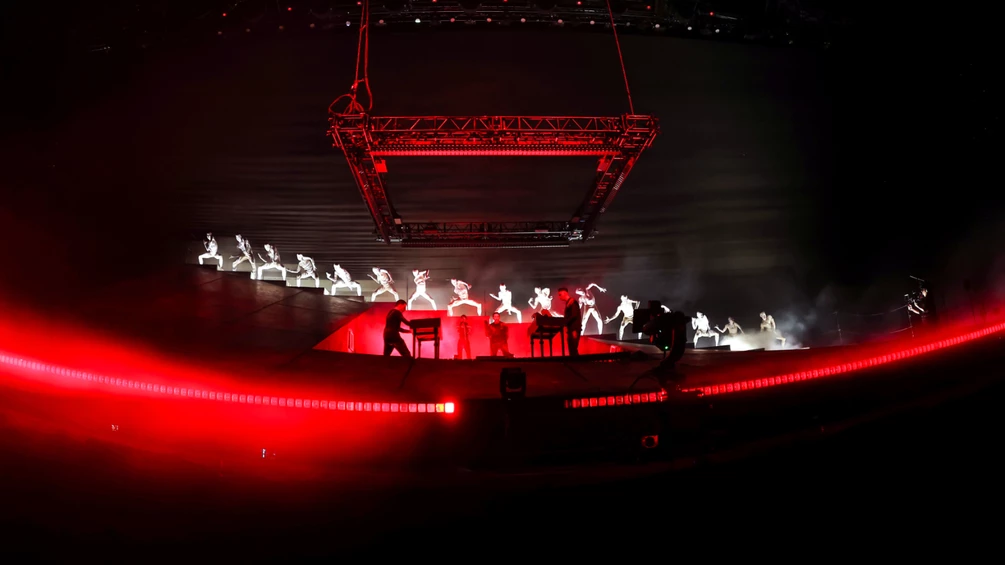
HangupsMusic.com – INDIO, CALIFORNIA, The Coachella Valley Music and Arts Festival has long been a crucible for unexpected musical unions, but few have carried the weight of historical significance quite like the official debut of Nine Inch Noize. This past Saturday night, April 11th, the Sahara stage became the site of a seismic shift in the landscape of heavy electronic music as Trent Reznor’s legendary industrial powerhouse, Nine Inch Nails, fully integrated with the rhythmic precision of German techno titan Boys Noize. The performance marked the formal unveiling of their collaborative identity, a project that has been simmering in the underground through a series of cryptic tour appearances and high-profile soundtrack work over the past year.
The 45-minute set was less a standard concert and more a meticulously crafted sonic assault, designed to bridge the gap between the grit of 1990s industrial rock and the clinical, high-fidelity energy of modern European techno. For decades, Nine Inch Nails has occupied a space that flirts with the dance floor while maintaining a foot in the world of visceral, raw instrumentation. Conversely, Alex Ridha—better known as Boys Noize—has spent his career injecting a punk-rock spirit into the structures of house and techno. In the desert heat of Indio, these two trajectories finally collided in their most realized form to date.
The atmosphere at the Sahara stage was electric long before the first notes rang out. Traditionally the home of high-energy EDM and hip-hop, the stage has recently evolved to accommodate more experimental and legacy-defining acts. The crowd, a mix of veteran "industrial-heads" in weathered black band tees and younger electronic enthusiasts, witnessed a performance that reimagined the Nine Inch Nails catalog through a modular, beat-driven lens.
The setlist was a masterclass in curation, blending familiar classics with deep cuts and unexpected covers. The duo opened with a mutated version of "Closer," perhaps Nine Inch Nails’ most recognizable hit. However, this was not the radio edit or the standard live arrangement. Stripped of its traditional funk-laden bassline and replaced with a driving, distorted 4/4 kick drum characteristic of Ridha’s production, the track transformed into a dark-room techno anthem. This set the tone for the evening: a relentless exploration of how mechanical rhythm can enhance emotional desolation.
A significant highlight of the performance was the inclusion of Mariqueen Maandig, the frontwoman of How To Destroy Angels and Reznor’s longtime creative partner. Her presence on stage provided a necessary melodic counterpoint to the aggressive textures provided by Reznor and Ridha. Maandig lent her ethereal yet commanding vocals to a cover of "Parasite," a track from the How To Destroy Angels catalog that felt perfectly at home within the Nine Inch Noize framework. Her contributions throughout the set added a layer of haunting beauty to the otherwise jagged soundscapes.
The group also reached back into the roots of electronic music with a cover of Soft Cell’s "Memorabilia." By choosing this 1981 synth-pop classic, Nine Inch Noize paid homage to the pioneers of the genre while simultaneously dragging the track into the future with layers of modular synthesis and heavy saturation. The performance also featured "As Alive As You Need Me To Be," a track that showcased the synergy between Reznor’s lyrical nihilism and the pulsing, architectural sound design that Boys Noize has perfected over his twenty-year career.
This Coachella debut did not happen in a vacuum. The foundations for Nine Inch Noize were laid during the "Peel It Back" tour, a string of highly successful dates that saw Boys Noize joining Nine Inch Nails across Europe. During those shows in cities like Dublin, Manchester, London, and Amsterdam, the collaboration was presented in a more experimental fashion. In those settings, Ridha would often perform remixes from a secondary stage, creating a dialogue between the live band and the electronic booth. The Coachella set represented the culmination of those experiments, bringing both entities onto a single platform to perform as a unified "supergroup."
The genesis of this partnership can be traced back to the cinematic world. Last year, Nine Inch Nails was tapped to provide the score for TRON: Ares, the latest installment in the iconic sci-fi franchise. This was a significant mantle to take up, following the cultural phenomenon of Daft Punk’s TRON: Legacy soundtrack in 2010. During the production of the Ares score, the band’s core duo of Trent Reznor and Atticus Ross began collaborating with Boys Noize on a series of remixes. These reinterpretations, released earlier this year, featured contributions from other avant-garde artists like Arca and Danny L Harle, but it was the chemistry between Reznor and Ridha that proved the most enduring.
As the set at Coachella concluded with a ferocious rendition of "Heresy," the message was clear: Nine Inch Noize is not a fleeting side project, but a serious evolution of both artists’ creative outputs. The timing of the performance is strategically aligned with the next major milestone for the group. This coming Friday, April 17th, the duo will release their debut EP, titled Halo 38, via Interscope Records.
For fans of Nine Inch Nails, the "Halo" designation carries immense weight. Since the release of the "Down in It" single in 1989, Reznor has used a chronological numbering system to catalog every official release, from full-length albums to singles and remix EPs. By granting this collaborative project a Halo number, Reznor is officially canonizing Nine Inch Noize within the broader NIN discography. Halo 38 is expected to feature the studio versions of the tracks debuted at Coachella, providing a permanent document of this industrial-techno fusion.
The implications of this collaboration extend beyond just the music. It represents a shift in how legacy rock acts can remain relevant in an increasingly electronic-dominated festival circuit. Rather than simply playing the hits, Reznor has chosen to dismantle his own legacy and rebuild it using the tools of the modern underground. By partnering with Boys Noize, he has found a collaborator who respects the history of the genre while possessing the technical prowess to push it into new, uncomfortable territories.
The production value of the Coachella set also mirrored this philosophy. Eschewing the massive LED screens and pyrotechnics often associated with the Sahara stage, Nine Inch Noize opted for a more minimalist, high-contrast visual aesthetic. Stark white strobes and deep shadows emphasized the mechanical nature of the performance, creating an atmosphere that felt more like a clandestine warehouse rave in Berlin than a mainstream festival in California.
As the second weekend of Coachella approaches, anticipation for the encore performance of Nine Inch Noize is at an all-time high. With the Halo 38 EP scheduled to drop just hours before they take the stage again, fans will have the opportunity to digest the studio material before witnessing its live iteration once more. The project stands as a testament to the power of collaboration and the enduring relevance of industrial music when it is allowed to evolve. Whether this marks a permanent new direction for Nine Inch Nails or a singular moment in time, the impact of Nine Inch Noize on the 2026 festival season is undeniable. The desert has seen many legends, but rarely has it sounded this loud, this dark, or this meticulously engineered.
