
 By Azzam Bilal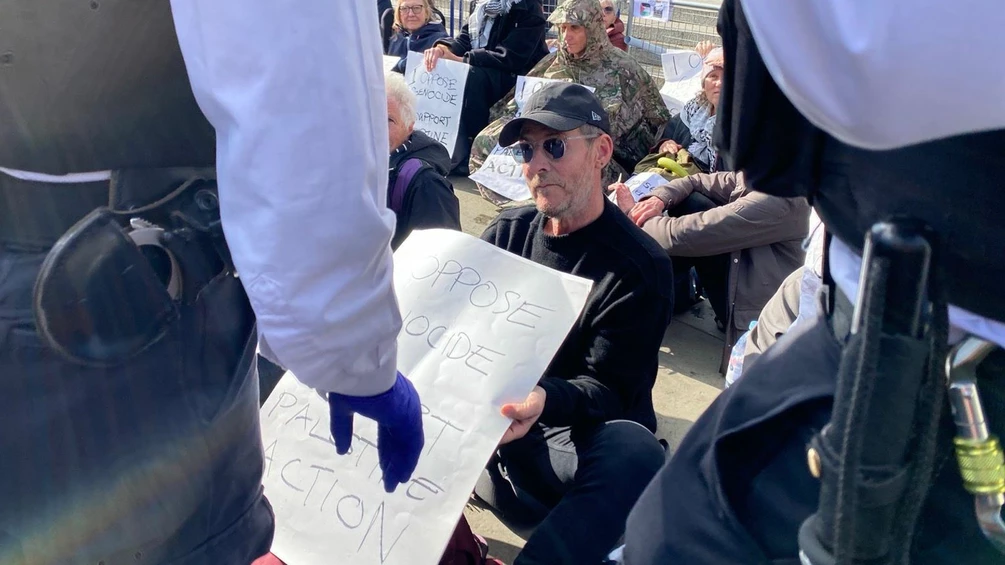
HangupsMusic.com – London, The historic landscape of Trafalgar Square, typically a site of cultural celebration and tourist congregation, transformed into a theater of significant civil unrest and legal confrontation this past Saturday, April 11th. In an event that has sent ripples through both the international music community and the sphere of political activism, Robert Del Naja, the founding member of the seminal trip-hop collective Massive Attack, was among the hundreds detained by the Metropolitan Police. The demonstration, organized to challenge the British government’s controversial decision to designate the activist group Palestine Action as a proscribed terrorist organization, resulted in one of the largest mass arrests seen in the capital in recent years.
The protest drew a diverse crowd of participants, ranging in age from 18 to 87, signaling a broad demographic of dissent against the current administration’s legislative trajectory. According to reports and legal observers on the ground, the atmosphere was characterized by a somber, determined silence rather than the chaotic energy often associated with large-scale demonstrations. Protesters engaged in a mass sit-in, occupying the square with placards and banners. Del Naja, a figure long associated with blending avant-garde art with staunch political conviction, was seen seated among the demonstrators, holding a simple cardboard sign that read: “I Oppose Genocide, I Support Palestine Action.”
The mass detention of 523 individuals underscores a deepening fracture in British civil society regarding the use of anti-terror legislation to police domestic activism. The backdrop to this weekend’s events is a protracted legal battle over the status of Palestine Action. The UK government recently moved to ban the group under the Terrorism Act, a move that critics argue is a disproportionate response to the group’s tactics, which primarily involve direct action against arms manufacturing facilities. While the High Court recently ruled that this proscription was unlawful, the ban remains technically in force as the government pursues an appeal, creating a volatile legal gray area that police utilized to justify the mass arrests on Saturday.
Following his release, Del Naja issued a comprehensive and scathing statement via Massive Attack’s official social media channels. His words reflected a profound disillusionment with the state of British democracy in 2026. He highlighted the irony of being arrested under the Terrorism Act for the act of sitting quietly with a cardboard sign. Del Naja’s critique was not merely directed at the police on the ground, many of whom he suggested were aware of the "madness" of the situation, but at the highest levels of the executive branch. He specifically targeted Prime Minister Keir Starmer and Home Secretary Shabana Mahmood, accusing them of attempting to suppress public dissent through draconian measures.
In his statement, Del Naja drew a direct parallel between the current political climate and the lead-up to the Iraq War. He suggested that the current government is populated by ideological successors to those who ignored the millions of peaceful marchers in 2003. By using the phrase "war is peace," a nod to George Orwell’s 1984, Del Naja framed the government’s rhetoric as a form of institutional gaslighting. He argued that the administration is attempting to hide its complicity in international crimes behind a veil of "distraction" and legal intimidation, betting on the public’s perceived apathy or lack of intelligence—a bet he insists they will lose.
The artist’s arrest is not an isolated incident of political expression but the latest chapter in a long history of activism for Massive Attack. For decades, the Bristol-based group has used its platform to highlight systemic injustices, environmental crises, and the human cost of conflict. Del Naja, often working under the moniker "3D," has been a central figure in this movement, ensuring that the band’s aesthetic output is inextricably linked to its moral compass. This latest action follows a series of significant steps taken by the band over the past year.
Last summer, during the heated public discourse surrounding artist controversies at major festivals like Glastonbury, Del Naja and his bandmates urged the media and the public to refocus their attention on the humanitarian crisis in Gaza. They argued that the focus on "artist rows" and personality-driven scandals served as a convenient diversion from the actual violence occurring on the ground. This sentiment was further solidified in September when Massive Attack joined the "No Music For Genocide" campaign. In a bold move of digital solidarity, the band geo-blocked their entire discography from streaming platforms within Israel, effectively creating a digital picket line to protest the ongoing military actions in the region.
The legal implications of Saturday’s arrests are expected to be far-reaching. Human rights organizations have expressed alarm at the application of the Terrorism Act to peaceful protesters. The act of proscribing an activist group is a tool traditionally reserved for organizations that pose a direct, violent threat to national security. By applying this label to a group focused on political advocacy and direct action against corporate entities, legal experts argue the government is setting a dangerous precedent that could eventually be used to silence any form of effective opposition. The fact that the High Court has already signaled the unlawfulness of the ban adds a layer of constitutional tension to the proceedings, as the executive branch appears to be operating in defiance of judicial skepticism.
Del Naja’s statement concluded with a reminder of the historical foundations of British liberty. He noted that the very civil rights and democratic protections currently enshrined in law were built upon the "small actions" of individuals willing to defy unjust authority. He posited that the government’s desire to "crush" these actions is born out of a fear of the power of collective conscience. His final call for a "Free Palestine" and "No wars" serves as a distillation of the band’s ethos—a refusal to separate the art they create from the world in which it exists.
The music industry has watched these developments with a mixture of concern and solidarity. For many in the electronic and alternative music scenes, Del Naja’s arrest represents a tipping point. There is a growing sense that the "neutral" ground for artists is disappearing, and that the pressures of the current political moment are forcing a choice between silent compliance and vocal, often risky, dissent. The electronic music world, in particular, has seen a surge in collective action, with DJs, producers, and labels increasingly aligning themselves with Palestinian solidarity movements and using their tours to raise awareness and funds for humanitarian aid.
As the 523 individuals arrested at Trafalgar Square begin their journey through the legal system, the focus remains on the government’s next move regarding the Palestine Action appeal. The outcome of this case will likely define the boundaries of protest in the UK for the remainder of the decade. For Robert Del Naja, the arrest appears to be less of a deterrent and more of a confirmation of the necessity of his work. Whether through the haunting, atmospheric soundscapes of Massive Attack or the stark, uncompromising messages on a cardboard sign, his commitment to challenging the "callous indifference" of power remains undiminished.
The events of April 11th will likely be remembered as a moment when the intersection of art, law, and human rights became undeniably visible. In an era where the definition of "terrorism" is being stretched to encompass non-violent dissent, the role of the artist-activist has shifted from the periphery to the front lines. As Del Naja suggested in his closing remarks, the struggle is not merely about a single geopolitical conflict, but about the fundamental health of democracy itself and the right of the citizen to stand in silence and say "no." Following the arrest, footage has circulated widely online, showing the quiet dignity of the protesters in the face of a massive police operation, a visual testament to the "total madness" Del Naja described in his statement. The conversation sparked by this weekend in London is far from over; it is likely just beginning.
