
 By admin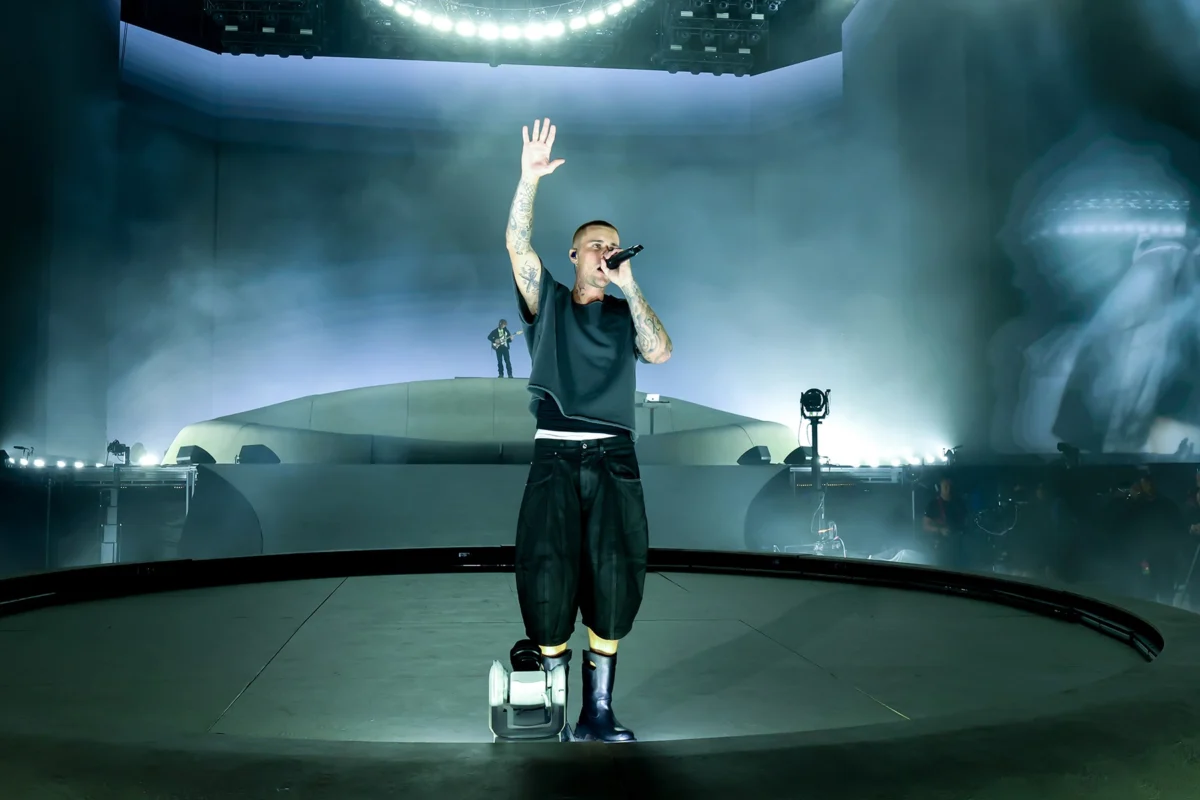
HangupsMusic.com – Coachella Valley, The desert night at the Empire Polo Club bore witness to a profound moment in pop history as Justin Bieber commanded the Saturday headlining stage. More than just a collection of chart-topping hits, his performance was a meticulously crafted narrative, tracing his extraordinary trajectory from viral YouTube phenomenon to global superstar, all while celebrating a hard-won journey of personal and artistic maturation. This pivotal set at Coachella 2026 was a testament to his enduring appeal and his conscious effort to reclaim his story, showcasing a newfound sense of peace and control.
Bieber is no stranger to the iconic Coachella grounds. Over the years, the Canadian sensation has become a familiar presence, transitioning from an enthusiastic attendee to a highly anticipated surprise guest. His impromptu appearances have often sent ripples of excitement through the festival crowd; in 2024, he joined Tems and Wizkid for an electrifying rendition of their global hit “Essence,” and in 2019, he famously crashed Ariana Grande’s headlining performance, delivering “Sorry” and cryptically teasing the need to "get his swag back." This time, however, the narrative was entirely different. Bieber was not there to support another act or make a cameo; he was there, unequivocally, for himself, to deliver a performance that solidified his standing as a generational artist.
This Coachella headlining slot marked a significant return to the grand stage, ending a four-year hiatus from major live performances. In the weeks leading up to the festival, Bieber meticulously reacquainted himself with the live environment through a series of intimate, highly exclusive shows at West Hollywood’s legendary venues, The Roxy and the Troubadour. These prelude performances were exclusively dedicated to material from his latest introspective projects, which he has dubbed SWAG and SWAG II. These smaller, more personal settings allowed him not only to fine-tune the delivery of his fresh compositions but, crucially, to reconnect with the raw energy of live performance, a vital step before facing the colossal scale of Coachella.
Yet, the transition from a 500-capacity club to a vast polo field teeming with tens of thousands of strangers is immense. Remarkably, Bieber navigated this shift with an almost effortless grace, transforming the expansive desert landscape into an intimate gathering among friends. The stage design itself echoed this sentiment of introspection and personal space. Minimalist in its approach, it featured a captivating, fluid, cocoon-like structure—a semi-transparent, undulating shell that served as both a dynamic playground for movement and a symbolic sanctuary. Within its ethereal confines, Bieber could traverse, recline, and at times, seem to shrink into its protective embrace, a visual metaphor for his journey of growth and self-discovery. His sole visible prop, a laptop, hinted at a deeper, more personal narrative yet to unfold.
The performance commenced with undeniable force, launching into "All I Can Take," the opening track from SWAG. Much like its album counterpart, the song served as a powerful declaration of boundaries and resilience, a poignant reminder to both himself and his devoted fanbase of the relentless effort and emotional investment he has poured into his career. It underscored the often-arduous path he has traversed, a journey far from easy.
Throughout the initial 50 minutes, Bieber immersed the audience in the sonic landscape of the "swagverse," largely drawing from SWAG and SWAG II. These projects, as revealed through their live interpretation, are more than just collections of songs; they are a deeply personal chronicle of his nearly two-decade-long public life, exploring profound questions of identity, faith, and purpose. Hearing these candid, often vulnerable, compositions resonate across such a massive crowd brought their message into sharp focus. A highlight of this early segment was the surprise appearance by The Kid Laroi, who joined Bieber for their collaborative hit, "Stay," injecting an immediate surge of youthful energy and pop euphoria. Further standouts from this introspective period included the reflective "Speed Demon," a track celebrating his tight inner circle and continuous self-improvement, "Go Baby," a heartfelt ode to his wife and entrepreneurial force, Hailey Bieber, and "Walking Away," a tender commitment to his burgeoning family.

The set then gracefully transitioned into a poignant acoustic interlude, where Bieber, seated center stage on an extended walkway, was joined by the skilled musicians Carter Lang and Dylan Wiggins. This trio delivered stripped-down renditions of "Glory Voice Memo" and "Zuma House." The emotional crescendo arrived with an extended, profoundly moving performance of "Everything Hallelujah," during which Bieber, his eyes visibly moistened with emotion, integrated new, heartfelt lyrics. "Coachella, hallelujah," he sang, before a tearful dedication: "Hailey, baby, hallelujah/ Baby Jack, hallelujah." It was a moment of raw, overwhelming gratitude, showcasing a vulnerability that captivated the entire audience. This segment powerfully underscored Bieber’s greatest strength: beyond his effortless vocal prowess—often hailed as one of his generation’s finest—lies an unparalleled ability to wield his immense star power to create pockets of profound silence, drawing thousands into the intimacy of his heartfelt reflections.
"Tonight is such a special night," Bieber declared, concluding the acoustic portion, "But I feel like we gotta take you guys on a bit of a journey…" And indeed, he did.
For the next 25 minutes, the performance took an utterly unique and unexpectedly humanizing turn. Bieber transformed into a millennial "iPad kid," literally sitting at his laptop on stage, navigating YouTube. Before inevitably tumbling down a rabbit hole of early internet culture—pulling up classic viral clips like "Deez Nuts" and the ethereal "Double Rainbow"—he dove deep into his own digital archives. Clip after clip of his career-launching hits flashed across the massive screen behind him, with Bieber singing along to snippets of "Baby," "That Should Be Me," and "Never Say Never." The journey culminated in a full-circle moment, as he played the very video that started it all: his famous cover of Chris Brown’s "With You," featuring a "Baby Bieber" still years away from superstardom.
This segment was a stroke of genius—a clever, authentic, albeit time-consuming, method of revisiting his past. It served as a powerful act of reclamation, celebrating the prodigious young talent he once was while seamlessly integrating that history with the mature artist he is today. Crucially, it provided an efficient and engaging way to navigate through a dozen early hits that, had they been performed in full, might have felt tonally incongruous with the deeply personal nature of the rest of the set. Most significantly, it was an oddly humanizing spectacle for an artist of Bieber’s monumental stature. Watching clips of his younger self comically walking into a glass door or accidentally falling through a stage hole evoked a shared, unspoken understanding among the crowd: "we’re good here." It felt like a long-awaited release, an artist finally comfortable enough to revisit his origins, run through his biggest hits (including "Sorry" and "Where Are Ü Now"), and even poke fun at his own past mishaps—a privilege often exercised by others, but now, definitively, by him. He was in control, owning every facet of his narrative, a sentiment subtly echoed in his festival merchandise.
As the set neared its conclusion, Bieber pivoted back to his more recent, collaborative work. He delivered "Yukon," followed by "Devotion," featuring the nuanced artistry of Dijon. Tems then joined him for "I Think You’re Special," which seamlessly transitioned into a powerful rendition of "Essence," with Wizkid making a triumphant return to the stage. The evening culminated with his latest hit, "Daisies," featuring the intricate guitar work of Mk.gee, bringing the night to a fittingly contemporary close.
For many fans, "Bieberchella" undoubtedly felt like a monumental celebration of a career that has defied expectations and transcended genres. Yet, for Justin Bieber himself, the performance seemed to be a profound acknowledgment and celebration of his hard-earned and much-deserved peace. It was the ultimate reward at the end of a long, often tumultuous road—a journey that demanded unwavering self-belief, especially in moments when the world was quick to doubt. This Coachella headlining set served as a powerful declaration, making it abundantly clear that there is nothing more paramount than safeguarding that peace—for himself, for his cherished family, and for the purity of his creative expression. And in today’s music landscape, that unwavering commitment to self and art is precisely the kind of foundation worth standing on.
