
 By Azzam Bilal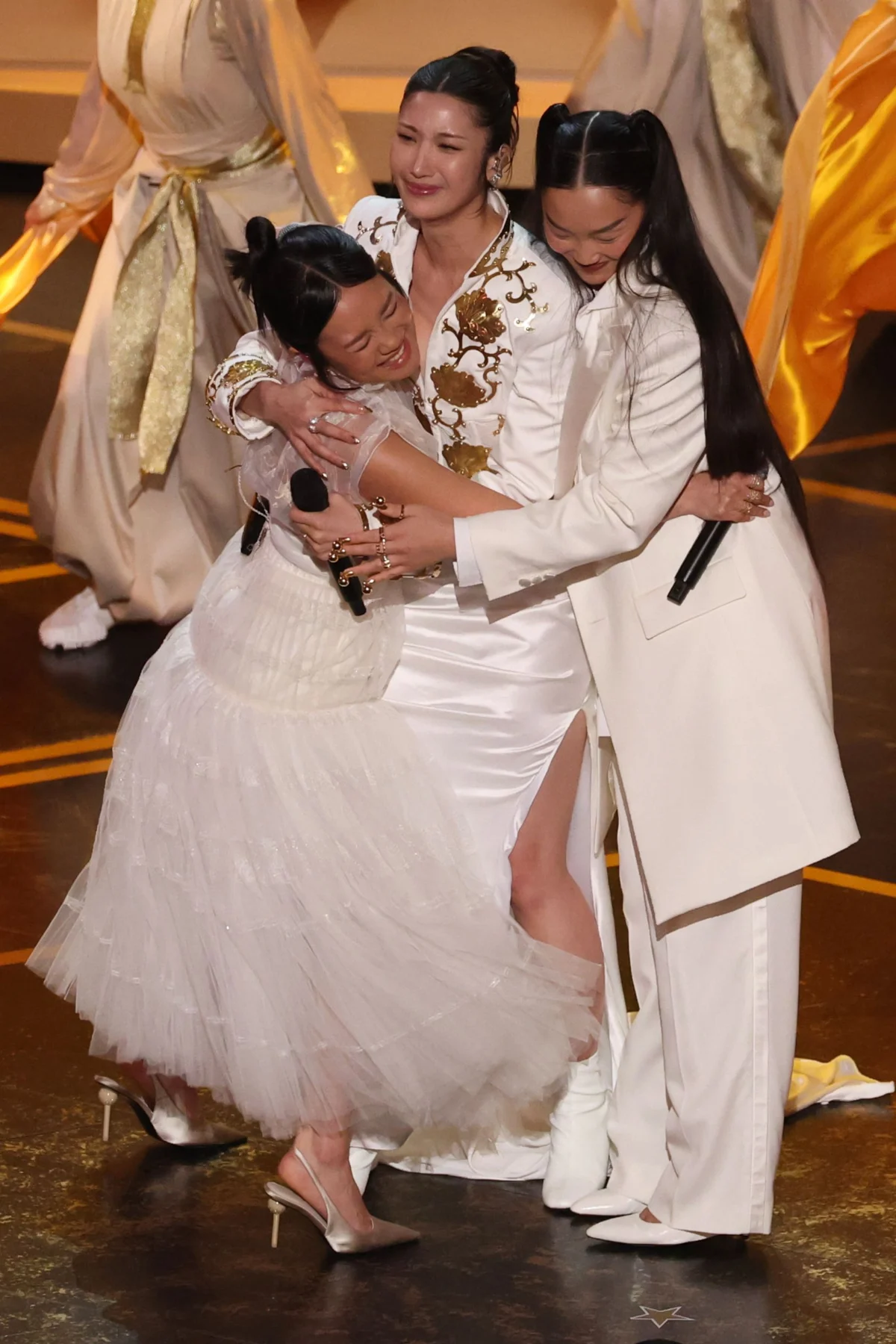
HangupsMusic.com – Los Angeles, The 98th Academy Awards will be remembered as the night the barrier between global pop subcultures and the traditional Hollywood establishment finally dissolved. In a ceremony marked by high-concept performances and a celebration of international narratives, the trio known as Huntr/x—comprising the formidable talents of Ejae, Audrey Nuna, and Rei Ami—secured a landmark victory. Their anthemic track “Golden,” written for the genre-defying blockbuster KPop Demon Hunters, took home the Oscar for Best Original Song, marking a definitive moment in the evolution of film music. The win was not merely a personal milestone for the three artists, but a symbolic validation of a musical movement that has spent decades moving from the periphery of global interest to the very center of the cultural zeitgeist.
The atmosphere inside the Dolby Theatre was electric long before the category was announced. Earlier in the evening, the trio delivered what many critics are already calling one of the most visually arresting performances in the history of the telecast. Ejae, Audrey Nuna, and Rei Ami took to the stage with a confidence that belied their status as first-time nominees. The staging for “Golden” was a masterclass in grand-scale production, featuring rows of dancers positioned on tiered risers, rhythmically waving massive golden flags that caught the stage lights to create a shimmering, kinetic backdrop. The performance mirrored the high-octane energy of KPop Demon Hunters, a film that blends the polished aesthetics of idol culture with supernatural action, and the live rendition of its theme song managed to capture that same lightning in a bottle.
When the time came to present the award for Best Original Song, the Academy tapped music royalty Lionel Richie to deliver the news. The tension in the room was palpable, given the caliber of the competition. This year’s shortlist was a gauntlet of industry titans and critical darlings. The nominees included Diane Warren, the perennial powerhouse of the category, with her introspective ballad “Dear Me” from the documentary Diane Warren: Relentless. Also in the running were Raphael Saadiq and the multi-Oscar-winning composer Ludwig Göransson for their soulful collaboration “I Lied to You” from the thriller Sinners. The category was rounded out by the haunting “Train Dreams” by Nick Cave and Bryce Dessner, and Nicholas Pike’s operatic “Sweet Dreams of Joy” from the biopic Viva Verdi!. Against this field of veterans and heavyweights, the victory for Huntr/x felt like a genuine shift in the Academy’s musical sensibilities.
As Richie read the names of Ejae, Audrey Nuna, and Rei Ami, the trio ascended the stairs together, a united front representing a new generation of songwriters. While the entire team stood behind the trophy, it was Ejae who first addressed the microphone, delivering a speech that resonated far beyond the walls of the theater. Her words were a poignant reflection on the personal and cultural journey required to reach this stage. She began by thanking her family and the creative architects behind the film, but the speech quickly pivoted to a broader narrative of identity and acceptance.
“Growing up, people made fun of me for liking K-pop,” Ejae told the star-studded audience, her voice steady but filled with emotion. “It was something people dismissed or didn’t understand. But tonight, seeing this room filled with people who have been singing our song—and singing it in all of the Korean lyrics—fills me with an incredible sense of pride. I realize now that this award is not just about success; it’s about resilience.”
The sentiment of resilience was a recurring theme throughout the night. For Audrey Nuna and Rei Ami, the win serves as a crowning achievement for two artists who have spent years carving out unique niches in the alternative R&B and pop landscapes. Audrey Nuna, known for her sharp lyricism and avant-garde visual style, and Rei Ami, celebrated for her genre-blurring vocal versatility, brought a contemporary edge to “Golden” that distinguished it from the more traditional ballads often favored by Oscar voters. The song itself is a sophisticated blend of driving percussion, soaring melodies, and bilingual verses that reflect the modern reality of the music industry: one where language is no longer a barrier to emotional resonance.
The victory of “Golden” follows a trend established at the 2025 Academy Awards, where the Academy began to show an increased appetite for multilingual and international musical contributions. Last year, the Best Original Song trophy was awarded to Clément Ducol, Camille, and Jacques Audiard for “El Mal,” a standout track from the Spanish-language French musical Emilia Perez. That award was presented by Mick Jagger, signaling a bridge between the rock-and-roll old guard and the new wave of international cinema. By awarding Huntr/x in 2026, the Academy has signaled that the success of Emilia Perez was not an anomaly, but rather the start of a more inclusive era for the music branch.
The film KPop Demon Hunters has been a box-office phenomenon, but its critical acclaim has been bolstered significantly by its soundtrack. The movie’s premise—using the discipline and synchronization of K-pop training as a metaphor for the skills needed to fight supernatural forces—required a musical backbone that felt both authentic to the genre and cinematic in scope. “Golden” achieved this balance, acting as the emotional anchor for the film’s climax. Its win at the Oscars is a testament to the songwriting team’s ability to translate the specific energy of a subculture into a universal anthem.
Beyond the immediate celebrations, the win for Huntr/x has sparked a wider conversation about the state of the music industry in 2026. The fact that a song featuring prominent Korean lyrics could win over a field of English-language tracks by some of the most respected names in Western music is a clear indicator of the "K-wave’s" permanent integration into the global mainstream. It marks a departure from the days when international music was relegated to "World Music" categories or viewed as a passing trend. Today, as Ejae noted in her speech, the world is not just listening; they are singing along.
The 2026 Oscars also highlighted the growing importance of collaborative projects in film scoring. Huntr/x is a "supergroup" of sorts, formed specifically to bring a diverse set of skills to the KPop Demon Hunters project. This model of collaboration—bringing together independent artists with distinct voices to create a cohesive sound for a film—is becoming increasingly popular as studios look for ways to engage younger, more digitally-native audiences. The success of “Golden” proves that this approach can yield results that are both commercially viable and artistically significant enough to garner the industry’s highest honors.
As the ceremony concluded, the image of the three women holding their Oscars remained a defining highlight of the broadcast. For Ejae, Audrey Nuna, and Rei Ami, the journey from the recording studio to the Oscar stage was paved with the very resilience Ejae spoke of. They navigated an industry that often tries to box artists into specific genres or demographics, and they emerged with a piece of work that defied those limitations.
In the coming days, "Golden" is expected to see a massive resurgence on global streaming platforms, further cementing its status as a cultural touchstone. For the Academy, the 2026 awards represent a successful step toward modernization, reflecting a world where the most "original" songs are often those that bring different cultures together. As the curtain falls on the 98th Academy Awards, the message is clear: the future of film music is global, it is multilingual, and it is undeniably golden.
