
 By Azzam Bilal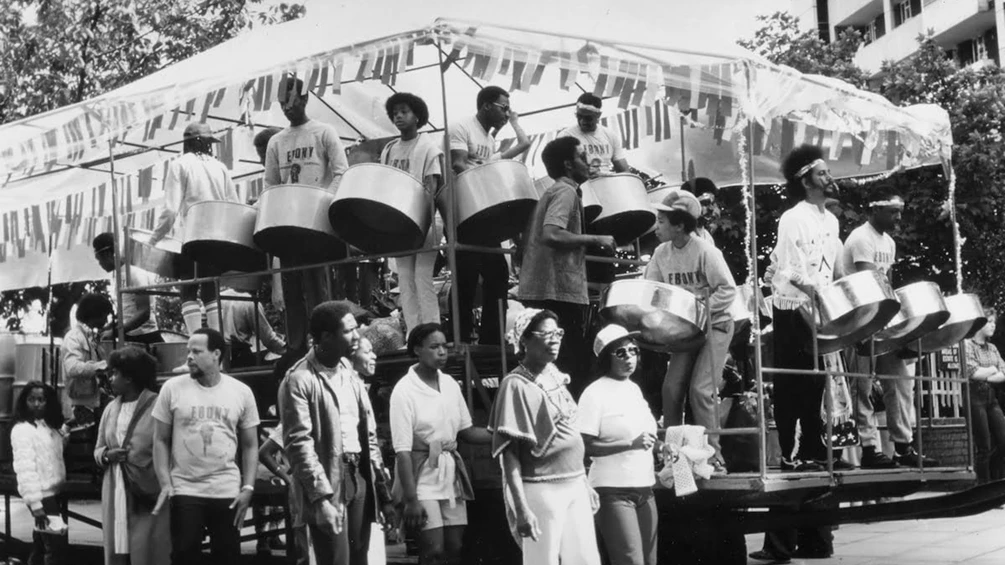
HangupsMusic.com – London, the cultural heart of the United Kingdom is currently hosting a profound retrospective of one of the world’s most significant street festivals. As the Notting Hill Carnival approaches its landmark 60th anniversary, a sprawling multimedia exhibition has taken residency at Somerset House, offering an immersive deep dive into the history, struggle, and triumphant joy of this Caribbean-led institution. Titled "The Legacy of Notting Hill Carnival," the exhibition occupies the prestigious Lancaster Rooms and River Rooms within the venue’s New Wing, providing a free-to-access sanctuary for both veterans of the festival and newcomers looking to understand its complex origins.
The exhibition serves as a chronological and thematic map, charting the festival’s meteoric rise from a modest community gathering in 1966 to a global phenomenon that now attracts millions of visitors to the narrow streets of West London. What began as a local response to racial tensions and a desire to foster community cohesion has evolved into a massive display of "Mas," calypso, soca, and sound system culture. By bringing together film, photography, archival documents, and physical artifacts, Somerset House has created a space where the ephemeral nature of a street party is given the weight of historical permanence.
Central to the exhibition’s narrative is the work of Horace Ové, a Trinidad-born titan of British arts. Often cited as the first Black British filmmaker to direct a feature-length film, Ové’s photography and video work provide an indispensable lens into the early years of the Carnival. His imagery captures the raw energy of the 1960s and 70s, documenting a community that was reclaiming its identity in the face of systemic adversity. The exhibition juxtaposes these historical snapshots with the work of contemporary photographers like Melissa Gardner and Ollie Tikare. Gardner, an award-winning visual storyteller, and Tikare, the founder of "Don’t Touch My Fro," offer modern perspectives that highlight how the aesthetic of Carnival continues to shift while remaining rooted in its African and Caribbean heritage.
The curation does not shy away from the sociopolitical friction that has often defined the Carnival’s relationship with the state. One of the most striking elements of the display is the inclusion of archival letters exchanged between Carnival organizers, local council authorities, and the Metropolitan Police. These documents reveal a decades-long tension regarding the policing of Black joy and the logistical challenges of hosting a massive, decentralized event in a residential neighborhood. By presenting these letters alongside footage from the BBC and the British Film Institute (BFI), the exhibition illustrates how the Carnival has functioned as a site of resistance and a platform for challenging the status quo.
In a particularly poignant addition, the exhibition features a sound archive dedicated to the Grenfell Tower tragedy, provided by Suzanna Vaz. The proximity of the Notting Hill Carnival route to the site of the 2017 fire has created an unbreakable bond between the festival and the local community’s mourning and activism. The inclusion of this archive serves as a reminder that the Carnival is not merely a party, but a vital organ of the North Kensington community—a space for collective healing and a megaphone for social justice.
Music, of course, is the heartbeat of the exhibition. The evolution of the Carnival’s sonic landscape is explored through the lens of the UK’s legendary sound system culture. While the festival’s early years were dominated by the acoustic melodies of steel pans, the 1970s saw the introduction of static sound systems, which transformed the event into a sprawling laboratory for bass-heavy genres like reggae, dub, and later, jungle and garage. The exhibition pays homage to institutions like the Rampage Sound System, which has been a cornerstone of the event for over thirty years. By highlighting the technical and social architecture of these systems, the curators emphasize that the "sound" of Carnival is a physical force, one that has influenced the trajectory of British electronic music at large.
The visual language of "Mas" (masquerade) is also given significant floor space. Visitors can inspect intricate costumes and sculptures that represent the craftsmanship and labor-intensive preparation that goes into every Carnival. These garments are not just decorative; they are symbolic of freedom and the subversion of colonial power structures, echoing the traditions of Caribbean carnivals that emerged after the abolition of slavery. The exhibition connects these historical dots, showing how the feathers and sequins of modern-day West London are direct descendants of the resistance movements of the 18th and 19th centuries.
Complementing the exhibition is a look back at the work of Peter Anderson, the Scottish photographer who famously documented the 1983 edition of the Carnival. His recently published photozine provides a gritty, black-and-white contrast to the vibrant digital captures of today. Anderson’s work captures a specific moment in time—the early 1980s—when the Carnival was asserting its permanence despite political pressure to move it to a confined stadium or park. His images of sound system stacks and crowded street corners evoke the DIY spirit that remains the festival’s core ethos.
The choice of Somerset House as the host venue is itself a statement. Once a center of British administrative and naval power, the building now houses an exhibition celebrating a festival that was born out of a rejection of those very power structures. This shift highlights the cultural integration of the Carnival into the fabric of British national identity. However, by focusing on the "Legacy," the exhibition asks the viewer to consider what the next sixty years will look like. As gentrification continues to reshape Notting Hill and the surrounding areas, the struggle for space remains a pertinent issue for organizers.
"The Legacy of Notting Hill Carnival" is more than a retrospective; it is a sensory experience that attempts to bottle the lightning of a bank holiday weekend in August. It honors the pioneers like Claudia Jones and Rhaune Laslett, who saw the potential for a street festival to bridge the gap between different cultures in a post-Windrush London. It also honors the anonymous masqueraders and sound engineers who have kept the tradition alive through decades of economic shifts and social change.
For those unable to attend the physical exhibition during its run, the digital resources and archival footage provided by the BFI and BBC ensure that this history remains accessible. The exhibition serves as a precursor to the 60th-anniversary celebrations, setting the stage for a milestone that will undoubtedly be one of the most significant cultural events in London’s modern history. By examining the past, the curators have provided a roadmap for the future, ensuring that the spirit of the Carnival—its defiance, its music, and its communal heart—remains understood and respected by future generations.
As visitors walk through the River Rooms, the sound of steel drums and the hum of heavy bass provide a constant backdrop to the visual displays. It is a reminder that the Notting Hill Carnival is a living, breathing entity. It is an annual reclamation of the streets, a vibrant tapestry woven from the threads of migration, creativity, and resilience. This exhibition at Somerset House successfully captures that essence, proving that while the costumes may change and the sound systems may get louder, the fundamental message of the Carnival remains as vital today as it was in 1966: a celebration of life, a demand for visibility, and a testament to the power of the people.
